Failed BRT Project Recast as Six-Lane Road After 14 Years and Billions Wasted, Raising Hopes of Relief
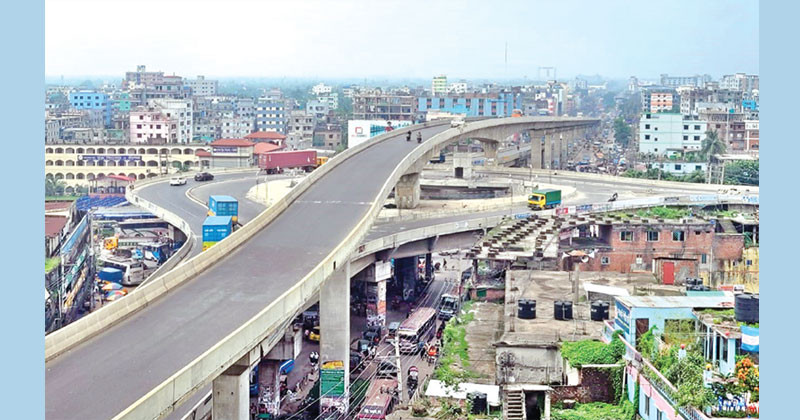
The construction journey lasted 14 years. The project cost Tk 2,811 crore. Still, the expected Bus Rapid Transit (BRT) service did not start. After long traffic jams, several deaths, dust and public suffering, the government has now made a new decision on the project’s future. It plans to turn the BRT corridor from Hazrat Shahjalal International Airport to Gazipur into a regular highway.
The road will grow to six lanes, with three lanes in each direction. The talk also includes widening the two two lane flyovers built under the project to four lanes. The government weighed several options for the BRT project. They were starting BRT, running buses through route franchising, building a toll based expressway and turning it into a regular highway. In the end, the plan to choose the regular highway option came forward.
A six lane road will add space for vehicles and may ease pressure on the road. Long distance buses, local buses, private cars, motorcycles and goods trucks use this road. Effective management will change how these vehicles move. Concerned people say jams will fall if authorities control random bus stops, illegal parking, road grabbing and unplanned junctions.
The government decided to dissolve the state owned Dhaka Bus Rapid Transit PLC, which ran and managed the project. Its work will move under the Roads and Highways Department (RHD). The cabinet meeting made this decision. A letter signed by Ms. Taslima Ahmed Poly, Deputy Secretary of the Road Transport and Highways Division, gave the details. It said authorities will remove the BRT corridor’s stations, lane dividers and other structures.
They will then turn the road into a regular six lane highway with three lanes each way. Authorities may also take steps to widen the two two lane overpasses to four lanes. The structures were built over a long time, but the BRT passenger service never began. Under the new decision, the government will move ahead after solving legal problems and finishing the needed steps. The Bangladesh University of Engineering and Technology (BUET) also published a report on the project’s work and success.
Experts say that if the government keeps 96 percent of the structures and makes a six lane highway after cancelling the project, the extra cost will not hurt much. BUET Civil Engineering Professor Dr. Shamsul Haque said keeping this project alive would not have made the public happy either. He welcomed the government’s decision and called it a win win situation. He said the 20 kilometre corridor from Gazipur to the airport is a broken part of the development plan.
He said a lot of work remained. Even if the government spends more, it will not make a working BRT, only a broken one. A broken BRT will never give the service people were promised. The project from Hazrat Shahjalal International Airport to Shibbari in Gazipur is about 20.5 kilometres long. It won approval in November 2012. The first cost was about Tk 2,039 crore 84 lakh.
The plan was to finish construction by 2016 and start the special bus service from 2017. The aim was to give fast public transport between Dhaka and Gazipur. Builders made a separate corridor for buses on a part of the road. The project’s time and cost rose several times. The long construction also disturbed traffic. Thousands of daily commuters suffered. The project has spent Tk 2,811 crore so far, but the special bus service did not start as planned.
The Bangladesh government, the Asian Development Bank (ADB) and the French agency Agence Francaise de Developpement (AFD) funded the project. The deadline ended in December 2024, but the BRT bus service did not start. At that time, 97 percent of the structure work was done, and the cost was Tk 2,811 crore. But the overall physical progress was 77.48 percent. Land acquisition, shifting of utilities and contractor problems delayed the project.
Design changes, questions about construction quality and poor coordination among government agencies also caused delay. During the work, the road narrowed in many places. Severe jams formed in the airport road, Tongi, Cheragali, Board Bazar and Gazipur Chourasta areas. For ordinary people, BRT became a symbol of suffering more than a development project. The most visible side of the project was people’s pain. Digging went on for years along the long road from the airport to Gazipur.
In some places the road became narrow, and in others big holes formed. Passengers sat stuck in jams for hours every day. Meanwhile, the Institute for Planning and Development (IPD) voiced deep concern and protest over the decision to cancel the BRT project from Gazipur to the airport. It said about 97 percent of the work was done. It also noted over a decade of public suffering and nearly Tk 3 thousand crore of public money already spent.
IPD said finishing the remaining work and making the project usable for the public would have been more logical. It said this would be better for planning, more profitable for the economy and better for the public interest. IPD said the move to cancel BRT and make a regular highway favours private bus owners and private car users. It said this clashes with the effective use of state resources, sustainable transport planning and the policy of public transport friendly urbanisation.
Mr. Ashraful Kabir, a resident of Uttara, told Inqilab that the Dhaka Mymensingh highway is very important. Many people use it every day to go to work. Factory workers, students, job holders, traders and long distance passengers all depend on this road. He said people now want relief from the suffering caused by the long construction. He hoped the work to change the structures would not bring new long suffering.
He also asked that the road be built so people can walk, cross the road and get on and off public transport safely, along with vehicle movement. BUET Civil Engineering Professor Dr. Hadiuzzaman told Inqilab that about Tk 3 thousand crore has already been spent on the BRT project. He said about 97 percent of the work is done, and destroying it now would leave things in a bad state. He said some now propose using it like an expressway.
He said a lot of money has been invested in the project over a long time, and people have suffered. So the government must talk to experts on how to improve the project and use it as a public transport corridor. The aim must be to give the public the highest benefit. Dr. Khasru Mia, Professor of Civil Engineering at the Dhaka University of Engineering and Technology (DUET), spoke as a representative of Gazipur’s conscious citizens.
He said thousands of people stay stuck in jams for hours every day on trips between Dhaka and Gazipur. Working hours are lost, productivity falls and transport costs rise. Economic and social development is also blocked. The BRT project was taken up to solve these problems. Yet after waiting about 14 years, the people of Gazipur have not got a modern public transport service.
He said it is worrying that new debate and doubt have arisen about the project’s future after about 97 percent of the work finished. If there are technical, management or operational problems, authorities must find and solve them. They must ensure the highest use of the built structures and finish the remaining work fast. RHD Chief Engineer Mr. Md. Moniruzzaman said they have learned of the government’s decision.
He said they are taking the needed steps. As directed, they will submit an initial progress report on the decision to the concerned authority. Later, they will take the needed steps as the government directs.