
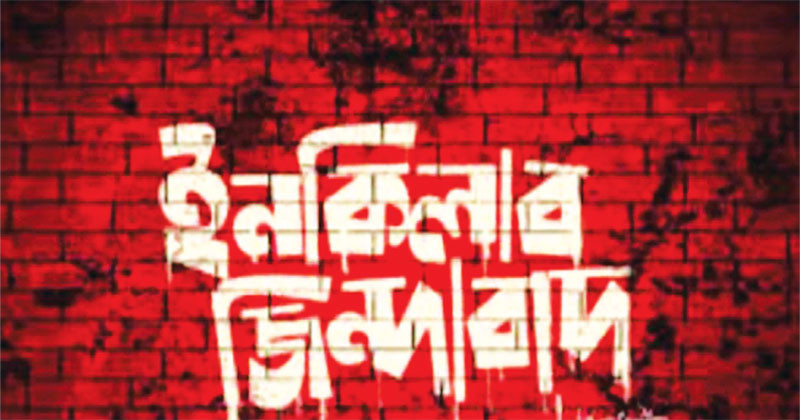
July Uprising gives new life to ‘Inquilab Zindabad’
Dr. Mahfuz Parvez
The history of political slogans in the subcontinent dates back to British rule. During the Partition of Bengal, two major slogans emerged: ‘Vande Mataram’ among Hindus and ‘Nara-e-Takbir, Allahu Akbar’ among Muslims, reflecting different political and cultural aspirations. Later, ‘Inquilab Zindabad’ became a powerful expression of anti-colonial and revolutionary politics.
Hasrat Mohani, a revolutionary politician, anti-British activist and poet, is credited with popularising ‘Inquilab Zindabad’. His writings combined a desire for freedom and human liberation with poetic expression, and the slogan became associated with resistance to imperialism, exploitation and oppression. While ‘Vande Mataram’ has increasingly been associated with Hindu nationalist politics in India, Bangladesh has given ‘Inquilab Zindabad’ renewed meaning in the context of the July Mass Uprising. After nearly a century, students and members of the public revived the slogan as part of their struggle against what they described as authoritarianism and for justice and democracy.
The political use of slogans in the subcontinent became more prominent after the Partition of Bengal in 1905. Over time, they evolved into expressions of political demands as well as religious, cultural and national identities, helping shape the region’s political culture. From the 1910s to the 1930s, Hasrat Mohani promoted ‘Inquilab Zindabad’ as a broad progressive and revolutionary idea. Revolutionary, communist, socialist and nationalist groups later adopted it to mobilise people against British rule, turning it into a symbol of political freedom, social equality and resistance to oppression.
After the Partition of India, political slogans became closely linked to the identities of India and Pakistan. In India, ‘Vande Mataram’ and later ‘Jai Shri Ram’ became prominent in Hindu nationalist politics, while religious slogans played a major role in Pakistan’s Islamic-nationalist political discourse. During Bangladesh’s Liberation War in 1971, slogans became part of the language of resistance, nationalism and popular mobilisation. ‘Inquilab Zindabad’ retained its anti-exploitation and anti-imperialist character, while the July Mass Uprising gave it renewed relevance as a call for democracy, human rights and resistance to authoritarianism.
The July Mass Uprising was not an isolated event but the culmination of prolonged public frustration, protests and mobilisation. Led largely by students and supported by wider sections of society, the movement also drew strength from social media, mass media and civic activism, giving ‘Inquilab Zindabad’ renewed political and cultural significance. In this context, the slogan does not necessarily imply a violent or military revolution. Rather, it can represent a call for democratic and constitutional change, social justice, accountability and the restoration of public rights. Its significance lies in mobilising people around long-term political and institutional reform rather than simply replacing those in power.
The slogan’s revival also connects contemporary political struggles with the region’s historical resistance movements. When political forces distort or deny aspects of the history of independence and popular struggles, slogans such as ‘Inquilab Zindabad’ can serve as reminders of historical continuity and collective political memory. However, the writer argues that the slogan must be used responsibly. Its lasting political value depends on clear principles, democratic leadership, protection of constitutional rights and social tolerance. Without these safeguards, powerful slogans can also be misused to promote extremism or justify abuses of power.
Thus, the July Mass Uprising and ‘Inquilab Zindabad’ represent more than memories of the past. In the writer’s view, the slogan has emerged as a contemporary political expression of dignity, freedom, justice and accountability, and its democratic use could contribute to a new political era in Bangladesh.