Saudi Arabia, Pakistan and Türkiye Form Defence Alliance
The Iran war has fundamentally altered the security landscape across the Middle East. The joint US-Israeli campaign to destroy Iran, followed by Iran’s counterattacks, has exposed the limits of the two powers’ military capabilities. Iran launched repeated strikes on US bases in Saudi Arabia, Qatar, Kuwait and other Middle Eastern countries, while also penetrating Israel’s advanced air-defence systems and inflicting extensive damage. The United States is now looking for ways to withdraw from the war. The conflict has also revealed the limits of its weapons capacity, with concerns emerging over depleted stocks of missiles and other munitions. Iran has demonstrated that it possesses the strength and capability to confront major powers on its own.
The attacks have also affected Saudi Arabia, Qatar, Kuwait and other regional countries. Iran has not only targeted US military installations but also struck important oil facilities and other infrastructure. The experience has prompted regional countries to question whether the United States, which they had long regarded as a powerful security guarantor, can actually protect them.
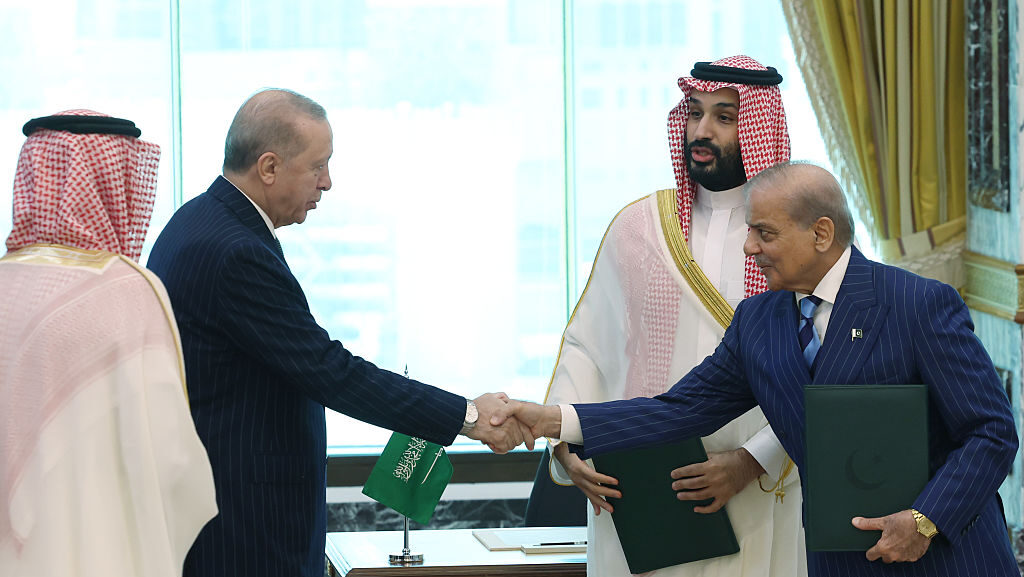
Against this backdrop, Saudi Arabia, Washington’s most important Middle Eastern ally, has begun exploring an alternative approach to its security. It has allied with Pakistan and Türkiye. Last Friday, the three countries signed an agreement at a historic “Joint Defence Summit” in the holy city of Makkah to strengthen their defence cooperation. The agreement was signed by Pakistani Prime Minister Shehbaz Sharif, Saudi Crown Prince and Prime Minister Mohammed bin Salman, and Turkish President Recep Tayyip Erdogan. Under the “Makkah Joint Defence Agreement”, an external armed attack against any one of the three countries will be considered an attack against all three.
International analysts regard the alliance as a significant development in regional geopolitics and the military balance. Pakistan is the Muslim world’s only nuclear-armed state and has an army with extensive combat experience. Türkiye possesses advanced NATO military technology and drone capabilities, while Saudi Arabia has substantial economic strength. Al Jazeera reported that the agreement brings three influential Muslim-majority countries under one framework. Beyond defence cooperation, officials and observers expect it to strengthen trade, technology and broader economic ties among the three countries.
Iran has strongly criticised the agreement. Ibrahim Rezaei, a member of the Iranian Parliament’s National Security and Foreign Policy Commission, urged Saudi leaders to reconsider their policy in a post on X. He said Saudi Arabia should understand that a “paper agreement” with Türkiye and Pakistan would not provide security, just as years of seeking favour with the United States had failed to guarantee its safety. He advised the Saudi leadership to reform its policies so that it would not have to seek security from others.
Observers say the failure of the United States to protect Saudi Arabia from Iranian attacks has encouraged Riyadh to consider alternatives. Given the changing regional environment, reassessing its reliance on Washington and developing new security partnerships is understandable. A defence alliance among Muslim countries can serve legitimate self-defence interests. However, the alliance must not become a mechanism for advancing US or Israeli interests while remaining silent on the concerns of Muslims.
The Muslim world has already seen Saudi Arabia and the Organisation of Islamic Cooperation offer limited responses to Israel’s prolonged military campaign in Gaza. Their reactions have largely remained confined to statements. Saudi Arabia has also spent heavily on confronting the Houthis in Yemen and addressing the conflict in Sudan. Critics argue that such spending could instead support the welfare and development of Muslim communities.
The issue of Al-Aqsa Mosque also remains critical. Israel is moving towards greater control over the site, which is sacred to Muslims as well as to Jews and Christians. Yet Saudi Arabia and other influential Muslim countries have remained relatively restrained. The Muslim world will closely watch how the leaders and members of the new defence alliance respond to such issues.
Muslims therefore have reason to hope that the new alliance among Saudi Arabia, Pakistan and Türkiye will help protect their interests. International analysts, however, argue that including Iran could make the alliance considerably stronger. They say lasting security and peace in the Middle East cannot be achieved while Iran remains outside regional security arrangements. Iran has demonstrated its ability to confront the combined power of the United States and Israel. Bringing Tehran into the alliance would therefore have been a strategic move. The opportunity, however, may not yet be lost.
The alliance will benefit Muslims only if it becomes a genuine shield for their security and interests. Its broader objective should be to strengthen the Muslim world, resolve internal disputes and promote unity and solidarity. Wherever Muslims face persecution, oppression or killing, the alliance should work to build effective resistance and protection.