Six Months of Government – A Promising Start
Shamsul Alam
Prime Minister Tarique Rahman began office on February 17, 2026, after the Bangladesh Nationalist Party won 212 out of 299 seats in the parliamentary elections on February 12. The July 2024 rebellion, harsh authoritarian control, protracted state instability, and an interim government preceded this political shift. Evaluating the administration at the six-month mark, supported by a robust popular mandate, necessitates monitoring structural improvements, administrative discipline, and concrete public relief rather than making snap decisions. The government revealed 60 significant choices in its first two months in office. At the 100-day mark, an official e-book detailing approximately 200 policy proposals in the fields of agriculture, healthcare, energy, and diplomacy was released. However, since paper assurances are worthless unless they directly benefit the public, good governance cannot be determined just by initiatives that have been declared.
The primary priorities on the policy agenda continue to be maintaining financial discipline and restoring macroeconomic stability. The administration implemented a Consumer Protection Policy, reorganised local market monitoring systems, and created a dedicated Food Security Fund to protect against unforeseen shocks to the world’s supply and battle chronic inflation. In an effort to combat systemic financial corruption, law enforcement secured bilateral asset recovery agreements with 10 nations, expanded international tracking operations with global monitoring groups, and seized illicit assets worth BDT 4,264 crore that belonged to the S. Alam Group. Using a ‘Vietnamese Model’ for export diversification, limiting corporate clearance processes to 14 days, and implementing round-the-clock port operations in addition to e-visas to draw in international investment, the government set an ambitious goal to increase overall exports to $100 billion by 2030.
In June 2026, total inflation decreased slightly to 9.16%, annual remittances reached $35.56 billion, foreign exchange reserves stabilised at $37.58 billion ($32.93 billion under IMF BMP6 guidelines), and Bangladesh Bank lowered the repo rate from 10% to 9.50% to encourage private credit. These macroeconomic indicators showed early stabilisation across key sectors. In addition, the government unveiled a BDT 9.38 trillion national budget that prioritises rural development, education, health, and agriculture while aiming for 6.5% GDP growth. However, political opponents maintain that public relief from high food prices is still insufficient and that the $100 billion export aim is unduly ambitious. In the meantime, the energy sector offers a significant operational issue since steady fuel supplies are crucial to industrial output. A third floating storage regasification plant was planned, along with discussions on gas imports with Malaysia and Myanmar. Public buildings were also required to install solar panels, with incentives for indigenous battery production
Despite these energy attempts, Chittagong’s gas supply was cut by 45% due to technical problems with distribution networks, which directly affected 600,000 residential and commercial customers and prompted national power conservation measures. The government provided subsidised rice at BDT 15 per kilogram to 5.5 million low-income families and issued 53,096 Family Cards and 20,748 Farmer Cards, which allowed access to subsidised inputs, machinery, and soft loans, in order to protect vulnerable populations from financial hardship. Recruiting 5,000 doctors and 100,000 community health workers, together with plans to set up intensive care units in each subdistrict hospital, marked the beginning of public health reforms. Enforcing merit-based university faculty appointments, lowering tuition costs, and implementing digital learning frameworks were the main educational reforms that grounded advances in public service in institutional integrity.
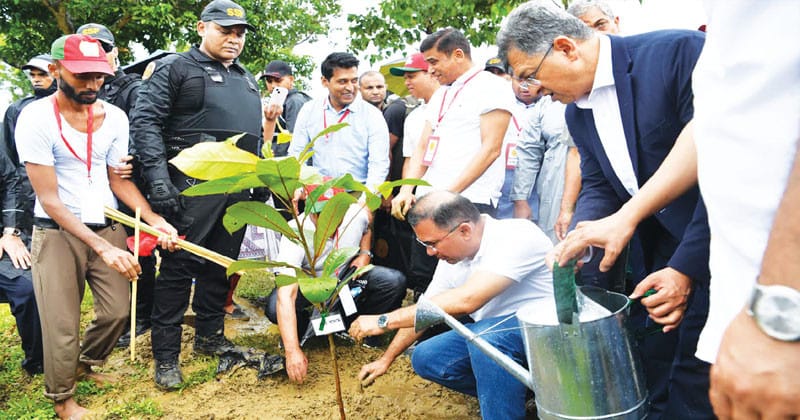
Through a massive nationwide program to re-excavate 20,000 kilometres of canals to improve agricultural drainage and flood mitigation, as well as a nationwide afforestation drive aiming at 250 million trees, including 125,000 saplings across export processing zones, environmental protection and urban infrastructure were directly linked to economic sustainability. In an effort to alleviate Dhaka’s extreme urban overcrowding, plans were started to build four satellite towns outside of the capital, along with directives to fully operationalise Terminal 3 at Shahjalal International Airport, expand the Dhaka Metro Rail network, and reorganise the Bus Rapid Transit system. In terms of foreign policy, the administration reinstated the ‘Except Israel’ clause in Bangladeshi passports while engaging with the United States, China, India, and Middle Eastern allies in a pragmatic diplomatic approach that was solely focused on regional equilibrium and national interest.
Administratively, the PM’s Office increased executive control directly to oversee project execution, manage election commitment fulfilment, and prevent cost overruns through updated construction cost frameworks and digital monitoring tools. There has been a noticeable shift toward administrative accountability as top officials and cabinet ministers have received clear warnings about bureaucratic slowness. While acknowledging encouraging first moves, anti-corruption groups like Transparency International Bangladesh demanded a more precise institutional path for governmental accountability.
Public opinion is still generally positive despite ongoing financial strains on day-to-day living. A national survey of 3,000 adult respondents by Deltagram in June found that 75.3% of respondents approved of the PM Tarique Rahman’s performance, while 17.5% expressed dissatisfaction and 7.2% were undecided. In the end, the first six months show a planned and encouraging beginning, but long-term public trust will depend on continuously reducing living costs, guaranteeing uninterrupted power, creating jobs, and providing ordinary individuals with uncompromised justice.