Chinese Missiles Could Strike Warplanes Near US Territory
China’s next-generation long-range missiles and hypersonic weapons are creating new risks for key US military aircraft operating in the region, according to American defence experts. Citing a Bloomberg report, analysts say China is developing weapons systems capable of targeting military aircraft from long distances, potentially even when they are operating far from the US mainland.
For decades, the US Air Force has kept critical support aircraft– including aerial refuelling tankers, early-warning and surveillance aircraft, and airborne command posts– well away from active combat zones. Keeping these aircraft outside the enemy’s direct strike range has been central to their role in supporting military operations. China’s advances in long-range missile and hypersonic technology, however, are challenging that strategy. Experts say that if China can reliably engage fast-moving targets at long distances, keeping these support aircraft at a safe distance could become increasingly difficult.
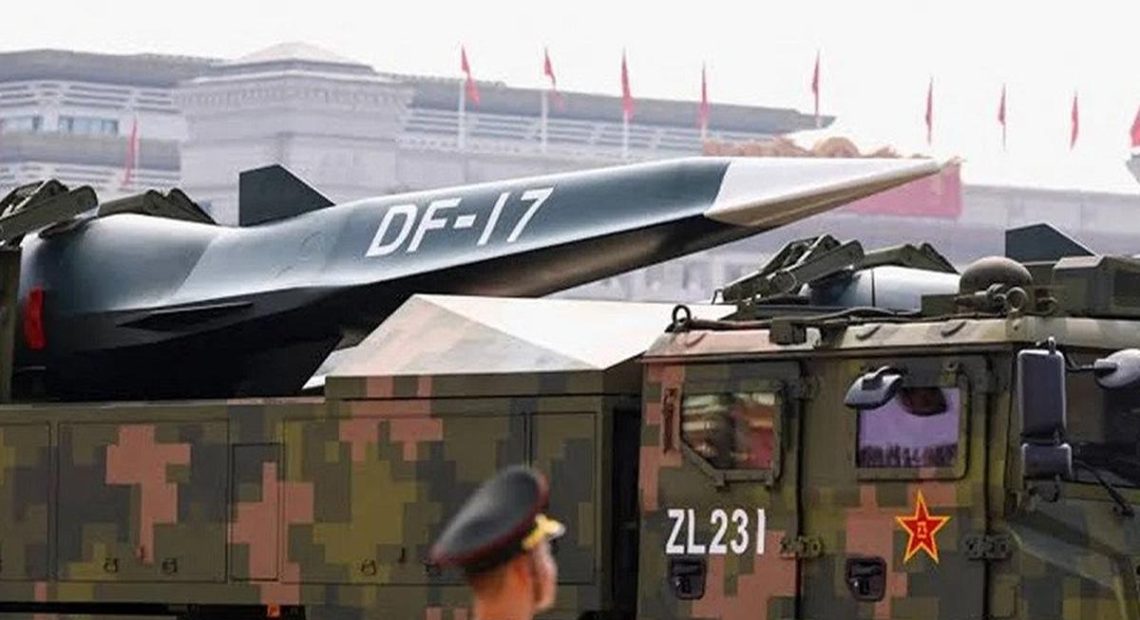
China’s DF-17 hypersonic glide vehicle is reported in various US assessments to have a range of about 2,500km. The DF-27 missile is estimated to have a range of up to 8,000km. These capabilities have raised fresh concerns over the security of US bases and military infrastructure across the Pacific region. A key feature of hypersonic weapons is their high speed and ability to manoeuvre during flight, potentially making them more difficult to detect and intercept with conventional defence systems. However, successfully striking a distant, moving aircraft requires accurate and continuous intelligence, surveillance and targeting capabilities.
Analysis of Pentagon data also points to a rapid expansion of China’s missile arsenal. According to the report, China’s ballistic missile inventory increased by about 147% from 2015 to 2024, reaching approximately 3,150 missiles. During the same period, its cruise missile inventory rose by about 50% to more than 300. Experts caution, however, that accurately striking a moving aircraft thousands of kilometres away remains extremely difficult. Without continuous and precise information on the target, the effectiveness of a missile over such distances can be significantly reduced. Another concern is the risk of miscalculation during a conflict. An opponent could potentially interpret the launch of a long-range missile as preparation for a nuclear strike, triggering a rapid escalation. Such misunderstandings could pose serious risks to international security, particularly between the two nuclear-armed powers.
In response to China’s growing military capabilities, the United States is also developing longer-range air-to-air weapons. The US Navy recently tested a new air-combat missile with a range of more than 300 miles. The military technology competition between China and the United States is no longer limited to fighter jets and missiles. Both countries are expanding their capabilities in long-range surveillance, satellite-based intelligence, hypersonic technology and missile defence. The competition is reshaping the military balance in the Indo-Pacific and prompting renewed debate over the nature of potential future conflicts.
Source: Bloomberg