Speaker Raises Alarm Over Parliament’s Future
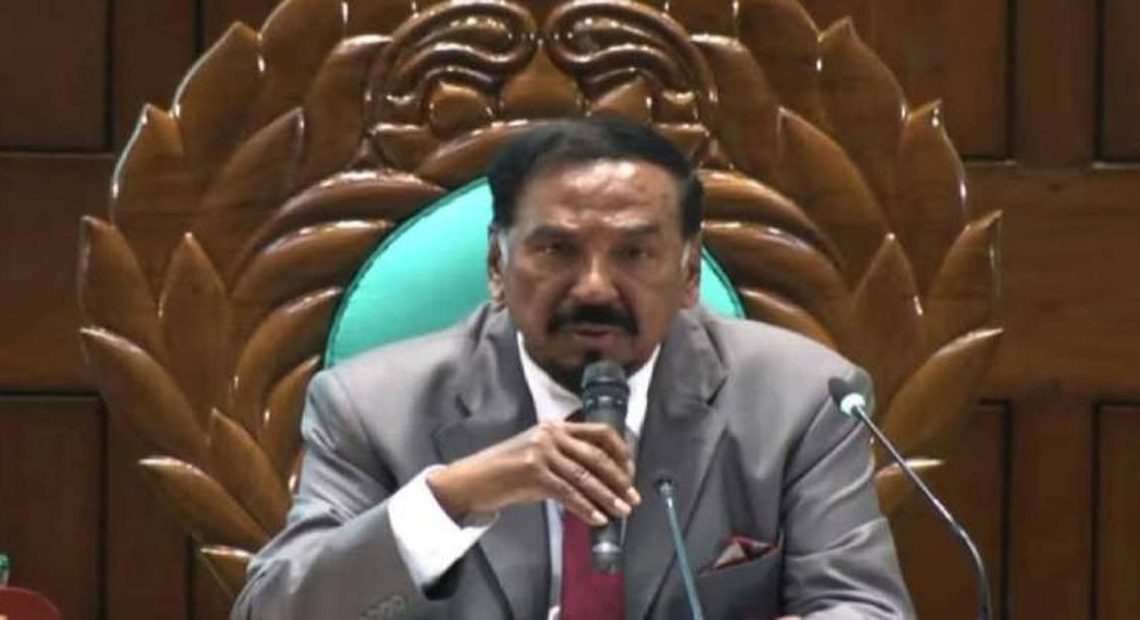
The National Parliament descended into a tense situation during a question-and-answer session after several remarks by Home Minister Salahuddin Ahmed triggered heated exchanges and protests from opposition lawmakers. Expressing deep concern over the disorder, Speaker Hafiz Uddin Ahmed (Bir Bikram) said he was worried about the future of the Parliament.
Presiding over Thursday’s parliamentary session, the Speaker said, “I am concerned about the future of this Parliament. Today, I saw attempts to prevent one another from speaking. This is not a good sign for Parliament. If this continues, I do not know how long this Parliament will last.”
He said democracy had been achieved after a great struggle and that every lawmaker had a responsibility to preserve it. Urging lawmakers to read the Rules of Procedure, he said ministers must be allowed to complete their statements and their remarks must be heard. Likewise, when the Speaker speaks, lawmakers must remain seated and listen. “If you do not follow these rules and conventions, this Parliament will not last long,” he warned.
The incident began when National Citizen Party (NCP) lawmaker from Cumilla-4, Hasnat Abdullah, raised a supplementary question about the country’s law-and-order situation. He cited statistics on murders and rapes during the six-month tenure of the previous interim government and also mentioned a situation in Brahmanbaria where cultural activities such as music, boat races and cinema screenings had reportedly faced restrictions. He asked the Home Minister whether he had succeeded or failed in restoring law and order and establishing the rule of law.
In response, Home Minister Salahuddin Ahmed said, “Honorable Speaker, I could not understand whether this was a question or a speech at Paltan.” His remark immediately created tension among opposition lawmakers. The Speaker intervened and managed to calm the situation, allowing the minister to complete his response. The Home Minister said improvements in the law-and-order situation were visible. He claimed that since the government took office, suspects involved in crimes had been arrested and brought under the law within 24 to 48 hours. He also questioned the basis of the statistics cited by Hasnat Abdullah, saying parliamentary discussions should always be based on facts.
Later, Jamaat-e-Islami lawmaker Shafiqul Islam Masud from Patuakhali-2 raised another supplementary question. He alleged that robbery, extortion and attacks on lawmakers were taking place openly and asked what steps the Home Minister would take. While responding, the minister again said, “This is not Shahbag; this is Parliament. Giving a speech at Shahbag Square and speaking in Parliament are not the same thing.” His remarks triggered another round of protests and uproar from opposition lawmakers, who accused him of repeatedly mocking them by referring to “Shahbag” and “Paltan.”
As the situation became increasingly disorderly, the Speaker repeatedly asked lawmakers to return to their seats. However, shouting and protests continued for some time. At one point, the Home Minister said, “If you do not even allow me to speak, then what kind of freedom of speech is this?” Opposition lawmakers subsequently demanded that the remark be expunged from the parliamentary record.
Opposition Leader Dr. Shafiqu r Rahman then sought the Speaker’s attention. After being given the floor, he said there was no point in speaking if such comments were made while he was addressing Parliament. Criticizing the Home Minister’s conduct, he said opposition lawmakers had not come to Parliament as his students. “If he wants to be a teacher, he should open a university and speak there,” he said. He described the minister’s behavior as a “culture of fascism” and demanded that he apologize and that his remarks be expunged.
Responding to the opposition leader, the Speaker said everyone has the freedom to speak in Parliament. However, when dozens of lawmakers stand up simultaneously, it becomes impossible for anyone to speak. He emphasized that Parliament is a place for debate, where members can counter one another’s arguments through discussion. But they must not deprive others of their right to speak through shouting and disruptions. “Freedom of speech exists in Parliament. But you cannot silence the voice of justice by creating noise,” the Speaker said. “When a minister is speaking, you must listen to him. Please allow me to conduct the Parliament.”
The Speaker also expressed concern over what he described as growing intolerance among some lawmakers. He said a minister must be allowed to finish his statement and that having dozens of members stand up simultaneously and prevent others from speaking was not parliamentary practice.
Referring to his long experience in Parliament, Hafiz Uddin Ahmed said he had been associated with the national legislature for around 40 years. He noted that previous parliaments had many negative records, including the killing of a Speaker of Bangladesh’s Parliament. However, he said the current Parliament was better than many of its predecessors and urged both sides to exercise patience.
He stressed that mutual respect and adherence to parliamentary rules were essential for democracy to function effectively. Without mutual respect and discipline, he warned, the future of Parliament would remain uncertain.