
Garment Sector Struggles Under Fuel Crisis
Hasan Sohail >
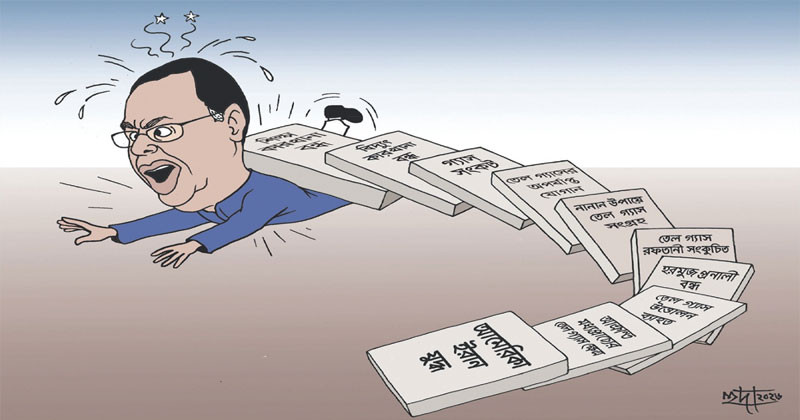
Bangladesh’s garment sector is facing growing pressure from prolonged gas and electricity shortages, rising production costs, financing difficulties, declining purchase orders and uncertainty over new investment. Some factory owners have reduced production or laid off workers, while others are considering mergers to keep their businesses running. Some are also being forced to shut factories permanently. Mohammad Hatem, president of the Bangladesh Knitwear Manufacturers and Exporters Association (BKMEA), said the prolonged energy crisis is disrupting production, increasing financial pressure on factories and putting jobs at risk. He said a factory was closed recently after its owner failed to sustain operations despite efforts to keep the business running.
The wider industrial sector is also under pressure. Entrepreneurs fear that continued energy shortages could turn temporary factory closures into permanent shutdowns, reducing production capacity and worsening unemployment. Data from the Centre for Policy Dialogue (CPD) show that 95 factories in Gazipur, Savar-Ashulia and Narayanganj-Narsingdi were permanently closed between January and August this year, resulting in 61,881 direct job losses. The actual number of affected workers may be higher because many factories have temporarily suspended production, reduced capacity or stopped recruiting.
Garment industry has suffered a lot from factory closures over the past few years. As per the statistics provided by BGMEA, 27 factories were closed in 2023, which left 8,920 workers jobless. In 2024, an even higher number of 61 factories was shut down, which resulted in unemployment of 39,470 people. Matters only became worse in 2025, when 168 garment factories were closed. The data also show that the average size of factories that closed increased. A closed factory employed around 330 workers on average in 2023, compared with about 650 workers in both 2024 and 2025.
Industry leaders say rising raw material and production costs, pressure from international buyers to keep prices low, difficulties in securing bank financing, declining orders and unreliable gas and electricity supplies are making it increasingly difficult for factories to remain profitable. BGMEA President Mahmud Hasan Khan said factories that are capable of overcoming the current crisis but are facing financial difficulties should be brought back under financing. He also called for measures to stabilise energy supplies and reduce business costs.
Bangladesh Textile Mills Association (BTMA) President Shawkat Aziz said he has decided to close a particle board factory because he does not expect the gas and electricity situation to improve within the next two years. Five spinning mills owned by him had already closed because of the energy crisis. He said keeping factories closed for long periods makes it difficult for entrepreneurs to pay fixed costs, workers’ salaries and bank loan interest. To survive, some businesses are now considering merging their remaining factories and operating on a smaller scale rather than making new investments or expanding capacity.
The impact of factory closures extends beyond individual businesses. Suppliers of raw materials, transport companies, banks, insurance firms and workers are also affected. CPD Distinguished Fellow Professor Mostafizur Rahman said the number of people losing jobs could be several times higher than the number of permanently closed factories. He said workers in permanently closed factories face uncertainty over unpaid wages, benefits and compensation. Workers at factories that have suspended operations for an indefinite period also face uncertainty, even if their jobs technically remain.
Business leaders say factories that are temporarily closed because of financial difficulties need policy support and easier access to finance to restart operations. They warn that new investment could also decline unless interest rates, credit availability, energy supply and production costs become more stable. Energy experts have called for uninterrupted energy supplies and sustainable financing, along with measures to reopen viable factories. They also stressed the need to create a more investment-friendly environment and reduce production costs. Economists warn that a prolonged crisis in the garment sector could affect export earnings, employment, banking-sector credit risks and industrial investment. Maintaining the competitiveness of Bangladesh’s garment industry in the international market is therefore becoming increasingly important.
Mr. Hatem said many factories are operating below full capacity because of gas and electricity shortages. Even when production falls, factories still have to pay workers’ salaries, loan instalments, utility bills and other fixed costs. Using alternative fuels such as diesel, LPG or CNG further raises production costs. However, garment prices are often fixed in advance with international buyers, making it difficult for manufacturers to pass higher production costs on to customers. “The biggest challenge now is to maintain factories and protect workers’ employment,” Mr. Hatem said. He warned that financially weak factories would face greater pressure if the energy crisis continues. He called for uninterrupted gas and electricity supplies, financial support and policy measures to help restart factories that have been partially or completely closed.