
The Makkah Agreement: A New Horizon for Muslim Unity and Security
Dr. Muhammad Asadullah Al Galib
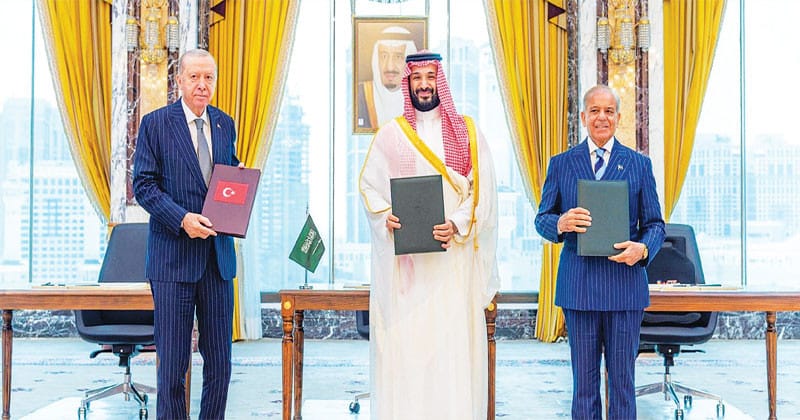
A historic trilateral agreement was inked at the Al-Safa Palace in the holy city of Makkah against the backdrop of quickly changing geopolitics and regional security. This historic initiative, known as the Makkah Joint Defense Agreement, unites the top leadership of three major Muslim powers: Turkey, a NATO member with cutting-edge military and technological capabilities, Pakistan, the only Muslim state with nuclear weapons, and Saudi Arabia, a prominent Middle Eastern nation. This agreement opens an opportunity for the Ummah’s collective security thinking and represents a significant break from the traditionally disjointed military strategies and over-reliance on the outside world that have long defined the Muslim world.
Media sources in the West and the region have reacted to the agreement with frenzy, calling it an ‘Islamic NATO’ too soon. Such a title, according to analysts, is an exaggeration and irrational thinking given the current political division within the Muslim world. Instead, the agreement is a fundamental trilateral agreement intended to be a first step toward an all-encompassing security framework. Critics draw attention to a visible double standard, pointing out that while Western nations are regarded as pillars of global balance when they form alliances like NATO, QUAD, or AUKUS, any joint security action taken by Muslim nations to protect their sovereignty and holy sites immediately triggers an international outcry.
A mutual defense policy claiming that any armed assault or unlawful aggression against any one member state would be regarded as an attack on all members is a fundamental principle of the Makkah Agreement. Securing the sovereignty and territorial integrity of member states, maintaining the continuous security of the holy sites of Makkah and Madinah, fighting terrorism, handling natural disasters, and responding to humanitarian crises are among its main goals as a defensive alliance. The agreement also places a strong emphasis on cooperative defense firms that specialize in drones, air defense, naval technology, artificial intelligence, and satellite technology, as well as joint military exercises and active intelligence sharing.
The agreement’s supporters draw their ideological strength from Quranic teachings, such as Surah Al-Imran’s command to hold tightly to Allah’s rope and Surah Al-Anfal’s order to build up military might and capacities to fight off attackers. Throughout history, the Ummah’s security and dignity have been based on shared military readiness and intellectual cohesiveness. Experts stress that to turn this humble agreement into a long-term security model, it should not be limited to only three countries but should progressively open the door for additional competent nations like Egypt, Iran, Indonesia, Malaysia, Bangladesh, Qatar, and the United Arab Emirates to participate.
There is already a lot of regional attention being paid to the agreement’s geopolitical implications, especially with reference to Bangladesh. Following the agreement, the Turkish newspaper Yeni Şafak released a study detailing the high likelihood of Dhaka’s participation, pointing out how participating may change its foreign policy and security architecture by integrating Pakistani marine knowledge with Turkish shipbuilding technology. These reports immediately worried Indian media outlets. Supporters argue that the government of Bangladesh should actively take advantage of this chance to safeguard its national growth by utilizing the economic, scientific, and defense might of Saudi Arabia, Pakistan, and Turkey.
Historians and political analysts warn that the Muslim world has seen many similar agreements collapse in the past, despite immense promise. The Arab League’s 1950 Joint Defense Agreement, which committed to collective defense but was unable to stop Jordan from losing the West Bank and East Jerusalem during the 1967 war, the 1955 Baghdad Pact, and the 34-nation Islamic Military Counter Terrorism Coalition, which was established in 2015 but mostly stayed limited to meetings and statements without coordinated military action, are notable examples. It is believed that the present effort must learn from these past mistakes to survive.
The Makkah Agreement has to be based on a true command structure, consistent finance, long-term political continuity, and genuine political will to escape the fate of its predecessors. According to analysts, Makkah is more than just a location; it is a powerful symbol of Muslim togetherness. This defense understanding has the potential to significantly change the geopolitical landscape of the Muslim world and effectively protect the Ummah’s overall security and self-respect if it develops into an organized, visionary, and self-reliant security framework supported by brave leadership and mutual trust.
Author: Professor (Retd.), Department of Arabic, University of Rajshahi and
Ameer, Ahlhadith Movement Bangladesh