Severe Power and Gas Disruptions Cripple Daily Life
Eklas Haque/Sadman Safi Pratik
In the midst of Bhadra’s extreme heat, severe power and gas shortages have ruined everyday life nationwide, causing great misery for common people. In rural places, power outages last an average of 12 to 14 hours per day. From cities to villages, the serious energy crisis has severely disrupted daily life. Residents complain that electricity almost goes out for significant sections of the day and night, and they consistently get high utility bills. Widespread public outrage over this terrible situation has resulted in protests, road blockades, and a shutdown of offices in some areas as people call for an urgent end to the ongoing load-shedding.
Production at steel mills, bakeries, garment factories, and building material manufacturing facilities in Narayanganj and Gazipur has dropped by as much as 50%, causing significant losses for both industrial manufacturing facilities and agricultural sectors. Energy difficulties are destroying hundreds of dyeing, printing, textile, and spinning mills in Narsingdi’s industrial belt, leading to daily financial losses of almost 400 crore taka. In addition, the largest fertilizer factory in the nation, Ghorashal-Palash Fertilizer Factory, has been significantly damaged and is still unable to manufacture urea at full capacity since gas supplies have dropped significantly.
Gas stoves in residential districts of Dhaka, Chattogram, and Sylhet are inoperable from morning till afternoon, leaving households to depend on expensive LPG cylinders that add to their expenses. As a result, residents are suffering severe culinary issues. Severe protests have also been sparked by this shortage of gasoline and electricity, including the blockade of the Rural Electrification Board’s Madhabdi zonal office by textile workers, the destruction of BPDB buildings in Mymensingh by outraged people, and the obstruction of highways in Rangpur and Tangail by customers.
Power, Energy, and Mineral Resources Minister Mr. Iqbal Hasan Mahmud Tuku, who claimed in May that there was no load-shedding then, admitted in August that the shortages were serious, is one example of how contradictory statements made by government ministers have increased public outrage. State Minister Mr. Anindyo Islam Amit first rejected the situation before admitting it was a legacy issue, and despite PM Tarique Rahman’s orders to evaluate energy import contracts, administrative issues and poor cooperation among officials remain obstacles to reform attempts.
Professor Mr. M. Tamim, an energy expert, said that the government has to maintain the supply of electricity and gas to industries due to the current crisis, suggesting that running oil-fired power plants may become urgently necessary despite raising the BPDB’s financial liability as a temporary crisis-management measure. The BPDB’s Director of Public Relations, Md. Shamim Hasan, told Daily Inqilab that the present electricity situation is completely out of control, while failing to discuss it in detail. However, he identified the underlying gas problem as the primary source of the outages.
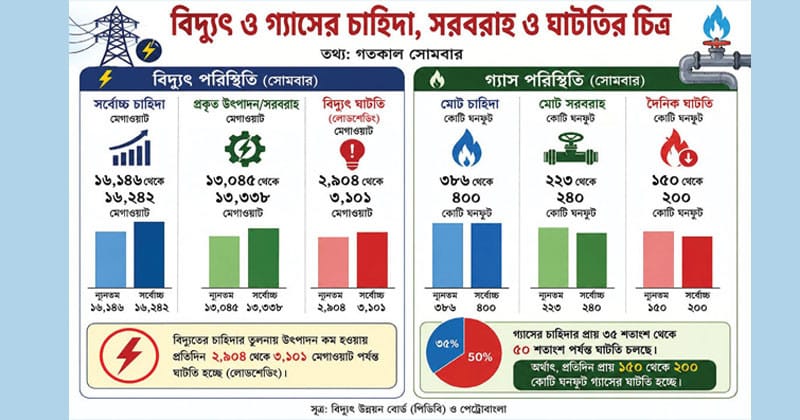
In response to the fuel shortage, Petrobangla Deputy General Manager Mr. Tariqul Islam provided data on gas supply, revealing a deficit of nearly 1,380 MMCFD with a total supply of 2,329 MMCFD compared to a daily demand of over 3,800 MMCFD. According to the most recent BPDB statistics, peak demand was 18,830 megawatts while actual generation was only 15,756 megawatts, resulting in a generation shortfall of more than 25% and real load-shedding of 2,942 megawatts.
People are using sarcastic photocards, live-streamed phone calls to electricity offices, and digital protests with darkened profile images to draw attention to their extreme suffering on social media platforms like Facebook and X. These widely shared postings call for the urgent import of alternative fuels to restart power plants, the reorganization of gas pressure, a severe crackdown on corruption and system failure, and rapid development of renewable energy.
The problem has an overall impact on rural health, education, and home management, making it difficult for households to charge essential electronics or keep food. Housewives from Shukundi village in Narsingdi, such as Ms. Anwara Begum, have expressed sadness at the unpredictability of power delivery, pointing out that power only lasts for two or three hours a day and that officials provide no accountability despite imposing severe bill collection.