‘Boat Village’ Aterpara Defies Time With Two Centuries of Heritage
Zahid Hasan, Bhedarganj (Shariatpur)
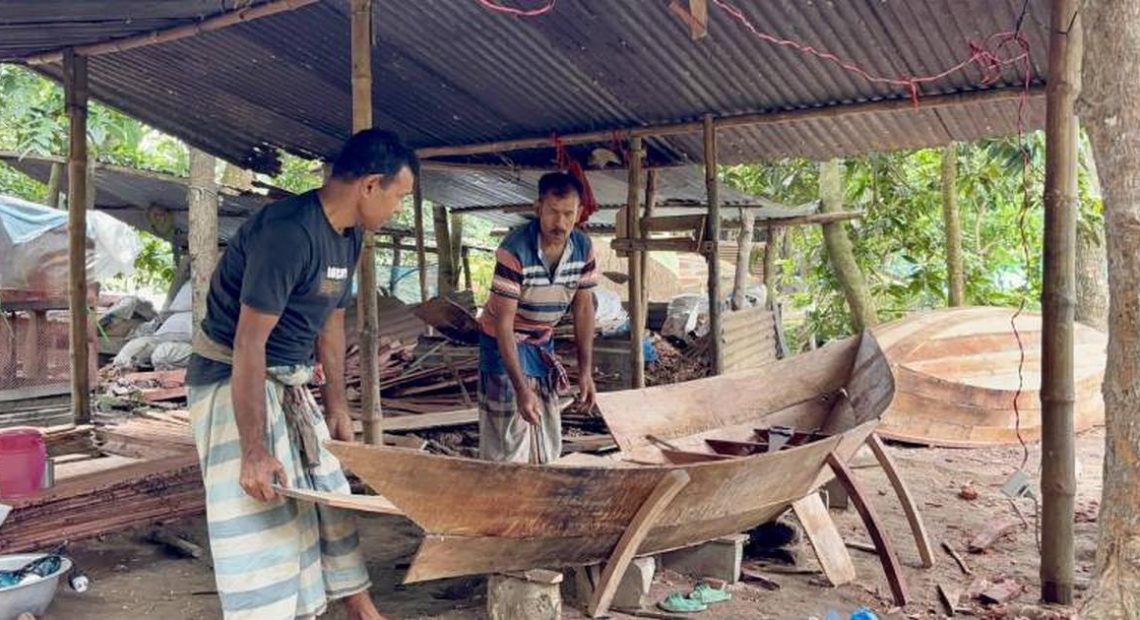
As soon as one enters Aterpara village in Chhaygaon Union of Bhedarganj upazila in Shariatpur, the sounds of hammers, saws and nails can be heard. Almost every household has rows of wooden logs, sawn planks and partially built boats scattered across its yard. For the people here, boat-building is not merely a means of livelihood; it is part of their identity and culture and a valuable tradition passed down through generations. More than a hundred families have been making boats for generations to earn their livelihood. This is why Aterpara has become known across the area as the ‘Boat Village.’
Once, boats were one of the main means of transport in this riverine region. Although demand has declined with the expansion of modern road networks and the shrinking of waterways, the craftsmen of Aterpara continue to preserve the centuries-old tradition with dedication. With proper patronage and planned initiatives, the boat industry could not only help preserve the country’s heritage but also make an important contribution to the rural economy.
Speaking to boat builders and local residents, it was learned that the tradition of boat-building has continued in the village for nearly two centuries. From an early age, children learn the entire process of making boats by working alongside their fathers, uncles or grandfathers– from selecting and cutting wood to fitting nails and completing a boat.
With the onset of the monsoon, activity increases in Aterpara. From morning until evening, craftsmen remain busy working with wood, hammers and saws. The boats are sold at local markets as well as in different parts of the country. A skilled craftsman can make a small boat in a day, while a large boat takes three to seven days to build. A small boat costs Tk 4,000–5,000 to make and is sold for Tk 7,000–8,000. A large boat costs Tk 8,000–9,000 to make and is sold for Tk 10,000–12,000.
Boats from this region generate sales worth nearly Tk 1 crore during the season at several markets in Shariatpur, including Burirhat, Bhojeshwar, Kazir Hat and Gosairhat. Although one-time boats once had the highest sales, they are no longer made with the passage of time. Many craftsmen have left the profession due to declining sales and rising raw-material costs. Although they remain engaged in boat-building for three months of the year, the craftsmen spend the remaining nine months travelling around the village and repairing old houses to earn a living.
Nagen Bain has been involved in boat-building for about 40 years. He first joined the work with his father at the age of 10. Even after 50 years, he continues to work with the same hammer and saw. Nagen Bain learned the craft by cutting wood and driving nails. During the season, he has to work from dawn until night.
Speaking to Nagen Bain yesterday, he said that more than 200 families in Aterpara were once involved in boat-building, but the number has now fallen by half. Many have been forced to leave the traditional profession due to the filling up of rivers and canals, the conversion of wetlands into fish enclosures, reduced water flow, declining demand for boats and rising prices of wood and other materials. He said that if the government provided modern training and financial assistance, it would be possible to produce better-quality boats and even export them abroad. Although Nagen remains in the profession, he does not want his children to follow it. Due to the hard work and low wages, he has encouraged his sons to pursue other professions.
Eighty-year-old Gouranga Bain has been involved in boat-building for nearly 65 years. Describing his experience, he said, “Previously, there was boat-building work throughout the year. We used to travel to different districts to build boats. Now, some orders come before the monsoon, and after that, the work decreases significantly. At one time, various types of boats, including one-malai boats and trawlers, were made here. Now, due to rising raw-material prices and the filling up of canals and wetlands, people are no longer interested in entering this profession. Some families are still involved in the profession to preserve the tradition. Without government assistance, this work will soon come to an end.”
The craftsmen said that boat-building has also embraced modernity over time. Alongside traditional handwork, many now use modern machines at different stages, including wood cutting. Women and children in the families are also an important part of the industry. They make ropes, sails, wooden seats and various other accessories for boats. Boat-building continues for about three months a year. During the rest of the year, many craftsmen support their families by repairing old houses.
Local journalist and environmental activist Ashikur Rahman said, “The boat industry of Aterpara is not merely a profession; it is part of our folk heritage and cultural identity. But alternative transportation systems, the shrinking of rivers and canals, and market shortages have put this industry at risk of extinction. This heritage can be preserved if training for craftsmen, easy-term loans and effective market management are ensured.”
Bhedarganj Upazila Executive Officer Md Abubakar Siddique said, “The craftsmen of Aterpara have preserved a centuries-old tradition. Their skill and hard work are truly commendable. The administration will take initiatives regarding training, market linkages and necessary assistance so that this traditional industry can develop further.”