
Have the Economic Corridor and Makkah Agreement Escalated India’s Anxieties?
Kamrul Hassan Dorpon
India’s foreign policy framework has shown severe concern and sorrow about losing its strategic hold on Bangladesh since the historic mass uprising that brought down the fascist administration of the previous Prime Minister, Ms. Sheikh Hasina. For more than fifteen years, New Delhi maintained an imbalanced diplomatic dynamic, weakening Bangladesh’s sovereignty while using the Hasina government to carry out its regional goals. While Indian federation states, such as West Bengal under Chief Minister Ms. Mamata Banerjee, often ignored directives from the central government, such as rejecting the Ayushman Bharat health insurance system or refusing to reach an agreement on the Teesta water-sharing treaty, analysts pointed out that the Hasina government unconditionally agreed with all demands from New Delhi. Bangladesh became an officially dependent state as a result of this obvious difference, which outraged the people of Bangladesh and caused confusion in India’s Ministry of External Affairs after her removal.
Following this political shift, the current Bangladeshi government, led by Prime Minister Tarique Rahman and based on the ‘Bangladesh First’ philosophy, has significantly changed the country’s foreign policy. By placing a high priority on mutual benefit and national interest, the government makes sure that Dhaka is no longer subject to outside pressure or historical imbalances that historically brought about little mutual benefit. The current foreign policy team, which includes diplomat Ms. Shama Obaid Islam, State Minister for Foreign Affairs Mr. Humayun Kabir, and Foreign Minister Dr. Khalilur Rahman, shows a sharp awareness of public sentiment by actively broadening international partnerships to enhance national influence while rejecting external pressures.
China has become Bangladesh’s main development partner during this strategic transition, providing significant resources and a cooperative attitude necessary to overcome inherent economic weaknesses and governance weaknesses. The planned China-Myanmar-Bangladesh Economic Corridor, a groundbreaking infrastructure project designed to directly connect Bangladesh’s road, rail, and marine networks with Southeast Asia and Europe, is a pillar of this strategic engagement. It is expected that this ambitious connectivity would boost regional mobility, increase import-export volumes, and promote trade, establishing Dhaka as a powerful logistical and commercial hub that may push long-term national success.
Bangladesh’s GDP might reach 677 billion dollars by 2030, even surpassing regional competitors like Malaysia, Vietnam, and Thailand, according to recent IMF economic predictions. The China-Myanmar-Bangladesh Economic Corridor must be urgently established in addition to major current infrastructure projects like the Teesta project and the Ganges Barrage to fulfill this high-growth projection. A strong basis for long-term domestic stability and sustainable growth may be established by such significant economic integration, which could bring Bangladesh to a financial position equivalent to that of Asia’s famous Four Tigers, surpassing even the countries of Southeast Asia.
It should come as no surprise that this growing alliance with Beijing has faced strategic caution from the United States and hidden opposition from India, both of which have geopolitical objectives focused on opposing Chinese power in the Indo-Pacific area. Due to the strategic interests of all three main nations, Bangladesh has an excellent negotiating position despite these external obstacles. Since China has made it clear that any country, including India, is welcome to join the economic corridor, Dhaka is in a strong position to maintain a balanced and strong position without turning to historical submission or sacrificing its fundamental sovereign goals.
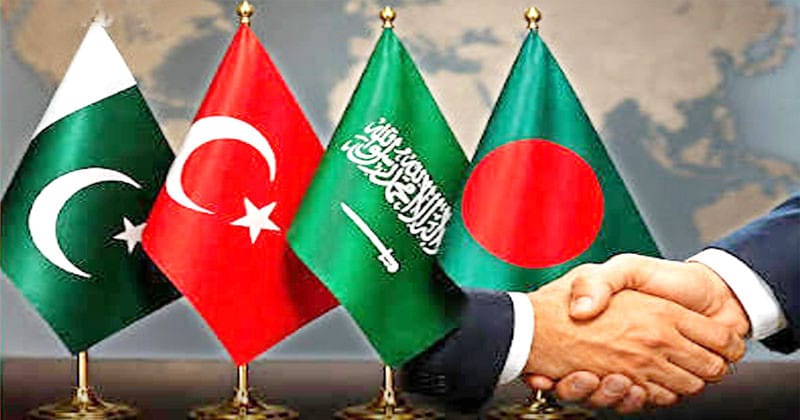
Mr. Randhir Jaiswal, a spokesperson for the Ministry of External Affairs, often gives press briefings, showing New Delhi’s continued interest in Bangladeshi domestic matters. When asked about rumors that State Minister Mr. Humayun Kabir and Foreign Minister Dr. Khalilur Rahman were interested in Bangladesh’s possible involvement in the Makkah Agreement during an ordinary briefing on August 28, Mr. Jaiswal said that India was keeping a close watch on developments. Similarly, Mr. Jaiswal stated that preserving law and order is still solely the duty of the independent Bangladeshi government in response to the sudden death of a Hindu family member in Rangpur.
Dhaka’s diplomatic caution about domestic issues within neighboring nations compares sharply with its ongoing public criticism of internal governance decisions. This ongoing review means New Delhi may continue to see Bangladesh through the lens of the subordinate framework of the previous government, ignoring the fact that modern Bangladesh has complete sovereign authority in its foreign policy actions. Attempts to project indirect pressure through public discourse are no longer effective, which is similar to wider regional patterns seen in Bhutan, Nepal, Sri Lanka, and the Maldives, where foreign hegemony has gradually reduced.
Through its strong governance and strategic initiatives, the present government successfully symbolizes the Bangladeshi public’s constant refusal to put up with foreign pressure, oppressive behavior, or inappropriate interference. If fully realized, active engagement in multilateral frameworks like the Makkah Agreement promises to significantly improve the country’s diplomatic credibility, religious diplomacy, and international status. However, transforming a bold diplomatic purpose into successful execution in the face of structural barriers requires skilled negotiating, strong political drive, and a firm commitment to protect national interests from foreign conflict.
The China-Myanmar-Bangladesh Economic Corridor and other domestic infrastructure projects are clearly economically essential, but there hasn’t been any visible progress in their performance. This is mostly due to New Delhi’s secret foreign opposition. Hesitancy over these national goals is completely inappropriate and harmful because the current administration obtains its essential authority and legitimacy from overwhelming public support. Bangladesh can effectively guarantee its long-term destiny as an advanced South Asian superpower, maximize its geopolitical power, and secure its sovereignty by pursuing these efforts under a common internal political consensus across party lines.
darpan.journalist@gmail.com