
On Bangladesh’s joining the Mecca Defense Pact
Maj. Gen. (Retd.) H.R.M. Rokon Uddin
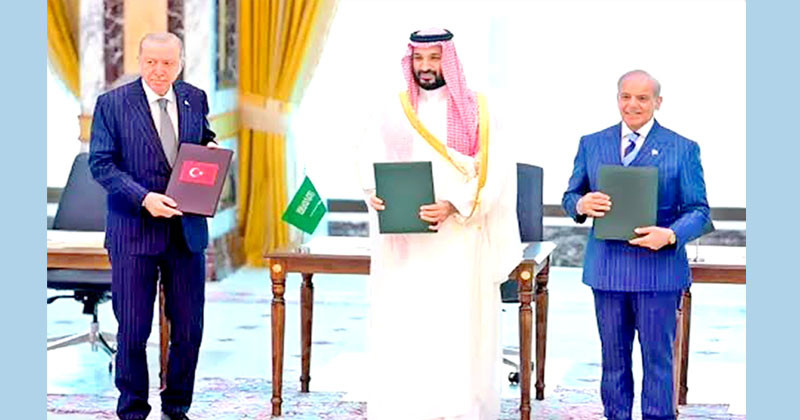
Saudi Arabia, Turkey, and Pakistan signed a joint defense pact in Mecca on August 7, 2026. The core principle of the pact is that an armed attack on one member state will be considered an attack on all members. As far as is known, Bangladesh has been invited to join, and the government is considering the proposal favorably. This is not merely some general cooperative organization of Muslim countries; rather, it is a military arrangement carrying mutual defense commitments. As such, decisions should not be made on the basis of religious sentiment, special affinity toward any country, or opposition to a neighboring state. Bangladesh’s own security, economy, diplomatic independence, and long-term national interest must be the sole basis for the decision.
The capabilities of the three founding countries are complementary. Turkey has a large and modern armed force, a strong drone and defense industry, and long military experience as a NATO member. Pakistan is a nuclear-armed state with real combat and counter-terrorism experience. Saudi Arabia has vast economic capacity, a modern arms arsenal, energy resources, and special political and religious influence in the Muslim world. The pact’s stated purpose is to enhance collective deterrence. The founding countries say it is not an offensive or sectarian alliance formed against any specific state. But it remains unclear exactly what kind of support other members would provide if a member were attacked — troops, weapons and intelligence sharing, or merely political support. There is also no published commitment that Pakistan’s nuclear capability would automatically extend a nuclear security umbrella to other members.
The potential benefits of Bangladesh
First: Participation in this pact could politically and strategically strengthen Bangladesh’s deterrence capability. If any external power exerts military pressure on Bangladesh, there would be a possibility of gaining the support of three important countries. Since Bangladesh’s own military strength is limited, an effective collective security arrangement could complicate the calculations of potential adversaries.
Second: The pact could play an important role in modernizing Bangladesh’s armed forces. Opportunities to obtain drones, warships, missiles, armored vehicles, electronic warfare systems, and defense technology from Turkey could increase. Training, military education, intelligence cooperation, counter-terrorism, air defense, and joint exercises with Pakistan could expand. There is also potential for Saudi-funded defense projects, military infrastructure, and joint production systems.
Third: Bangladesh could become a partner in the defense industry rather than merely a buyer of weapons. Joint investment in shipbuilding, military apparel, ammunition, communications equipment, drone components, and maintenance could boost Bangladesh’s technological capacity and employment. However, to gain this benefit, the agreement must include specific guarantees for technology transfer, local production, and workforce training.
Fourth: Saudi Arabia is an important source of energy, labor markets, investment, and foreign currency for Bangladesh, with a large number of Bangladeshis working there. Deeper defense cooperation could allow Bangladesh to seek additional benefits in Saudi investment, energy supply, infrastructure development, and skilled manpower export. Trade, education, and technological exchange with Turkey and Pakistan could also increase.
Fifth: Bangladesh’s voice in security discussions within the Muslim world could grow stronger. Bangladesh is one of the world’s largest Muslim-majority countries by population and has long experience in UN peacekeeping operations. Joining the pact could allow Bangladesh to exert influence in favor of moderation, peaceful resolution, and adherence to international law.
Sixth: Opportunities for cooperation on Bay of Bengal and maritime security could emerge. Exchange of intelligence and technology to address non-traditional threats such as piracy, arms and drug trafficking, cyberattacks, terrorism, and commercial vessel security could benefit Bangladesh.
The biggest risk is Bangladesh becoming entangled in a war unrelated to itself. Saudi Arabia’s security concerns center mainly on the Gulf region, Yemen, Iran, and energy infrastructure. Turkey’s security interests are tied to Syria, Iraq, the eastern Mediterranean, the Caucasus, and the Kurdish question. Pakistan’s main concerns are India, the Afghan border, and internal terrorism. These issues differ from Bangladesh’s own security situation. If a founding country is attacked, Bangladesh may be required to send troops, naval vessels, aircraft, weapons, or funds. This could mean Bangladesh’s lives, resources, and military capacity are spent on a conflict in which it has no direct national interest. In particular, if Bangladesh sides in a conflict involving Iran, Yemen, or another regional dispute, it risks losing its long-standing balanced relationships.
Second: Joining the pact could narrow Bangladesh’s non-aligned and balanced foreign policy. Bangladesh currently maintains relations with Saudi Arabia, Turkey, and Pakistan, as well as with China, the United States, the European Union, Japan, India, Russia, Iran, Qatar, the UAE, Kuwait, and Oman, all at the same time. Entering a formal military alliance would raise the question internationally of which bloc Bangladesh actually belongs to. Bangladesh’s main garment export markets are Europe and the US; the Middle East is an important source of remittance income; and China is a major trade and defense partner. If military polarization leads to sanctions, export controls, reduced investment, or trade barriers from any side, ordinary people would bear the cost. For an economy as dependent on exports and imports as Bangladesh’s, strategic flexibility is itself a valuable national asset.
Third: New tensions could arise in relations with India. Delhi may view Bangladesh’s joining a security pact that includes Pakistan with suspicion, which could affect border management, water sharing, trade, communication, and regional cooperation. However, India’s satisfaction or dissatisfaction cannot be the determining factor in Bangladesh’s decision — as an independent state, Bangladesh will decide according to its own national interest.
Fourth: There is the question of bearing financial liabilities. As a member, Bangladesh may need to pay for joint headquarters, military exercises, troop deployments, arms standardization, and various operations.
Fifth: Bangladesh could become entangled in internal sectarian and political divisions within the Muslim world. All three founding countries are Sunni-majority. Even though the declaration does not name any country as an adversary, if the pact is in practice viewed as an anti-Iran bloc, Bangladesh could become part of an unnecessary Sunni-Shia polarization.
Since this pact is tied to national security, the decision should not rest on executive action alone. Its military, economic, and diplomatic implications need to be reviewed through parliament, the armed forces, the foreign ministry, security experts, economists, and relevant stakeholders. While maintaining necessary confidentiality, the public should be informed of the pact’s basic obligations.
The writer is a researcher and security analyst.