

Digital Tracking and QR Codes to Be Installed on Batteries to Control Auto-Rickshaws: Home Minister
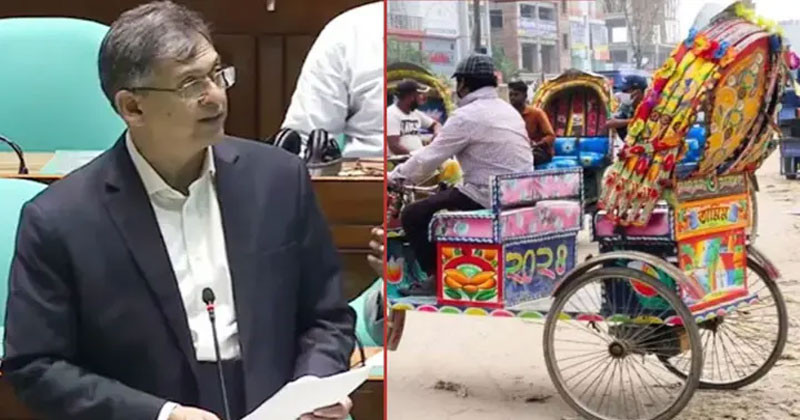
The government has decided not to completely ban battery-powered auto-rickshaws but to bring them under a registered and regulated system. In response to a notice raised in Parliament, Home Minister Salahuddin Ahmed said new policies and regulations would soon be implemented to restore discipline on Dhaka’s roads while protecting the employment of auto-rickshaw drivers. He said each auto-rickshaw battery would be fitted with a QR code and a digital tracking system under the new policy. This would prevent multiple illegal rickshaws from operating under a single registration number.
At the same time, the government is placing strong emphasis on replacing lead-acid batteries with environmentally friendly batteries and restricting the movement of rickshaws to designated areas. The Home Minister made the remarks when reserved-seat MP Rehana Akter Ranu raised a notice under Rule 71, with Deputy Speaker Kaiser Kamal in the chair.
In the parliamentary session, Rehana Akter Ranu highlighted the benefits of the 50 AI-based traffic cameras operating at 17 intersections in the capital and the problems created by battery-powered auto-rickshaws. She said violations such as running red lights, changing lanes improperly and driving at excessive speeds had decreased significantly after the introduction of AI-based traffic cameras.
However, she said it was disappointing that battery-powered auto-rickshaws were still operating recklessly without following any rules. As these vehicles do not have number plates, violations detected by AI cameras cannot be followed by fines or legal action, she said. Rehana Akter Ranu said a large number of auto-rickshaws were also entering major roads in Dhaka. Due to the lack of proper structural design, these vehicles were frequently involved in accidents.
However, she said auto-rickshaws had become popular among ordinary people because of their low fares and easy availability. She therefore urged the Home Minister to take necessary measures instead of completely banning the vehicles, including structural changes, adding number plates, issuing driving licences to drivers and bringing them under proper training.
Millions of Electric Three-Wheelers
In response to the notice, Home Minister Salahuddin Ahmed told Parliament about the social and economic realities surrounding these vehicles. He said battery-powered auto-rickshaws, easy bikes and three-wheeled electric vehicles had become a major part of rural and urban transport over the past decade.
Their low operating costs and easy availability have benefited ordinary people. At the same time, they have created a large informal economy and employment opportunities for drivers, garage workers, spare-parts traders and charging service providers. However, the rapid and unregulated expansion of these vehicles has created serious challenges for the country’s electricity management, road safety, environment and public health.
5% of Electricity Used by Electric Three-Wheelers
On electricity consumption and revenue losses, the Home Minister said there are an estimated 5 million to 8 million electric three-wheelers across the country. They consume around 5 percent of the country’s total electricity generation.
In contrast, there are only around 3,300 legal charging points. In Dhaka alone, an estimated 48,000 informal and illegal charging points are operating. Illegal electricity connections are causing the government to lose around Tk 4,000 crore in revenue every year, he said.
Lead-Acid Batteries Pose Environmental Risks
Expressing concern over environmental damage, the Home Minister said the harmful lead-acid batteries used in these rickshaws and the unsafe recycling of those batteries release smoke and lead, causing serious pollution of the air, soil and water. He also said poultry farms that have developed around these areas are being destroyed. Citing road accident statistics, he said a total of 6,729 road accidents occurred in Bangladesh in 2025, leaving 9,011 people dead. Unregulated battery-powered auto-rickshaws were involved in 13.54 percent of these accidents, he said.
Government Steps Against Illegal Operations
Explaining the current legal measures, the Home Minister said the Dhaka Metropolitan Police (DMP) was conducting regular drives and dumping operations after completely banning auto-rickshaw movement on major roads. Joint operations by the DMP, Dhaka Electric Supply Company (DESCO) and Dhaka Power Distribution Company (DPDC) are also being conducted to disconnect illegal electricity connections.
As the 50 AI cameras installed at 17 intersections in Dhaka have produced positive results in modernising traffic management, work is underway to install another 200 AI cameras in the Tejgaon and Ramna divisions. The system will gradually be expanded across the capital. After the Home Minister’s statement, MP Rehana Akter Ranu was given an opportunity to ask a supplementary question. She clarified that she had not called for a ban on rickshaws. Rather, she had demanded that they be regulated through a specific plan.
She said at least 300 new auto-rickshaws are being added in Dhaka every day, while around 1,000 megawatts of electricity are being consumed daily for these vehicles. She said this is one of the major causes of the current load shedding.
She proposed stopping the seizure and dumping of the vehicles and harassment by police, allowing them to operate on roads inside neighbourhoods, developing solar-powered charging infrastructure, registering them with the Bangladesh Road Transport Authority (BRTA), and introducing an area-based zoning system. Finally, she asked the Home Minister when the proposed coordinated and specific policy would be formulated and implemented.
QR Codes and Tracking System Under New Policy
In response, Home Minister Salahuddin Ahmed assured Parliament, referring to discussions with the State Minister for Local Government, that specific rules and a policy had already been formulated. The policy, finalised by the Local Government Division, includes a framework to ensure that drivers’ employment is not disrupted.
The minister said a digital registration process, QR codes and a tracking system would be introduced under the policy. This would prevent multiple rickshaws from being operated illegally under a single registration number.
At the same time, strict conditions would be imposed to replace lead-acid batteries with environmentally friendly digital batteries. Currently, around 5 million to 8 million battery-powered auto-rickshaws are operating across the country. More than 48,000 of them are in Dhaka alone. The government loses around Tk 4,000 crore annually because the batteries of these auto-rickshaws are charged through illegal connections, the minister said.
In conclusion, the Home Minister urged officials involved in electricity supply and city corporations to raise their voices with integrity against corruption by dishonest employees. He said the government would implement the policy fully and as quickly as possible, prioritising national interest, road safety, public health and the economy.