Political Etiquette in a Democratic State
Professor Dr Saiful Islam
Recently, the publication of statements or content on social media mocking BNP Chairman and Prime Minister Tarique Rahman has once again brought an important question about our political culture to the forefront. Mockery, criticism or strong disagreement over a political leader, his policies, decisions and activities is not unusual in a democratic society. Rather, political satire also has a recognised place within the scope of freedom of expression.
Before the 2026 national parliamentary election, satirical cartoons about PM Tarique Rahman, as a top BNP leader, were published. Yet he accepted them as part of freedom of expression. This approach is an important example of tolerance towards political criticism and satire.
However, when freedom of expression turns into personal insults, obscenity, attacks on family members, character assassination or hate speech, it no longer remains healthy political criticism. The state has a responsibility to ensure citizens’ freedom of expression. At the same time, using that freedom to undermine someone’s personal dignity or to use obscene and insulting language cannot be considered a sign of a healthy democratic culture.
Especially when political criticism targets the country’s elected executive head, it may be as strong as necessary, but if it crosses the limits of decency and responsibility, it may not be acceptable to ordinary people. These recent incidents are therefore not merely about an individual, a family or a political party. Rather, they raise a larger question: how decent, responsible and democratic should the language of criticism, satire, protest and disagreement be in Bangladesh’s politics?
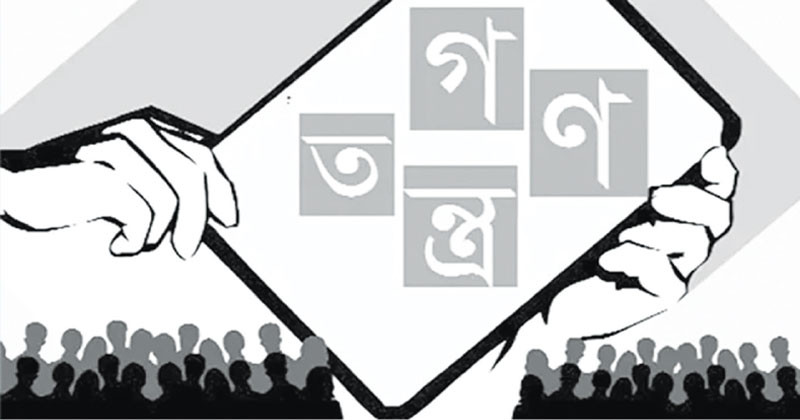
Democracy is not merely the name of elections, voting rights or majority rule. The foundation of an effective democratic state rests on the Constitution, the rule of law, independent institutions, freedom of expression and citizens’ rights. Alongside these institutional structures, however, another factor makes democracy stable and humane—political decorum.
Political decorum does not mean agreeing with political opponents. Rather, its main principle is to recognise the political rights, personal dignity and equal status of opponents as citizens of the state, even amid strong disagreements.
There will be competition, debate, protest and strong criticism of the government in a democracy. But when political competition turns into personal hostility, insult, revenge or violence, democratic culture becomes weakened.
One of the most important principles of democratic politics is that today’s opposition party may become tomorrow’s government, while today’s government may become tomorrow’s opposition. Therefore, power is not the permanent property of any political party.
In the parliamentary system of the United Kingdom, intense debates often take place between the government and the opposition. The Prime Minister regularly faces tough questions from the opposition. At the same time, the opposition is recognised as an essential part of the constitutional political structure.
The concept of “His Majesty’s Loyal Opposition” is particularly significant. The opposition may oppose the government, but it is not treated as an enemy of the state. In other words, criticising the government and opposing the state are not the same thing.
This concept is also important for a parliamentary democracy like Bangladesh. Treating criticism of the government as opposition to the state, or interpreting every activity of the opposition as a conspiracy, can narrow the democratic space.
The tradition of peaceful transfer of power is particularly important in the democratic history of the United States. No matter how intense an election contest is, state power belongs not to an individual but to the Constitution and the people.
In many democratic countries, a ‘concession speech’ by a defeated candidate is a familiar part of political culture. If there are legal questions about an election result, the courts can be approached. But pushing political disputes towards indefinite conflict is harmful to democracy.
A memorable example was the 2000 US presidential election. The electoral dispute between George W. Bush and Al Gore eventually went to court. After the Supreme Court’s decision, Al Gore accepted the result and prioritised national unity in his address. The incident shows that fighting a legal battle and accepting a final institutional decision are not contradictory in a democracy.
However, the recent experience of the United States also serves as a warning. When deep distrust develops over the legitimacy of an election result and political polarisation reaches an extreme level, long-standing democratic norms can also come under pressure. In other words, no democratic culture is permanently guaranteed; it must be protected continuously.
New Zealand’s political culture shows how deeply the language of leadership can influence the democratic environment. Alongside political debates, there are many examples of cooperation between the government and opposition during national crises.
A major feature of political decorum is that a leader can strongly criticise an opponent’s policies without insulting the person. A politician may say that an opponent’s economic policy is wrong, foreign policy is harmful or administrative decisions have failed. But such criticism does not need to turn into attacks on personal dignity, insulting family members or hate speech.
In a democracy, language is not only a means of expressing views; it also shapes the political environment. Germany’s modern democratic system was built after the devastating experience of World War II and Nazi rule. As a result, its political culture places particular importance on constitutional democracy, human dignity and institutional balance.
Germany has political parties representing different ideologies, and they often have strong disagreements. At the same time, different political parties form coalition governments when necessary.
In other words, political rivals who compete against each other in elections can sit at the same table for discussions when the needs of state governance require it. The important lesson here is that compromise is not always a sign of weakness. In a democracy, compromise can sometimes be an essential method of governing the state.
In Canada’s political culture, diversity in language, regions, ethnic identities and immigration is important. Despite this diversity, tolerant political behaviour has become essential for the functioning of democratic institutions.
Protesting against government policies, criticising the opposition or disagreeing with the central government over provincial interests are all normal parts of democracy. Political decorum does not eliminate differences of opinion. Rather, it keeps disagreements within a rules-based framework. This experience is particularly important for pluralistic societies.
Differences in religion, language, ethnicity or political ideology should be accepted as normal diversity within a democratic system rather than being viewed as the opposite of national unity. South Africa’s experience is particularly significant in discussions of political decorum. After decades of apartheid rule, Nelson Mandela came to power and focused on national reconciliation instead of a politics of revenge.
One of the strongest aspects of Mr. Mandela’s political philosophy was that justice must be sought for wrongdoing, but a new state cannot be built on permanent revenge. Under his leadership, the ‘Truth and Reconciliation Commission’ explored a new path to uncover the truth about serious human rights violations of the past and promote national reconciliation.
The experience of South Africa offers a profound lesson: the greatest test of a political victory is how the victorious side treats the defeated or weaker side. Multiparty political systems are common in countries such as Sweden, Norway, Denmark and Finland. Often, no single party wins an outright majority. As a result, negotiations, compromise and coalitions become essential for forming a government.
Under such systems, political parties maintain their own principles and election promises while also negotiating with their opponents because of the practical needs of governing the state.
This makes one important truth of democracy clear: it is difficult to run a long-term democratic system with the mindset that “I am 100 percent right and you are 100 percent wrong.” Parliament is the main forum for debate in a democracy. Rather than praising the government, the opposition’s important responsibility is to ensure government accountability.
At the same time, answering questions from the opposition is part of the government’s constitutional and political responsibility. Political decorum in parliament does not mean weak opposition. Rather, it means strong opposition based on facts, arguments and policies.
Personal insults, obscene language, physical clashes or preventing opponents from speaking undermine the dignity of parliamentary democracy. Similarly, using a majority to silence the opposition is not a sign of a healthy parliamentary culture.
One of the biggest tests of political decorum today is social media. In the past, a political leader’s statements mainly reached people through public meetings, parliament or newspapers. Now, a video or post can reach millions of people within seconds.
As a result, misinformation, rumours, character assassination and hate speech can spread rapidly. Algorithm-based platforms often make provocative content more visible. Political disagreements can therefore quickly turn into social divisions.
For this reason, digital responsibility must also become part of political decorum in the 21st century. For Bangladesh’s democratic future, political decorum is not a matter of mere courtesy; it is a necessity for state stability.
First, we must move away from the culture of portraying political opponents as enemies of the state. A party may oppose the government, but it is not democratic to assume that every leader and activist of that party is anti-state.
Second, an election victory must not be seen as permission to eliminate political opponents. A majority gives a party the right to form a government, but it does not give it the right to deny minority views.
Third, political leaders need restraint in their language. The statements of leaders influence the behaviour of their activists and supporters. If insulting language becomes normal at the top level, it can take an even more aggressive form at the grassroots level.
Fourth, parliament must be made the centre of political discussion. Street protests are a democratic right, but parliament should be the main institutional forum for resolving important national disputes.
Fifth, the culture of keeping the Election Commission, judiciary, administration, law enforcement agencies and other state institutions above partisan competition must be strengthened.
Sixth, democratic practices are also needed within political parties. A party that cannot tolerate differences of opinion within itself will find it difficult to respect pluralism at the state level.
Seventh, political violence and mob culture should not be accepted as legitimate political methods by any side. If there are allegations, they should be investigated; if there is a crime, there should be a trial. But public pressure, humiliation, intimidation or physical attacks cannot replace the law.
There is a common misconception that political decorum means soft politics or compromising with injustice. In reality, the opposite is true. A politician can take a very tough position against corruption, strongly criticise government failures, organise movements involving millions of people, go to court and try to defeat the government in an election. None of these actions contradict political decorum.
The boundary lies elsewhere: Is the politician denying the opponent’s human dignity? Is he encouraging violence? Is he spreading false information? Is he supporting taking the law into one’s own hands? Is he denying the right to express a different opinion?
The answers to these questions determine the standard of a democratic political culture. The beauty of democracy is not that everyone says the same thing. Rather, its beauty lies in the fact that people can hold completely opposing views and still live in the same state as equal citizens.
The institutional opposition in the United Kingdom, the tradition of peaceful transfer of power in the United States, Germany’s politics of compromise, Canada’s pluralism, India’s electoral experience, the coalition and negotiation culture of the Scandinavian countries, and Nelson Mandela’s vision of reconciliation in South Africa all teach us the same basic lesson.
Strong institutions are necessary to sustain democracy, but so are democratic behaviour and a culture of tolerance. In a mature democratic society, the government will not fear the opposition, and the opposition will not consider the government an enemy. An election victory will not turn into a celebration of revenge, nor will defeat become a reason to undermine state stability.
Criticism will not descend into personal insults. Political disagreements will not become an excuse to attack families or private lives. No citizen’s safety, freedom or dignity will be threatened because of differences of opinion.
The simplest principle of political decorum can therefore be: One can be tough against policies and uncompromising against injustice, but one must never act against human dignity. To establish a stable, participatory and lasting democratic culture in Bangladesh, it will not be enough for political parties or leaders alone to act responsibly. Democratic practices must be developed at every level of society.
Political activists and supporters, teachers and students, journalists, writers and intellectuals, professionals, social organisations and ordinary citizens—all need to develop the mindset of respecting differences of opinion.
Citizen awareness is particularly important in the age of social media. The use of obscene language, personal attacks, character assassination, false information and rumours, or attempts to socially humiliate opponents because of political differences must be avoided.
Freedom of expression is an essential democratic right. At the same time, using that freedom responsibly is also part of democratic citizenship. Therefore, democracy should not be viewed only as an election-centred political system. Democracy must be practised through everyday social and civic behaviour.
From families to educational institutions, political parties to parliament, and the media to social media, a culture of tolerance, dialogue, mutual respect and trust in the law must be developed everywhere.
This requires broad social awareness. Citizens must understand that differences of opinion are not a weakness of democracy. Rather, the ability to accommodate different opinions peacefully is the strength of a democratic society. Ultimately, establishing political decorum is not the responsibility of any one party or side; it is the responsibility of all of us.
Through a combination of an aware civil society, responsible political leadership and regular democratic practice, Bangladesh can develop a political culture where there will be a struggle of ideas, but no humiliation of dignity; competition, but no revenge; opposition, but no violence. This is the expected path towards a healthy, humane and mature democracy.
Writer: Political analyst and teacher,
University of Dhaka.
Email: drsaiful@du.ac.bd