Brief session marked by heated debate
- 6 Key Bills Passed;
- Opposition and Islamic Scholars Object to Property Transfer Law Amendment
Rafiq Muhammad
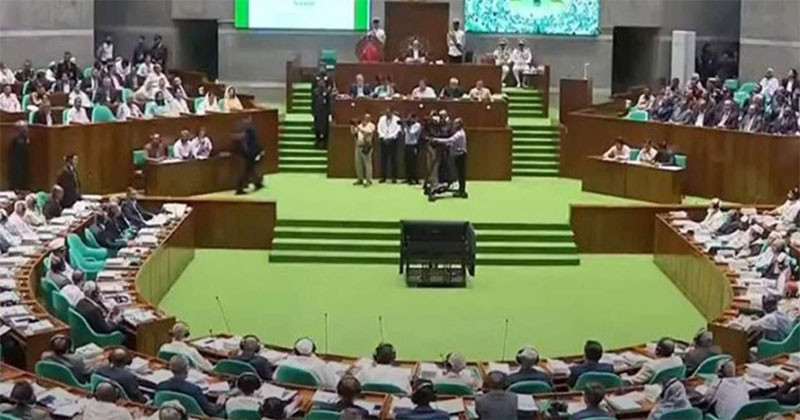
The 13th National Parliament’s third session, which began August 27, ended on September 10 after just 9 working days but generated significant controversy. On its opening day, Home Minister Mr. Salahuddin Ahmed’s dismissive remarks toward opposition MPs caused disorder, prompting Speaker Mr. Hafiz Uddin Ahmed Bir Bikram to say he was worried about parliament’s future and would not continue if such interruptions persisted.
Bills passed:
Six bills were introduced and passed over the nine days, including the National Human Rights Commission bill, an enforced-disappearance prevention bill, and the Property Transfer (Amendment) bill — all passed despite opposition objections. Also passed: a law dissolving RAB and replacing it with a new agency called SRB, and a Bank Resolution law (after a controversial Section 18(a) was dropped following criticism). MPs’ questions numbered 1,678 across various rules, with the Prime Minister personally answering 15. Independent MP Ms. Barrister Rumin Farhana’s remarks caused an uproar at one point. PM Mr. Tarek Rahman outlined the government’s energy plans, including 150 new gas wells, new LNG terminals, and seismic surveys targeted by 2030-31, plus solar power expansion plans.
Standing committees:
50 parliamentary standing committees were formed during the session; only one — the Public Accounts Committee — was chaired by an opposition member, Deputy Opposition Leader Dr. Mr. Syed Abdullah Mohammad Taher. Of the rest, 24 committees include opposition members (22 with three members each, others with two). Chief Whip Mr. Nurul Islam noted that opposition chairmanship of standing committees is historically rare, but that the Public Accounts Committee — one of parliament’s most important for government spending accountability — was given to the opposition.
Property Transfer Law debate:
The amended law allows a person who gifts property to retain usage rights over it for life. It passed by voice vote on August 30 despite objections from Jamaat-e-Islami and allied MPs, who argued it conflicts with Quran, Sunnah, and Sharia principles, and Islamic scholars nationwide also objected. Law Minister Mr. Md. Asaduzzaman argued the new provision doesn’t conflict with existing Muslim “heba” (gift) law or other transfer methods. Motions to send the bill to public opinion review or a select committee were rejected by voice vote, and it ultimately passed by voice vote. Jamaat MP Mr. Najibur Rahman (Pabna-1) called it directly contrary to Quran and Sunnah and noted BNP leaders had promised before the election not to pass such laws; he suggested the 2013 Parents’ Maintenance Act could address the same concern instead. Jamaat MP Mr. Shafiqul Islam (Patuakhali-2) said the bill was creating confusion among Islamic scholars and suggested referring it to a fatwa board. Opposition Leader Dr. Mr. Shafiqur Rahman said he didn’t question the law’s humane intent but argued it creates a contradiction with Sharia’s fixed inheritance rules under Surah An-Nisa, and asked whether lawmakers had the right to set aside Quranic principles — he requested it be sent to Sharia law experts or the Islamic Foundation before passage. The bill passed regardless, by voice vote.
Fertilizer crisis debate:
The government maintained adequate fertilizer stock exists and that new dealers were being appointed to address distribution issues. The opposition, via a motion from Mr. Najibur Rahman under Rule 68, argued the government has failed badly at fertilizer distribution — keeping factories closed while buying costlier fertilizer with public money — and questioned why farmers still can’t get it if stock exists. He drew a parallel to earlier denials about the energy crisis. Jamaat MP Mr. Shafiqul Islam Masud cited a national newspaper report saying farmers are paying above fair price for fertilizer and still not getting it, alleged a minister’s personal warehouse was full of it, and claimed dealer appointments involve corruption, comparing the situation to the 2001-2006 period. Another Jamaat MP, Mr. Mahbubul Alam, cited warehouse-looting incidents in Kurigram’s Nageshwari and Rowmari and farmer unrest elsewhere. Responding, State Minister for Local Government Mr. Mir Shahe Alam said many dealers appointed under the former “autocratic” government remain in place (some absconding), that roughly 3,759 dealer positions are vacant, and that new dealer appointments (one per union) are underway; he accused former-regime-era dealers of trying to create artificial shortages to embarrass the government.
In his closing address, Opposition Leader and Jamaat Ameer Dr. Mr. Shafiqur Rahman said Bangladesh’s foreign policy would no longer operate under any other country’s influence — ties and dialogue with neighbors would continue, and if needed, Bangladesh would stand its ground as an equal, but foreign policy would answer to no one else. His roughly 40-minute speech also covered the political situation, the flight of former “fascist” leaders, India-Bangladesh relations, border killings, the Ganges and Teesta water disputes, the referendum verdict, constitutional reform, justice for the July killings, disparities in MPs’ allocations, the property transfer law, corruption, and the education, industry, and health sectors — drawing broad praise.