The Prophet’s (PBUH) Teachings and Ideals for Poverty Alleviation
Belal Ahmed Chowdhury
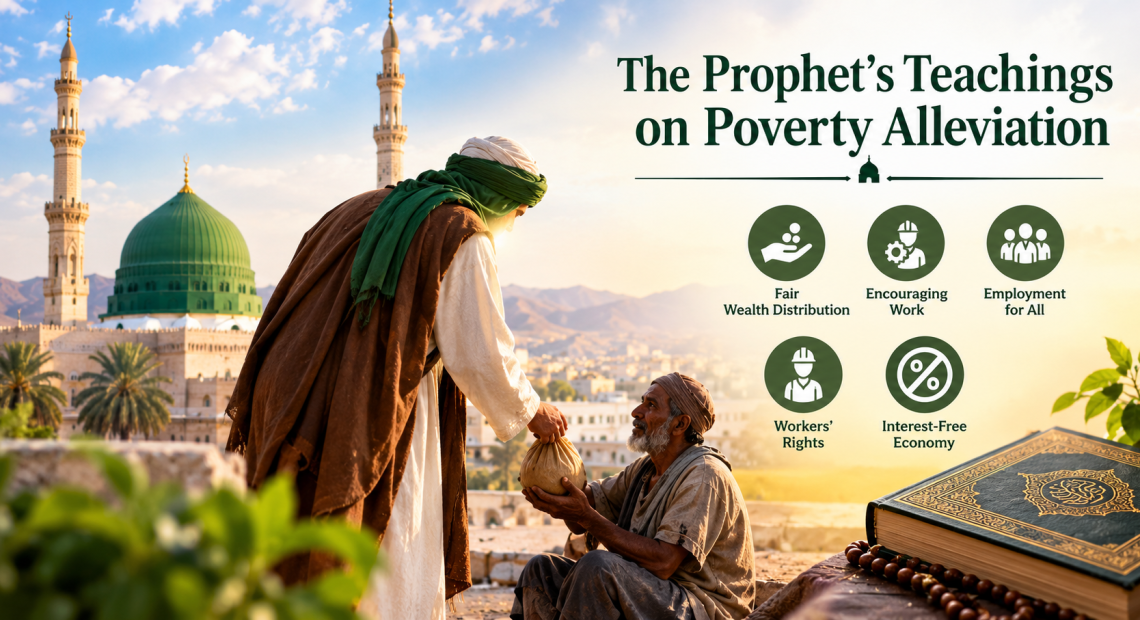
Poverty is a severe curse for humanity. It can push human beings towards an animal-like state. For this reason, the Prophet Muhammad (PBUH) would regularly pray to Allah, saying, “O Allah (SWT), bless our food.” The Prophet Muhammad (PBUH) left humanity a noble example and valuable teachings on poverty alleviation. This article discusses some of his teachings and principles for eliminating poverty.
Changing the Concept of Ownership
Absolute ownership of wealth can create arrogance, lawlessness, and an unrestricted attitude among people. This selfish mindset is at the root of exploitation, which contributes to the spread of poverty in society.
The Prophet Muhammad (PBUH) rejected the concept of absolute human ownership of wealth and sought to remove the exploitative mindset from its roots. In this regard, he conveyed two revolutionary principles to humanity from Allah.
First, sovereignty and ownership belong only to Allah. Human beings are not the ultimate owners of anything in creation, no matter how small it may be. The Holy Quran says, “To Allah (SWT) belongs the dominion of the heavens and the earth. He creates whatever He wills…” Allah also says, “To Allah (SWT) belongs whatever is in the heavens and whatever is on the earth.”
Changing the Concept of Acquiring Wealth
The Prophet Muhammad (PBUH) took another historic step towards poverty alleviation. He fundamentally changed the prevailing concept of acquiring wealth.
For ages, people had believed that earning wealth was the sole purpose of human life and that a person’s status was determined by how much wealth he possessed. In place of this concept, the Prophet Muhammad (PBUH) declared that although wealth is essential for human life, it can never be the sole objective of life.
The Prophet Muhammad (PBUH) conveyed Allah’s (SWT) message to humanity: “Indeed, the most noble of you in the sight of Allah (SWT) is the most righteous of you.” (49:13) After this declaration, the competition for wealth began to decline, and people’s understanding of poverty also began to change.
Encouraging People to Work
One of the most effective ways to remove poverty from society is to remain engaged in productive work. The Prophet Muhammad (PBUH) himself was always engaged in work and encouraged his companions to work. The Prophet Muhammad (PBUH) earned his livelihood through labour, and his hands developed blisters because of his work. Showing his hands, he said, “Allah (SWT) and His Messenger greatly like and love hands that have been injured by labour.”
The Prophet Muhammad (PBUH) always encouraged people to work. He said, “Earning halal livelihood is the most important duty.”
He further said, “There is no food better than that which a person earns with his own hands.” The Prophet Muhammad (PBUH) said, “There are seventy parts of worship, and the highest of them is seeking halal livelihood.”
One day, the companions asked the Prophet Muhammad (PBUH), “What type of earning is the best?” The Prophet Muhammad (PBUH) replied, “The earnings from a person’s own work or the profit earned through honest business.”
Encouraging people to work, he said, “If one of you takes a rope, goes into the forest, cuts wood and carries it on his back, Allah will protect him from begging, in which there is no certainty of receiving anything.” He also said, “Do not sleep after performing the Fajr prayer without engaging in earning your livelihood.”
The Prophet Muhammad (PBUH) himself engaged in trade and also tended goats. In fact, not only the Prophet Muhammad (PBUH), but all the prophets and messengers, including Prophet Dawud (AS), Prophet Adam (AS), Prophet Nuh (AS), Prophet Idris (AS), and Prophet Musa (AS), worked.
In this way, by encouraging people to work continuously, the Prophet Muhammad (PBUH) played a major role in reducing poverty in his society.
Protecting the Right to Employment
One of the major causes of poverty is unemployment. No society can eliminate poverty while people remain unemployed. For this reason, the Prophet Muhammad (PBUH) not only recognised everyone’s right to employment but also ensured opportunities to exercise this right.
In fact, all people are equal in this right, and it is also a human right. No person can be deprived of this natural right. No one can unfairly gain an advantage over another person in this regard.
In the state of Madinah, the Prophet Muhammad (PBUH) opened equal opportunities for everyone to exercise this right. As a result, people could earn wealth through their skills and become financially secure.
Of course, some people could lose their financial stability because of their own inability. But even then, no one had to be deprived of basic necessities. If someone failed to earn a livelihood through his own skills, the state ensured arrangements to meet his basic needs. As a result, no one was left helpless under the burden of poverty.
Declaring the Dignity of Workers
Generally, people from poorer sections of society work as labourers because of financial hardship. They are often exploited and abused by capitalists and industrialists. Due to inadequate wages, they may spend day after day facing hunger and hardship. Poverty becomes a constant companion in their lives.
To protect the working class from such unavoidable poverty, the Prophet Muhammad (PBUH) declared all people to be brothers. He himself took pride in being identified as a worker. Declaring the dignity of workers, he said, “A working and earning person is a friend of Allah (SWT).”
Urging good and equal treatment for subordinate workers and servants, the Prophet Muhammad (PBUH) said, “Give your dependants the same food that you eat and give them the same clothes that you wear.”
Declaring that workers could have equal or even greater dignity than their employers, the Prophet Muhammad (PBUH) said, “It is not unusual that a worker may be superior in dignity to his employer. It is also not impossible that the actions of a servant under someone’s authority may be more pleasing to Allah.”
Regarding workers’ safety, he said, “A worker must not be forced to do work that will make him incapable or unfit for work.” He further said, “They may be given only as much work as they are capable of doing.” To protect workers from exploitation, he declared, “Pay the worker his due before his sweat dries.” He also said, “Do not employ a worker without determining his wages.” According to him, “Workers, labourers and servants must be properly provided with food and clothing.”
Giving Workers a Share of Production Profits
To reduce the financial hardship of workers and employees, the Prophet Muhammad (PBUH) created a historic precedent by recognising workers’ rights to a share of profits. According to the principles he introduced, workers’ food, clothing, and housing could not be below the standard of living of their employers.
The Prophet (PBUH) declared, “Give workers a share of the products they produce. For these workers, the servants of Allah (SWT), must not be deprived of anything.” The Prophet Muhammad (PBUH) also said, “I will complain against three types of people. One of them is the person who employs a worker, takes full benefit from his work, and then does not pay the worker his wages.” The Prophet Muhammad’s (PBUH) declaration was revolutionary in eliminating poverty among workers and establishing their economic security.
Abolishing Interest
Interest is one of the strongest means of exploitation in society. Because of interest, the poor become poorer and the rich become richer. Poor and needy people, finding no other source of assistance in times of need, are often forced to take interest-based loans.
Because borrowers are required to repay the interest, they may sometimes have to sell their movable and immovable property to repay the principal along with interest. As a result, poverty continues to increase rapidly.
It is known that during the time of the Prophet Muhammad’s (PBUH) emergence, compound interest was widely practised in Arab society.
To protect humanity from the terrible and harmful effects of interest, the Prophet Muhammad (PBUH), in accordance with Allah’s command, prohibited interest and created conditions for investment and production to reach their highest levels.
The prohibition of interest created greater balance and fairness in the distribution of wealth. With the establishment of an interest-free economy in Madinah, the economy was protected from interest-driven inflation, rising prices, recession, and instability, while a healthy environment for investment and production was maintained. Exploitation and inequality created through interest were reduced. Consumers were relieved of interest-related costs, increasing their economic capacity. (To be continued)
Author: Poet and Columnist