Mujtaba Ali: A Master of Humorous Literature
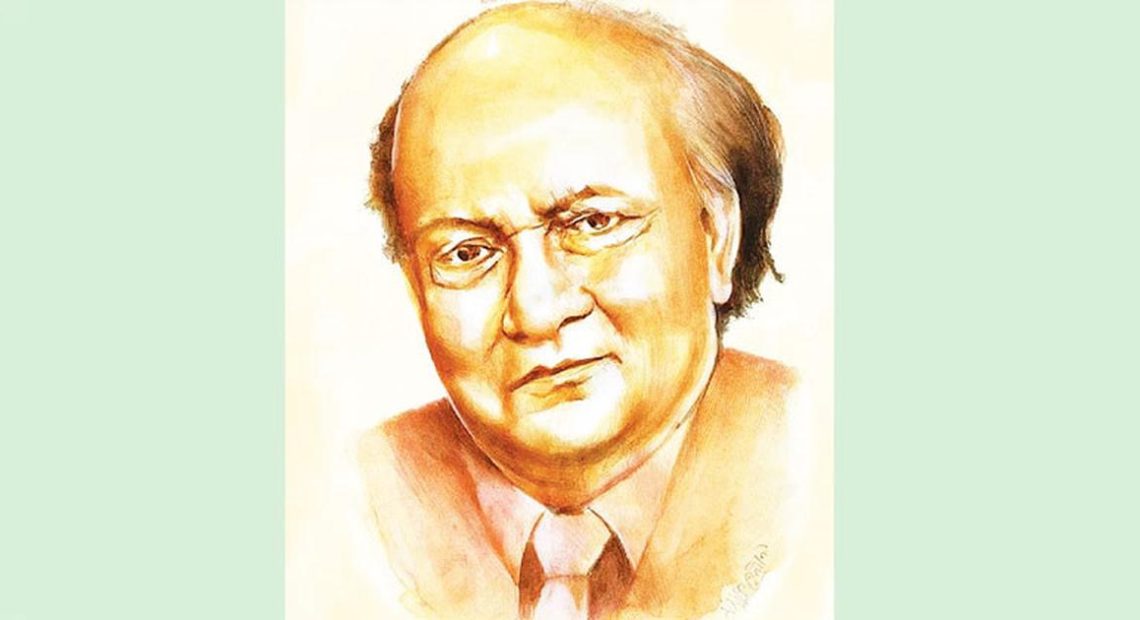
Aftab Chowdhury
A towering figure of Bangla literature, Syed Mujtaba Ali was born in Karimganj, Sylhet, on September 13, 1904, and died in Dhaka on February 11, 1974. He excelled in travel writing, short stories, novels and humorous literature. However, it was in humorous writing that his style was particularly distinctive. No other Bangla writer has so far been able to successfully imitate or reproduce his unique literary voice.
A multilingual writer, Mujtaba Ali incorporated words, expressions, spellings, pronunciations, idioms and proverbs from numerous languages into his works. He could effortlessly place Bangla, Urdu, Arabic, Persian, French and English words side by side in the same sentence. He could also combine formal and colloquial Bangla, as well as words of Sanskrit, indigenous and foreign origins, without making the writing feel linguistically awkward.
He could easily bring together formal literary words with dialects from Sylhet, Dhaka, Mymensingh and Barishal, making his writing appealing to readers from all backgrounds. Above all, he had a remarkable conversational style, enriched with humour, satire and gentle wit. While telling a story, he could suddenly introduce a dramatic twist that left readers pleasantly surprised.
Panchatantra is one of Mujtaba Ali’s famous books of humorous writings. Each piece in the collection is captivating. His essay Boikena (“Buying Books”) is a notable example. He discusses both the Bengali reader’s strong interest in reading and their reluctance to buy books. Through witty satire and dramatic turns, he humorously explains why Bengali readers are reluctant to purchase books.
In the essay, Mujtaba Ali refers to the idea that flies have numerous eyes around their heads and can therefore see the entire world at once. He says that the learned Anatole France supposedly lamented that if he had eyes around his head like a fly, he could see the complete beauty of the earth at once. Yet France also suggested that although humans cannot increase the number of their physical eyes, they can expand their “eyes of the mind” through reading books.
To illustrate the importance of expanding the mind, Mujtaba Ali refers to Bertrand Russell’s observation that one of the main ways to escape the troubles of life is to create a world within the mind and retreat into it during difficult times. The more worlds a person can create, he suggests, the greater their ability to escape suffering.
Mujtaba Ali’s love of food is evident in his piece Aharadi. It is through him that readers learn that Hungarian goulash is essentially another version of an ordinary meat curry, while Italian risotto resembles pulao, though not exactly the kind prepared in this country. He humorously explains that if the koftas of kofta pulao were cut into small pieces and mixed with the rice, the result would be something like risotto.
Describing the taste of risotto, he writes in his characteristic humorous style that if a friend is both a connoisseur and a good cook and serves Italian risotto with goulash, it would be impossible to drag a person away from the restaurant even with an elephant. For the rest of the days in Europe, one would want to cling to the restaurant table like a kitten.
Mujtaba Ali also demonstrated his literary brilliance in portraying love. His piece Nevar Radha illustrates the idea that true love means sacrificing one’s own interests and desires to make another person happy. The story concerns renowned writer Ivan Turgenev and a young woman from an ordinary fisherman’s family. Mr. Turgenev became attracted to her while staying by the Neva River to recover from illness and poor health. When he later prepared to return to Paris, the girl wept at the prospect of separation.
Mr. Turgenev promised to return and asked what he could bring her from Paris. She requested only some perfumed soap. When asked why she wanted such a simple gift, she explained that she knew he loved kissing her hands, but they always smelled of fish because of her family’s work. She had heard that French perfumed soap could remove the smell, so he would not notice the odour when kissing her hands.
This touching story demonstrates Mujtaba Ali’s ability to present profound emotions through simple yet powerful details.
His extraordinary poetic talent is also evident in Marjar Nidhan Kando. Written in payar and tripadi metres and enriched with Bengali, Arabic and Persian vocabulary, the poem is a remarkable example of his versatility. A few lines read:
“In Iran lived twin young maidens,
With beauty, style and countless virtues laden.
One resembled Laila, another Shirin,
Lightning flashed in their eyes, music played on their lips.”
The poem’s central message is humorously expressed through the advice that, to keep one’s wife under control, a husband should “kill the cat” on the first night of marriage; otherwise, everything would be ruined.
Mujtaba Ali was equally skilled in composing graceful prose with a poetic quality.
Through his ability to choose appropriate language for diverse subjects and moods, Mujtaba Ali made his writings entertaining and rich in flavour. Humorous writing can be created on almost any subject. But to turn it into timeless literature requires a refined sense of humour, intellectual richness and an engaging style of presentation.
Mujtaba Ali possessed all these qualities. Above all, he had a profound sense of humour and a deep understanding of life. That insight into life was the key to creating his exceptionally delightful and enduring humorous literature.
The author: Journalist and columnist.