Is Bangladesh Reshaping Its Defence Strategy
Dawn
On August 27, 2026, 55 acres of land belonging to a long-closed textile mill in Fauzihat, around 245 kilometres southeast of Chattogram city, were handed over to the Bangladesh Army. The authorities are planning to establish factories there to manufacture modern weapons, ammunition and military equipment.
Army Chief General Waker-Uz-Zaman said the initiative is part of efforts to strengthen the country’s defence capabilities. At the land handover ceremony, he said, “We have decided that whatever we use, we will make it ourselves. Because it is not possible to conduct a war by importing everything from abroad.”
However, viewing the Fauzihat initiative as merely a single project would overlook its broader significance. Bangladesh’s efforts to acquire fighter jets from China, jointly produce unmanned aerial vehicles (UAVs or drones), expand defence cooperation with Turkey, and discuss the possibility of joining the proposed “Mecca defence alliance” raise a bigger question about the country’s overall security policy.
The question is: Is Bangladesh reshaping its defence strategy after 2024, or are these developments part of a long-term process of military modernisation? Through efforts to build its own defence industry, increase military cooperation with China and Turkey, and show interest in the Mecca alliance, Bangladesh is redefining the outline of its security policy. At the same time, these changes are also affecting Bangladesh’s relations with India.
President of the Bangladesh Enterprise Institute (BEI) and former Bangladesh ambassador to the United States M Humayun Kabir believes the effort to strengthen military capabilities is linked to the sense of national confidence and self-reliance that emerged among Bangladeshis after 2024. That year, a student-led mass uprising ended Ms. Sheikh Hasina’s 15-year rule and brought political change. He said the current interest in strengthening military capabilities reflects the idea that “If necessary, we can ensure our own security ourselves.”
However, security analyst Air Commodore (retd) Ishfaq Elahi Chowdhury does not agree with viewing these steps directly as a result of the political changes. He said, “Military strategy and foreign policy are long-term matters. I do not think that a single event, such as July 2024, can fundamentally change these policies.”
Whatever the case, Bangladesh’s recent steps cannot be explained only by the need to replace old military equipment. According to Mr. Humayun Kabir, the changing security environment in South and Southeast Asia is also influencing Bangladesh’s thinking. Along with tensions between India and Pakistan, the Rohingya crisis and the Myanmar border are major concerns for Bangladesh. He noted that the impact of Myanmar’s military operations on Bangladesh has made the need to strengthen the country’s own air defence system even clearer.
On the other hand, Professor Dr Delwar Hossain of the Department of International Relations at the University of Dhaka rejected the idea of turning Bangladesh into a military power. He said the country is mainly trying to address gaps in its defence capabilities.
New Partners
China has long been a major source of military equipment for Bangladesh. However, one notable aspect of recent initiatives is that defence relations with China are no longer limited to buying military equipment. In January 2026, the Bangladesh Air Force and China Electronics Technology Group Corporation International signed an agreement to establish a drone production and assembly centre in Bangladesh, including technology transfer. Later, in August, an aide to the Chief Adviser said that a draft proposal had been prepared to purchase China’s J-10CE fighter jets and attack helicopters.
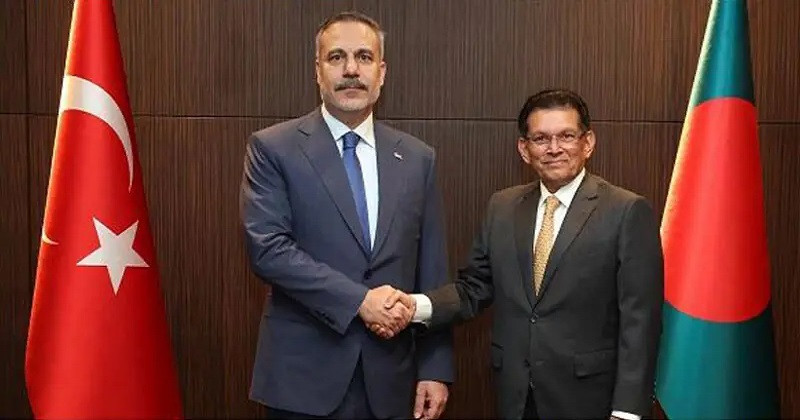
Defence cooperation between Bangladesh and Turkey is also expanding. Turkish Foreign Minister Hakan Fidan visited Bangladesh in June this year and discussed the formation of a joint committee at the defence and foreign ministry levels of the two countries. In July, Bangladesh announced plans to establish a drone manufacturing plant in Bogura with Turkish cooperation.
The Fauzihat initiative and the proposed drone factory in Bogura both point towards a new defence policy for Bangladesh. The country is not only diversifying its sources of military equipment but is also focusing on increasing domestic production and technological capabilities.
Mecca Alliance and Regional Calculations
While Bangladesh’s defence cooperation with China and Turkey is mainly focused on weapons, technology and production capabilities, the “Mecca alliance” raises a different question about the country’s security policy. In August 2026, Saudi Arabia, Turkey and Pakistan signed an agreement called the “Mecca Defence Alliance.” Although Bangladesh is not a member, Foreign Minister Dr Khalilur Rahman told Parliament on August 27 that Bangladesh would “positively consider” joining the alliance if the member states showed interest.
However, questions have emerged over how joining such an alliance would fit with Bangladesh’s long-standing non-aligned foreign policy. Mr. Humayun Kabir believes Bangladesh should carefully consider its strategic independence before joining the alliance. He said, “We have not joined any military alliance for more than five decades.”
In his view, the right approach is: “We will not join anyone’s alliance, but we will maintain relations with everyone while protecting our own interests.” Ishfaq Elahi Chowdhury also questioned the strategic value of joining the alliance. According to him, Bangladesh’s main security concerns are centred on South and Southeast Asia.
Therefore, the logic of joining a military alliance focused on a distant region needs to be carefully considered. Bangladesh’s efforts to strengthen its defence capabilities are certain to attract New Delhi’s attention. Both the purchase of fighter jets from China and possible participation in the Mecca alliance could influence India’s regional security calculations.
So far, India’s position has been to closely monitor the developments. After Bangladesh’s Foreign Minister made a positive comment about joining the Mecca alliance, India’s Foreign Ministry said it was closely watching issues that could affect India’s national security.
Analyst Dr Delwar Hossain believes Bangladesh does not intend to threaten any country. However, he acknowledged a key concern, saying, “If Bangladesh’s military capabilities increase, even its current friendly countries may think that Bangladesh is becoming much more powerful.”
New Dependence or Strategic Independence?
The key question is whether obtaining weapons and technology from different countries will give Bangladesh greater strategic independence or simply reduce dependence on one country while creating new dependence on another. Increasing domestic capacity to manufacture weapons and military equipment would give Bangladesh an alternative in situations where external supplies are disrupted. However, sustaining such an industry would require technology, financing, skilled manpower and an uninterrupted supply of necessary components.
It is still unclear whether Bangladesh is moving towards a new security alignment or whether its expression of interest in joining the Mecca alliance is simply part of a diplomatic strategy. One possible explanation is that keeping the option of joining the Mecca alliance open could give Dhaka additional leverage in negotiations with India and other regional powers. Therefore, the key issue is not simply whether Bangladesh joins the alliance. The more important question is how far it can use this opportunity to strengthen its own position in the region’s political arena.
According to former diplomat Mr. Kabir, maintaining strategic autonomy, or according to Professor Mr. Hossain, addressing gaps in the defence system—whatever the objective may be, both views highlight a major truth. The more Bangladesh seeks to strengthen its defence capabilities, the more the question will arise: How will these capabilities be developed, and how much can dependence on foreign countries actually be reduced?
The land where yarn and textiles were once produced will now be used to manufacture weapons. Bangladesh’s future security strategy will not depend only on what is produced domestically. It will also largely depend on how the country maintains its autonomy while balancing its relations with the outside world.