

Awake Brain Surgery Stops Patient’s 10-Year Hand Tremor
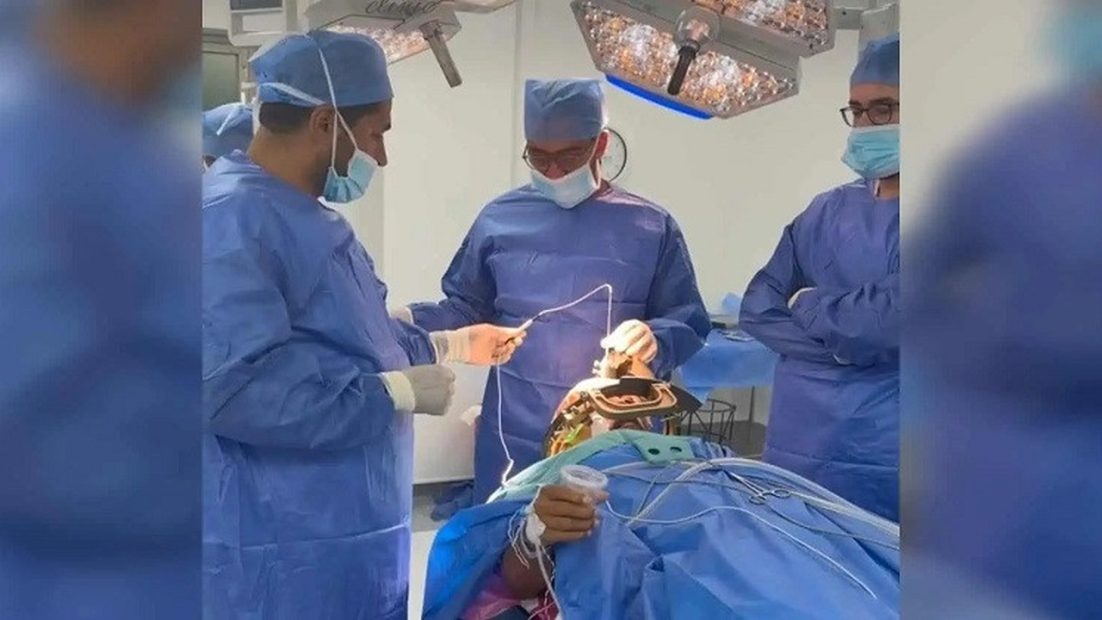
An Egyptian neurosurgeon has successfully performed a rare and complex brain surgery in which the hand tremor of a Parkinson’s patient who had suffered from the condition for 10 years completely stopped during the operation. The entire procedure was recorded on video and shared on social media to raise awareness. The video has already received widespread attention.
Dr. Ali Salah, a consultant in functional neurosurgery at the Faculty of Medicine of Suez Canal University, performed the complex surgery on a Saudi patient named Ahmed Al-Zahrani. The patient was kept fully conscious during the procedure using local anaesthesia, allowing him to talk to and respond to the medical team throughout the surgery.
Dr. Salah later shared a video of the surgery on his Instagram page. At the beginning of the video, Mr. Al-Zahrani can be seen holding a glass of water while his hand is shaking severely. As the surgery progresses, however, the shaking completely stops, and he is able to hold the glass steadily without spilling any water.
In the caption, Dr. Salah wrote, “After 10 years of suffering and pain, the tremor stopped at this very moment.” However, he noted that treatment outcomes can vary from patient to patient, and only a careful assessment by specialists can determine whether a patient is suitable for the surgery. The patient himself agreed to have the procedure recorded and shared to raise awareness among other people with Parkinson’s disease.
How Was the Surgery Performed?
The Egyptian doctors carried out the entire procedure step by step. First, patient Mr. Al-Zahrani sent videos showing his physical condition, including his tremor and muscle stiffness. After reviewing the videos online, Dr. Salah and his team checked for other health conditions, such as diabetes and high blood pressure. The patient then travelled to Cairo for a final in-person assessment.
Before the surgery, CT and MRI scans were performed, and specialised software was used to create a three-dimensional map of the patient’s brain. Dr. Salah said the doctors targeted a specific thalamic nucleus measuring only about 1 millimetre.
Using a special navigation device, the doctors mapped a safe path from the skin to the thalamus and inserted a radiofrequency needle. Dr. Salah compared the navigation system to a sniper rifle, saying that it identifies the precise target and guides the needle accurately to the intended location. Thermal energy was then applied to treat the specific area responsible for producing abnormal signals.
What Is Parkinson’s Disease?
Parkinson’s disease is a progressive neurological disorder that affects normal nerve function and body movement. Its main symptoms include shaking of the hands and legs, muscle stiffness and slowed movement. The condition is usually managed with medication. However, specialised surgery of this kind may be considered for patients whose symptoms do not respond adequately to medication or remain difficult to control.