Dhaka’s Air Quality ‘Moderate’, Kolkata Tops Global Pollution List
Rising dust, smoke, and fine particulate matter continue to disrupt daily life as climate change and ongoing development drive air pollution levels higher across major global cities.
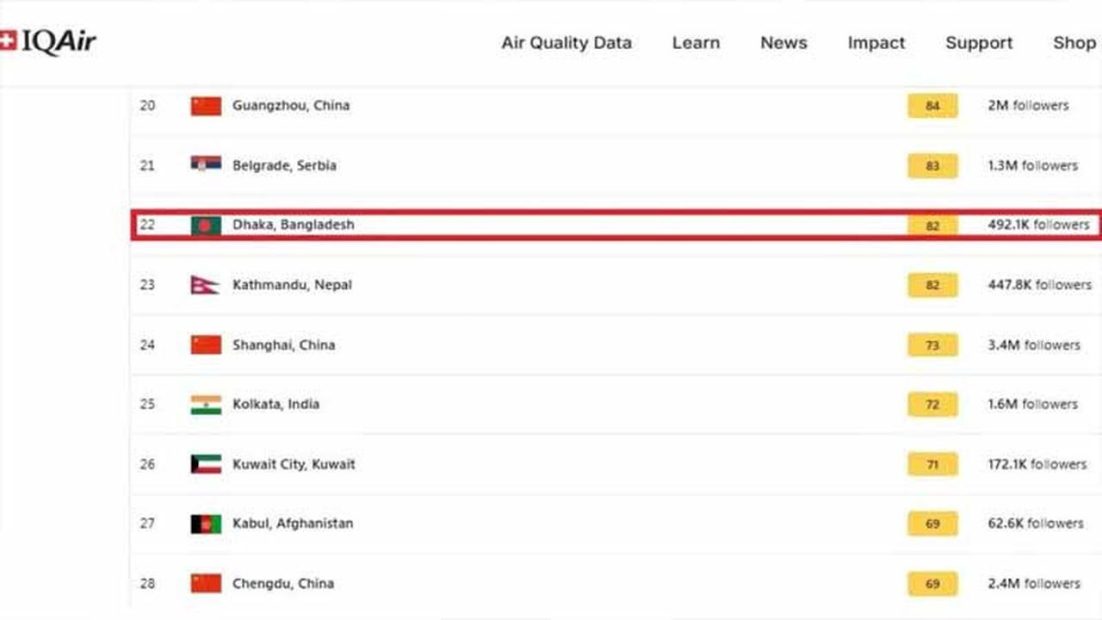
Bangladesh’s capital, Dhaka, ranked 22nd on the global list with an Air Quality Index (AQI) score of 82, categorized as ‘moderate’. Meanwhile, Kolkata, India, topped the ranking with an AQI score of 189, which is considered ‘unhealthy’.
The figures were released on Monday (September 21) by Swiss-based air quality technology company IQAir.
According to IQAir, Kolkata led the list of polluted cities with a score of 189, followed by Lahore, Pakistan (174); Hanoi, Vietnam (171); Doha, Qatar (166); and Kinshasa, Democratic Republic of the Congo (163).
IQAir classifies air quality scores between 0 and 50 as ‘good’.
Scores between 51 and 100 are considered ‘moderate’, 101 to 150 ‘unhealthy for sensitive groups’, 151 to 200 ‘unhealthy’, 201 to 300 ‘very unhealthy’, and ratings above 301 ‘hazardous’.
In Bangladesh, the AQI is measured based on five criteria pollutants: particulate matter (PM10 and PM2.5), nitrogen dioxide (NO2), carbon monoxide (CO), sulfur dioxide (SO2), and ozone (O3).
A March 2019 report by the Department of Environment and the World Bank identified brick kilns, vehicular emissions, and construction dust as the three main sources of air pollution in Dhaka.
According to the World Health Organization (WHO), air pollution increases mortality from stroke, heart disease, chronic obstructive pulmonary disease, lung cancer, and acute respiratory infections, causing an estimated 7 million premature deaths globally each year.