Solar Power Drives Bangladesh Towards Energy Self-Reliance
Recent instability in the Middle East, rising international oil prices, and uncertainty in power generation costs have created new challenges for Bangladesh’s economy. Concerns are growing over electricity costs and reliable supply across residential, commercial, agricultural, and industrial sectors.
In this situation, solar power is becoming increasingly popular. Renewable energy is playing a major role in reducing dependence on imported fossil fuels. Tax breaks in the current fiscal year’s budget have helped this sector expand rapidly.
Joint efforts by the government and private sector have opened a new chapter for solar power in the country’s energy sector. According to the Sustainable and Renewable Energy Development Authority, Bangladesh’s total renewable energy capacity has already crossed 1,800 megawatts. Of this, about 1,534 megawatts comes from solar power.
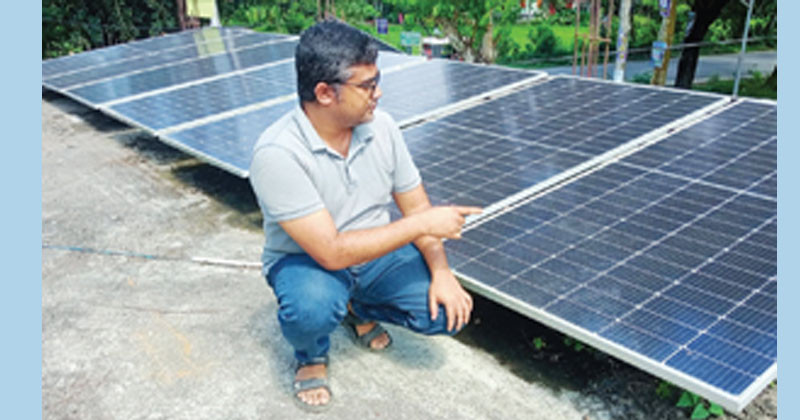
Large solar parks and grid connected solar plants have been set up in Gaibandha, Feni, Sirajganj, and Jamalpur. The biggest recent growth has come from rooftop solar technology. Rooftop solar panels have become especially popular on commercial buildings and garment factories.
According to international research organization IEEFA, the rooftop solar capacity in the commercial and industrial sector has reached 1,000 megawatts, or 1 gigawatt. Under the government’s net metering policy, customers can meet their own needs and sell surplus electricity to the national grid.
To encourage solar adoption, the government has announced a special policy through 2030 that will pay 10 taka 50 paisa per unit for solar electricity. The government has also made it mandatory for all district administration offices and about 46,000 government and educational institutions to install solar panels to help address the power crisis.
State Minister for Power, Energy, and Mineral Resources Mr. Anindya Islam Amit said the government has finalized specifications to ensure quality solar equipment imports. He explained that the Power Division is working to keep low quality products out of the Bangladesh market.
Prime Minister Mr. Tarique Rahman has directed that solar panels be installed in phases at all major government buildings, including the National Parliament House, Bangabhaban, and the Prime Minister’s Office. He said the National Parliament will run on solar power within a few months. He also stressed the need for an effective economic model to make solar power affordable, accessible, and profitable for the general public.
Member of Parliament Engineer Mr. Md. Ashraf Uddin spoke about efforts to make renewable energy equipment more affordable. He said the government has exempted duties and VAT on solar equipment imports to help meet the target of generating at least 20 percent of national electricity demand from renewable sources by 2030. He added that rooftop solar and solar irrigation are being actively promoted.
In remote areas outside the main power grid, solar energy has brought major change to rural economies. More than 6 million solar home systems now provide light in off grid areas across the country.
Solar irrigation pumps are being widely used nationwide to reduce dependence on costly and polluting diesel pumps. This has lowered farmers’ production costs and helped reduce environmental pollution.
To ensure energy security, the government has adopted a master plan to generate 5,000 megawatts of electricity from solar power within the next five years. To boost private sector participation in reaching this goal, new agreements have already been signed with 12 leading companies to connect 918 megawatts of power to the national grid.
According to the National Board of Revenue, known as NBR, this year’s budget offers several important tax and duty benefits to expand the solar power sector. Duties and advance tax on imports of solar panels and related key components have been withdrawn, a benefit that will remain in place until 2031.
Tax free benefits for solar power generation have been extended until 2035. Users get a 5 percent tax rebate on solar electricity bill payments. NBR has also cut duty and tax on solar equipment imports from 17 percent to just 1 percent.