

Capital Chaos: The Street Hawker Crisis
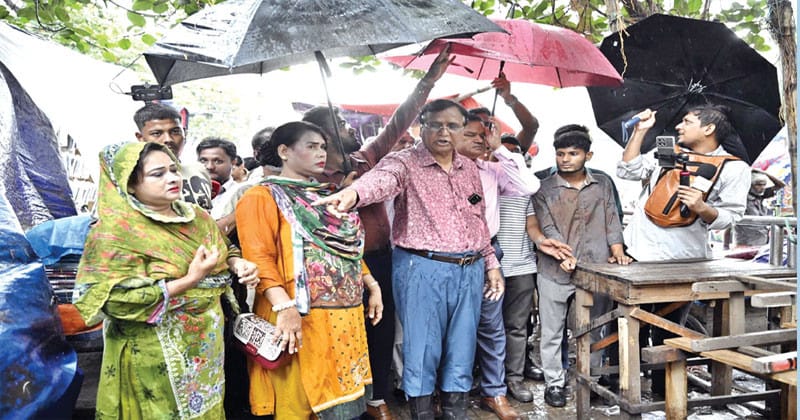
A significant portion of Dhaka’s major roads and footpaths has long been illegally occupied by hawkers, creating severe obstructions for daily pedestrian movement and rendering walkways completely unusable near markets, bus terminals, and commercial hubs. In response to widespread public complaints regarding worsening traffic congestion and heightened risks of road accidents, the Dhaka South City Corporation (DSCC) initiated a major eviction drive covering the primary thoroughfare stretching from the Paltan Intersection through Gulistan Zero Point to North South Road to restore public order.
Emphasizing the necessity of strict enforcement, DSCC Administrator Freedom Fighter Md. Abdus Salam stated to The Daily Inqilab that hawkers will strictly not be permitted to conduct business on primary roads, though an organized management framework has been formulated to consider their livelihoods. He firmly warned that chaos caused by haphazard vendor setups will not be tolerated and immediate legal action will follow any defiance of the ban along the key Paltan-Gulistan corridor, asserting, ‘There is no alternative to strict measures to ensure standard civic amenities and uninterrupted movement in Dhaka city.’
To achieve a long-term resolution without compromising livelihoods, the Local Government Division has officially released the ‘Dhaka City Hawker Management Guidelines-2026’ to establish a clean, pedestrian-friendly capital free from traffic bottlenecks. Under the new policy applicable to both DSCC and DNCC, hawkers must complete a one-time registration for BDT 5,000, pay an annual renewal fee of BDT 2,500, and contribute BDT 3,000 monthly for space usage and waste management, after which they will receive digital identity cards containing barcodes and QR codes to verify their designated spots and schedules.
Under these regulations, vendors are strictly barred from main roads and are permitted only on select wide footpaths while keeping pedestrian pathways clear, alongside new provisions for holiday and night markets in commercial zones. Holiday markets will function on Fridays, Saturdays, and public holidays from 7:00 AM to 5:00 PM, whereas night markets will operate after office hours from 6:00 PM to 10:00 PM, excluding sensitive locations like playgrounds, places of worship, or graveyards, while reserving a 30 percent allocation quota specifically for women and individuals with disabilities.
Reflecting on the severe daily hazards faced by ordinary citizens, Gulistan pedestrian Mr. Saiful Islam shared his frustration regarding the local conditions, highlighting how temporary structures, displayed goods, and crowded stalls completely obscure footpaths and force residents into traffic. ‘All roads in Dhaka have wide footpaths, but they have been encroached upon. The situation in Gulistan is particularly difficult. In many spots, there isn’t even space to walk,’ he remarked, underscoring why city residents are routinely compelled to walk on dangerous main roads alongside motor vehicles.
Highlighting the urban planning perspective, Professor Dr. Adil Mohammad Khan, Executive Director of the Institute for Planning and Development (IPD), told The Daily Inqilab that clear footpaths are vital for pedestrian safety and overall traffic order, though sustainable success requires curbing extortion, improving public transport, and maintaining disability-friendly infrastructure. He explained, ‘Footpaths are primarily designated for pedestrian movement. If footpaths are kept clear, pedestrians can travel safely, which can also restore some order to vehicular traffic,’ while emphasizing that hawkers’ livelihoods and low-income buyers’ access to affordable goods must remain balanced.