

China develops advanced handheld submarine-detecting device
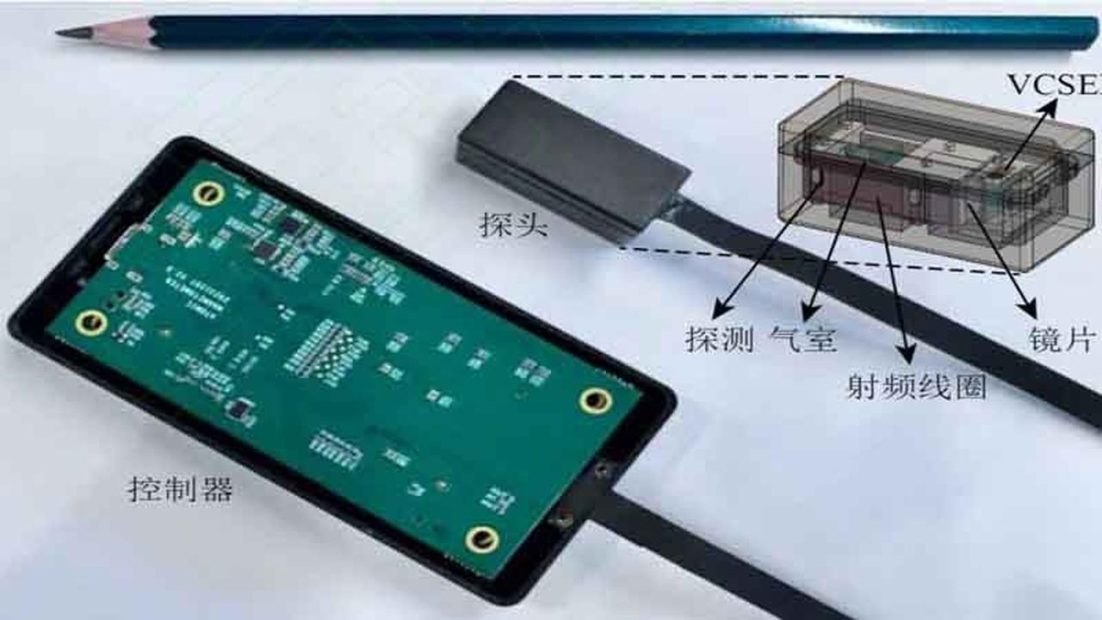
China has recently developed an advanced handheld quantum magnetometer capable of detecting submarines on the seabed more accurately and at a higher speed than conventional devices.
The device, developed by Peng Xinhua of the University of Science and Technology of China and his colleagues, was designed by tracking the movement of a subway train. It successfully detected the train slowing down, stopping as it entered a station and restarting under engine power.
The compact technology was primarily developed for anti-submarine warfare, where detecting magnetic anomalies caused by submarines is an important method of locating them. It can also be used for navigation and positioning, mineral exploration, mine clearance, monitoring urban traffic, detecting faults in underground metal pipelines and locating unexploded ordnance.
Measuring 0.4 cubic inches, the quantum magnetometer is slightly larger than a pencil and operates on 5 watts of power. In the low-frequency range of 0.1 to 10 hertz, it has a sensitivity of about 10 picoteslas per square root hertz. This allows it to distinguish magnetic disturbances generated by a moving train from the Earth’s background magnetic field.
While more sensitive devices, such as conventional superconducting quantum interference devices and spin-exchange relaxation-free atomic magnetometers, generally require extremely low temperatures or complete magnetic shielding, this compact device is designed to operate in magnetically complex and moving environments.
The researchers said the system checks signal strength, maximum amplitude and stability to maintain reliable measurements. When the magnetic field changes rapidly, its strength or source varies, or the field becomes uneven, the device scans the entire frequency range, identifies the source centre again and returns to a “locked” state in less than one second.
The research paper reported a slew rate of 25,200 nanoteslas per second, about 2.5 times the roughly 10,000 nanoteslas-per-second rate of the MG magnetometer developed by US-based QuSpin.
Source: South China Morning Post