Xi Jinping’s Role in Bangladesh’s Development
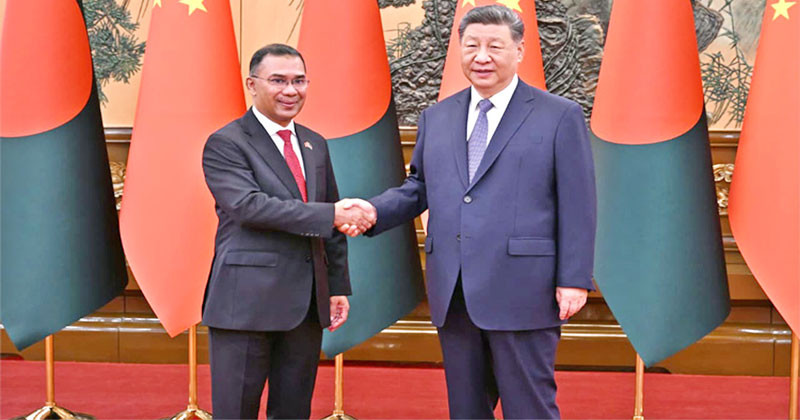
Under the leadership of Xi Jinping, Bangladesh-China relations have moved from strategic cooperation to a new phase focused on building a “community with a shared future.” Alongside infrastructure, technology, energy and trade, new areas of cooperation are emerging in artificial intelligence and the digital economy. China also has scope to expand cooperation with Bangladesh on regional connectivity, the Teesta and water management, maritime cooperation and resolving the Rohingya crisis.
From grassroots to the centre of China’s leadership
As China celebrates its 77th National Day on October 1, 2026, it is timely to look back at the significant progress in Bangladesh-China relations during Xi Jinping’s leadership. Understanding Xi Jinping is important for Bangladesh not only because he leads a major global power, but also because his leadership has coincided with an important period in the development of Bangladesh-China relations.
My own association with China began in 1988, when I first travelled to Beijing on a government scholarship and began studying at the then Beijing Language Institute, now Beijing Language and Culture University (BLCU). Since then, China has remained an important part of my professional and personal life as a Chinese language student and graduate, interpreter, teacher, researcher and close observer of Bangladesh-China relations.
Xi Jinping’s political journey began at the grassroots level and eventually took him to the top of the Communist Party and the Chinese state. Born in 1953, Xi spent part of his adolescence in Liangjiahe village in Shaanxi province, where he was sent as an “educated youth.” He later studied at Tsinghua University and held various positions in Fujian, Zhejiang and Shanghai before reaching China’s top leadership.
This broad experience exposed him to rural development, local administration, reform, investment and economic development at different levels. In 2012, he became general secretary of the Central Committee of the Communist Party of China, and in 2013 he became president of China. During his leadership, China has undergone major changes in modernisation, infrastructure, technology and poverty reduction. People may have different views of China’s political system and specific policies, but the scale of China’s transformation during this period is significant.
Xi Jinping and Bangladesh: A deeper relationship
Xi Jinping first visited Bangladesh in June 2010, when he was China’s vice president. During his June 14-15 visit, he met Bangladesh’s political leaders. The two countries discussed strengthening their “closer comprehensive cooperative partnership,” with talks covering connectivity, infrastructure, trade, investment and broader development cooperation.
One notable event during the visit was Xi’s meeting with then opposition leader Khaleda Zia. On June 15, she led a nine-member delegation to meet Xi Jinping at the Pan Pacific Sonargaon Hotel. They discussed infrastructure, connectivity, economic cooperation and defence cooperation. Contemporary reports also mentioned that Xi invited her to visit China.
During my active military career, I had several opportunities to work as an interpreter for former prime minister Khaleda Zia in China-related activities. However, I did not have the opportunity to work as an interpreter for Xi Jinping because I retired from the Bangladesh Army at the beginning of 2008. My subsequent work in Chinese language education and China-related activities allowed me to continue following the development of relations between the two countries.
2016: A major turning point
Xi Jinping visited Bangladesh again as president in October 2016. His state visit on October 14-15 became an important milestone in bilateral relations. During the visit, Bangladesh and China agreed to elevate their relationship to a strategic partnership of cooperation. Discussions covered infrastructure, energy, transport, information and communication technology, agriculture, water, maritime affairs and people-to-people exchanges.
The importance of the 2016 visit went beyond the agreements and memorandums signed during the trip. It created a broader framework for China’s involvement in Bangladesh’s development, including railways, roads, electricity, telecommunications, water management and other infrastructure. At the same time, bilateral relations became increasingly linked to Belt and Road cooperation, connecting Bangladesh’s development priorities with wider regional connectivity.
From strategic partnership to a shared future
In July 2024, Bangladesh and China agreed to elevate their relations to a comprehensive strategic cooperative partnership. Cooperation expanded in areas including development, trade and investment, infrastructure, agriculture, water resources, technology, digital development and people-to-people exchanges. In 2025, the two countries celebrated the 50th anniversary of the establishment of diplomatic relations, with the year observed as a year of people-to-people exchanges.
These milestones show that Bangladesh-China relations have moved beyond traditional trade and development cooperation into broader areas such as infrastructure, manufacturing, technology, education, human resource development, maritime cooperation and people-to-people connectivity.
2026: A new chapter
On June 26, 2026, Chinese President Xi Jinping met Bangladesh Prime Minister Tarique Rahman in Beijing. The two leaders announced their decision to build a community with a shared future for Bangladesh and China in the new era and further elevated bilateral relations. Their discussions covered political communication, high-quality Belt and Road cooperation, trade, connectivity, agriculture, technology, green development, education and health. New energy, the digital economy, information technology and artificial intelligence, industry and supply chains, financing and regional connectivity were also identified as promising areas of cooperation.
These areas could become particularly important in Bangladesh’s next phase of modernisation. Cooperation in artificial intelligence, digital transformation, information and communication technology, green energy, skills development and technology transfer could create new opportunities for young people, businesses and industries in both countries.
The two countries have also placed importance on ports, water management, the Chinese economic and industrial zone in Chattogram, maritime cooperation and broader regional connectivity. The China-Myanmar-Bangladesh Economic Corridor could create new opportunities for Bangladesh to connect with China’s southwestern region and wider regional markets.
Looking ahead
I personally hope President Xi Jinping will visit Bangladesh again. I would also welcome future visits by senior leaders of the Communist Party of China and the People’s Liberation Army (PLA). Such visits could provide opportunities for broader discussions on regional peace, security, development and practical cooperation.
A future visit could also open discussions on the next generation of Bangladesh-China cooperation, including appropriate defence technology cooperation, assistance in resolving the Rohingya crisis, further development of Chinese economic and industrial zones, regional connectivity, management of the Teesta and other water resources, maritime and blue economy cooperation, artificial intelligence and digital transformation, new energy, skills development, healthcare, and greater opportunities for Bangladeshi products and skilled workers in the Chinese market.
Some proposals discussed in Bangladesh include establishing a larger Bangladesh-China complex outside Dhaka, expanding Chinese language and technical training, and improving connectivity with southwestern China. These remain aspirations or proposals rather than confirmed projects. Their practical value will depend on feasibility, mutual agreement and Bangladesh’s national priorities.
From witnessing China’s rise to building a shared future
My journey with China began in Beijing in 1988. Since then, I have witnessed China’s remarkable transformation and the development of Bangladesh-China relations through different stages. For me, therefore, Xi Jinping’s story is not simply the story of a Chinese leader. It is part of a broader story of China’s transformation, Bangladesh’s development aspirations and the growing cooperation between the two countries since the establishment of diplomatic relations in 1975.
A particularly emotional symbol of this friendship is the story of Alifa Chin. In 2010, Chinese military doctors aboard the Chinese hospital ship Peace Ark provided emergency medical assistance to her mother. Her father named her “Chin,” which means China in Bangla. In 2023, Alifa Chin wrote to President Xi Jinping. He replied by encouraging her to concentrate on her studies, pursue her dreams and contribute to strengthening Bangladesh-China friendship. Alifa Chin and her family later visited China.
The story shows that relations between the two countries are not limited to governments and agreements; they can also touch people’s lives. As China enters another National Day and Bangladesh moves towards the future, the challenge is not simply to repeat past achievements. It is to identify new areas of cooperation based on mutual interests while respecting each country’s national interests and its own path of development.
About the author: Lt Col (retd) Md Shahadat Hossain is a graduate of Beijing Language and Culture University (BLCU). He is an adjunct professor at Bangladesh Maritime University and founder and general secretary of We Speak Chinese Club Bangladesh Limited. He is also the founder of Zhong Meng Chinese Academy and Zhong Meng Enterprise. A former Chinese-English-Bangla interpreter, he is the author of five basic Chinese language textbooks. In 2023, he received the China-Bangladesh Friendship Award.