Saving Agriculture Requires Reviving Farmers’ Traditional Knowledge
Al Shahariya
For several months, I have been travelling for different work through the roads and fields of Kolkonda Char in Rangpur. As I walk along the road through the green fields, a sharp smell reaches my nose. When I look at the crop fields hoping for some peace, I see someone spraying fertilizer or pesticide. When I ask, they say the crops have many diseases, so they use it, and they believe it causes no other harm.
Who is really fooling these simple farmers? If we look a little way back, we see that today’s farming has nothing left in common with the farming of our fathers and grandfathers. The farmer may still keep the land deed in his own box. But he no longer controls what he sows on that land or what he sprays to kill pests.
Once, the farmer went to the field with seeds he had carefully kept from his own granary. Today, he must run to the shop of a company dealer. On his own land, the free farmer is now almost a hostage of multinational companies. The cycle of hybrid seeds, chemical fertilizer and pesticide has locked farming into a new chain of dependence.
It was not long ago that the farming of our fathers and grandfathers was fully friendly to nature and able to stand on its own. Farmers had cows in the cowshed and rice in the granary. They applied cow dung, water hyacinth, ash and green leaves to the soil. Earthworms and helpful microbes dug the soil naturally and raised its fertility.
Farmers used neem leaves or a mix of ash to control pests. They sowed one crop between another so the soil kept its nutrients. The whole system was a complete cycle in itself. The farmer had to spend money on almost nothing from outside.
Knowledge was the farmer’s biggest capital. In the name of modernity, we threw away that traditional knowledge as old. Once, the farmer’s biggest strength was his seedbed. Native seeds had a life force of their own.
After the harvest, farmers kept the most nutritious part for the next season. This tradition of knowledge and seed saving, hundreds of years old, has almost disappeared today. Hybrid seeds have now taken over completely. If a farmer plants the crop of these seeds again the next year, he does not get the result he wants.
So every season, the farmer must buy new seeds at a high price. Saving seeds was the key to the farmer’s independence. That key is now held captive by the company syndicate. Seed is now just a product of the market.
A handful of multinational companies have used this chance to take over the seed market completely. Today’s hybrid seeds also bring a huge demand for chemical fertilizer and pesticide. One farmer told me how much he must plead just to get fertilizer. The fight over fertilizer even turned into a clash in a nearby area.
As he said this, he sighed deeply. The lively soil of our fathers’ time is now drowned in chemicals. Companies try to raise the yield artificially and deny the natural fertility of the soil. In this process, the life of the soil is drying up.
Native crops had their own power to resist disease. But hybrid crops are very helpless against insects. So the farmer must use costly and poisonous pesticide. Many marginal farmers do not even take the basic safety steps when they spray it.
Because of this poison, they face health risks for a long time. Once a farmer starts using chemical fertilizer and poison on a field, the yield does not come the next year unless he raises the dose. The companies trap the soil in this poison and grow rich. Marginal farmers become poor. The cost of production is sky high today.
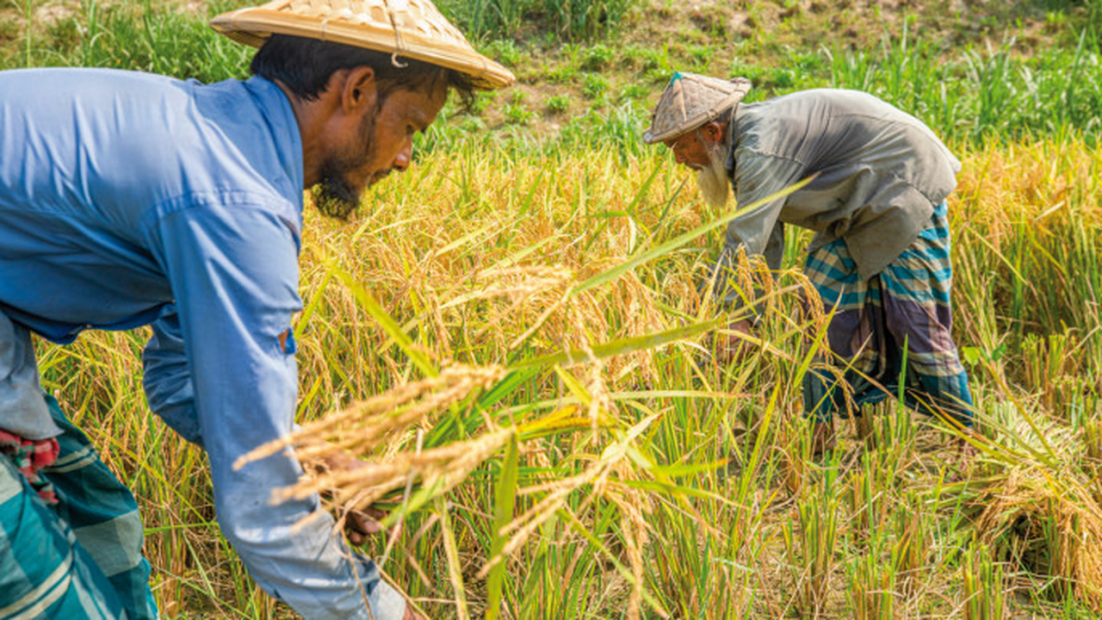
Where the farmer once used cow dung from his house and seeds from his granary, he must now count money at every step. The price of seeds keeps rising. The prices of fertilizer and pesticide are going out of the farmer’s reach. During the Boro harvest, farmers work in open fields and risk disasters like lightning with their exhausting labor.
Even then, a loan hangs over their heads. At the end of the day, when the crop reaches the market, the farmer does not get a fair price. The farmer takes the most risk in the whole process of production. Yet the biggest share of the profit goes easily into the pockets of companies and middlemen. The farmer’s real income keeps falling even after he sweats on his own land.
Thousands of farmers are falling into debt. The free farmer is slowly turning into a farm slave of the company. Climate change makes this crisis of dependence even deeper. In extreme disasters like drought, heavy rain, flash floods or sand deposits on river chars, hybrid crops are destroyed very easily.
Our native crops could handle the climate much better. We had hundreds of native varieties that could survive floods or severe drought. By depending on company seeds, we lost that natural shield. Now, in the name of the climate, companies bring new seeds in new packaging that they say can face climate change.
They have turned the farmer’s crisis into a new tool for their business. This is basically a clever corporate trade built on the helplessness of farmers. The way out of this aggression is not unfamiliar to us at all. To save agriculture, we must bring back the traditional knowledge that farmers have lost.
It is now the demand of the time to build community seed banks at the village level to save native seed varieties. We must practice integrated pest management and nature friendly farming instead of chemical poison. To restore the natural fertility of the soil, we have no choice but to focus on organic fertilizer. We must wake up anew to save the roots of agriculture.
The freedom of the farmer is not limited to getting a good price for his crop. A farmer is not free just because he owns the land, unless he has full right over the seed. Food sovereignty can never be ensured in a pattern set by multinational companies. The time has come to free agriculture from this new colonialism that depends on the market and to bring it back to independence.
Author: Mr. Al Shahariya is an environmentalist writer, organizer and columnist.