APBN to Investigate Cases Under New Law, Special Focus on Drugs and Arms in Rohingya Areas
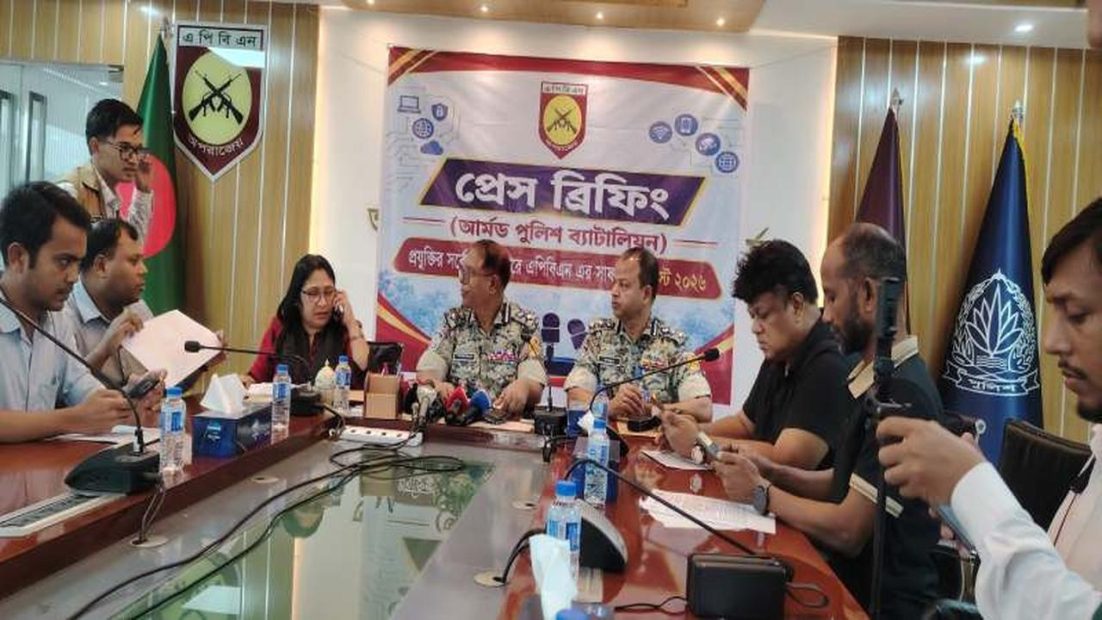
The Armed Police Battalion (APBN) has been granted the authority to investigate cases under a new law. However, the force will not investigate all cases. APBN will investigate only those cases assigned to it by the government, court or Inspector General of Police (IGP). In particular, it will be deployed in cases involving crimes in Rohingya camps and hilly areas where district police face geographical and practical limitations in conducting investigations.
APBN Deputy Inspector General (Administration) Mohammad Shahjahan disclosed the information at an exchange meeting with journalists on Thursday (September 17) afternoon.
The DIG said the new law has created an opportunity for APBN to conduct investigations. However, despite being an armed force, APBN will not investigate all cases. It will investigate only cases assigned to it by the government, court or IGP.
He said various types of crime have increased in camp areas since the arrival of the Rohingya population. Conducting investigations in these remote areas often becomes difficult for district police. For this reason, with government approval, unarmed APBN sub-inspectors had been involved in investigations in the camps. The new law has provided a clearer legal basis for this activity.
The new law also provides for the formation of a separate cell to control cybercrime, he said. It has also clearly defined APBN’s responsibilities regarding airport security and crime prevention.
Regarding security in Rohingya camps, DIG Shahjahan said around 2,200 APBN personnel are currently deployed to ensure the security of nearly 1.8 million people. The force considers this ratio of personnel to population a major challenge. A proposal has been sent to the government to increase manpower in the camps and establish a new battalion.
Asked which types of crimes are being given the most priority in the camps, he said drugs, arms, abduction, violence against women and crimes against humanity are receiving special attention. APBN is also working to control human trafficking and organised crime.
Regarding efforts to prevent the fresh entry of Rohingyas into Bangladesh, he said APBN’s primary responsibility is to ensure security inside the camps. The Coast Guard is responsible for the maritime boundary, while the Border Guard Bangladesh (BGB) and other relevant forces are responsible for the borders.
APBN officials also discussed security and police jurisdiction at Hazrat Shahjalal International Airport. DIG Shahjahan said the airport, as part of Bangladesh’s territory, also falls under police jurisdiction. Airport security and crime prevention should be viewed separately. Crime prevention, intelligence gathering and civilian security fall under the responsibilities of the police.
He said no part of the airport is outside police jurisdiction. Various agencies will perform their respective duties at the airport, with coordination among them as necessary.
Asked whether APBN can investigate crimes committed at the airport, Mohammad Shahjahan said there is no restriction under the new law. If APBN considers that it should investigate a particular crime, it can do so in accordance with the law.
He further said there will be coordination among the relevant agencies in carrying out duties in areas including the airport apron and outer areas. Each agency will perform its duties according to those defined by law. There is no conflict between these agencies and APBN, he said.
At the meeting, DIG Mohammad Shahjahan also presented information on APBN’s achievements in various areas during August. He said 784 lost mobile phones, three hacked Facebook accounts, two WhatsApp accounts, two email accounts and one Telegram account were recovered with the assistance of technology. A total of 572 people received assistance through the national emergency helpline 999. Tk 749,718 was recovered in bKash and Nagad fraud cases.
In anti-drug operations, 6,652 yaba tablets, 3.49kg of cannabis, 43.75 litres of alcohol, 387 cartons of cigarettes and 209 vapes were seized. Eleven cases were filed and 15 people were arrested in these incidents. In arms recovery operations, two one-shooter guns, three rounds of ammunition and two bullet casings were recovered, and one person was arrested.
In anti-smuggling operations, 4,929 grams of gold were recovered, with an estimated value of Tk 97,988,385. Seventeen cases were filed and 27 people were arrested in connection with the incidents. Various foreign currencies and Tk 264,976 in Bangladeshi currency were also recovered.
Under traffic management operations, 483 cases were filed and Tk 1,463,500 was collected in fines. He said several hundred more people were arrested through various legal measures and operations.
Regarding operations in the Rohingya camp areas, the DIG said 23 vehicles were detained on charges of illegal entry and sent to Shah Porir Dwip Highway Police Station. One case was filed and one person was arrested over the recovery of ration items prohibited for sale. Various smuggled and illegal goods were also recovered from the camp areas.
During this period, three missing children and 19 victims were rescued. In August, units 8, 14 and 16 APBN jointly filed a total of 43 GR and CR cases.
Regarding the scope of APBN’s responsibilities under the new law, the DIG said that in peacetime, assisting other law enforcement units in maintaining law and order and ensuring internal security, as well as serving as infantry battalions during wartime, are among the force’s fundamental characteristics.