Awami League Killed 1,400 People, Including Abu Sayed and Children: Harry K. Thomas Tells New York Seminar Hosted by AL
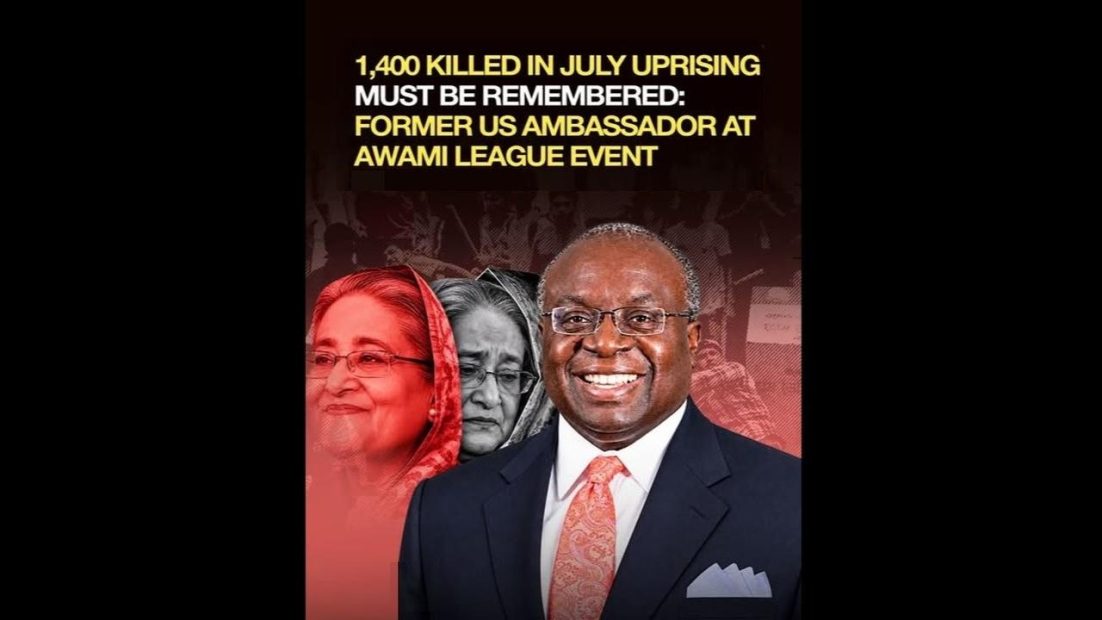
Around 1,400 people, including student Abu Sayed in Rangpur and a six-year-old child in Narayanganj, were killed during the July-August 2024 uprising, former US Ambassador to Bangladesh Harry K. Thomas has said.
Referring to the role of security forces under the then Awami League government, Ms. Thomas said the United Nations Human Rights Commission estimated that the death toll during the uprising could have reached 1,400. His remarks reportedly made Awami League leaders and activists uncomfortable at a seminar organised by the party in New York.
Ms. Thomas was the keynote speaker at the seminar titled “Which Way Is Dhaka Heading? Bangladesh Today and Tomorrow”, organised by the Awami League, whose activities are currently banned. He shared his observations on Bangladesh’s political situation, democracy, the July uprising, the economy and international relations.
He also stressed the importance of democratic progress and called for an end to divisions among political parties. Speaking about the July uprising, Ms. Thomas said the student-led movement in 2024 brought an end to Sheikh Hasina’s long rule. According to the UN human rights body, up to 1,400 people may have been killed during the summer of that year. Many of them died from gunfire by security forces. Police and other security personnel were also victims of violence during the same period. Forty-four police officers and eight other members of the security forces were killed.
Ms. Thomas said every number in the death toll represented a human life. He recalled that student Abu Sayed stood before police in Rangpur with his arms outstretched before being shot dead. He also mentioned a six-year-old child who was killed while watching clashes from a rooftop in Narayanganj. He said Bangladesh had achieved its present democratic position at the cost of these lives.
On Bangladesh’s political future, Thomas said multiparty democracy could not be imposed from outside. The people of a country must choose it themselves. He said the people of Bangladesh had made that choice through their votes in February. He added that democracy required not only a government with a public mandate but also a strong opposition capable of questioning the government and holding it accountable.
Ms. Thomas further said that, after 17 years in exile, Tarique Rahman returned to Bangladesh and led the BNP to a two-thirds majority. Regardless of differing opinions about the election results, he said the peaceful transfer of power through voting should be recognised.
Discussing political divisions, the former ambassador pointed to the divide between the BNP and the currently banned Awami League. He also referred to the political distance between the government and Jamaat-e-Islami, which leads the opposition in parliament.
He said divisions also existed between the bureaucracy, which had long remained at the centre of power, and the younger generation seeking opportunities to realise its potential. He urged political groups to move beyond old rivalries and hostility and work together for the country’s future.
Ms. Thomas also addressed the human rights situation under the new government. Citing observations by Human Rights Watch, he said arbitrary detention of people considered opposition supporters and weak human rights protections were continuing a cycle of political repression.
He stressed that justice for those killed in 2024 must be ensured through fair trials based on evidence and conducted in accordance with the Constitution. Detaining people without charges, he said, could not establish justice. On the economy, Thomas identified inflation, poverty, pressure on the banking sector and weak revenue collection as major challenges for the new government.
However, he described the extension of Bangladesh’s transition period from the UN’s least developed country (LDC) category until 2029 as an important diplomatic achievement. He said Bangladesh should use the additional time to carry out economic reforms, diversify exports and attract more investment.
Regarding US-Bangladesh relations, Mr. Thomas said the United States had never withdrawn from Bangladesh. American assistance for Rohingya refugees and cooperation in the health sector were continuing, he said. He added that a trade agreement with the United States and investment opportunities through the US International Development Finance Corporation (DFC) could also contribute to Bangladesh’s economic progress.
On foreign policy, Mr. Thomas said Dhaka wanted to maintain strategic balance while building relations with all countries. Bangladesh had realised that it could not depend on a single partner, he added. Concluding his remarks, Ms. Thomas urged political parties to abandon the idea that one side’s victory must mean another side’s defeat. He called on all political forces to find ways to work together for future generations.