Bangladesh’s capital market will change within a year:Finance Minister
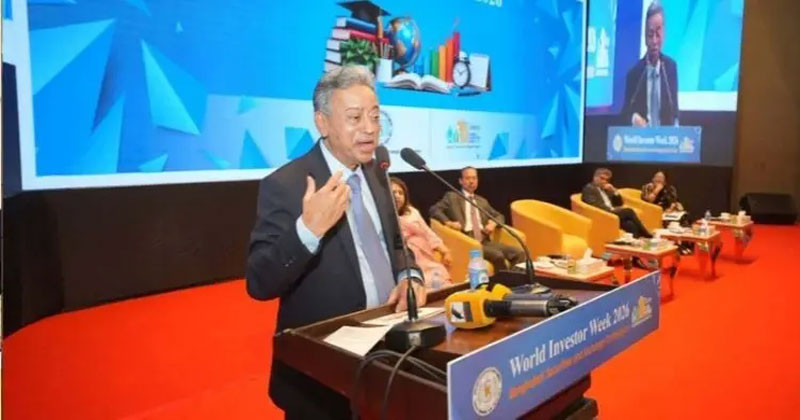
Minister for Finance and Planning Mr. Amir Khasru Mahmud Chowdhury said the face of Bangladesh’s capital market will change within the next year. He said the government is changing the country’s financial structure. He said the days of running the economy on money from the World Bank, ADB and IMF are over.
He spoke as chief guest at the opening of World Investor Week 2026 yesterday at the Krishibid Institution Bangladesh Auditorium in the capital. The theme this year is “Investor resilience, digital fraud and fraud alert”. Mr. Chowdhury said the government is changing Bangladesh’s financial architecture, public finance architecture and private sector financing system. He said the days are gone when the World Bank, ADB and IMF give the money and Bangladesh just runs the country.
He said businesses must cut the cost of money instead of taking bank loans at high interest to run their work. If they cannot cut the cost of funds, Bangladesh’s business and industry cannot compete in the world. He said the capital market and the bond market must become strong options. He said the capital market is the answer, and the bond market is the answer. The government is taking steps to raise money from the assets and future income of its big infrastructure projects.
The Finance Minister said the government is moving to securitise the Padma Bridge and the Jamuna Bridge. He said the public and private sectors have many more chances like this. He said Bangladesh cannot depend only on money from international development partners if it wants to reach a trillion dollar economy by 2034. He told the audience to forget that the IMF or the World Bank will give money. He said he has cancelled the IMF program, as people have seen, because its conditions are not acceptable to Bangladesh.
Mr. Chowdhury said he is going to the market to get his money. He said the money the partners give cannot take Bangladesh to a trillion dollars. He said Bangladesh needs 50 billion dollars every year, and the partners together will give only 10 billion dollars. He said he has no time for that. He said the government is getting a good response, and local and foreign investors are ready to invest in the Bangladesh stock market. He said the face of the Bangladesh capital market will change within a year, unless some accident happens, which he cannot rule out.
He also asked stock market firms and other financial sector bodies to build self regulation in their own work. He told them not to wait for the regulator to give orders. He said each body must understand its own duty. He said no one can wait for the regulator to come and say what to do and what not to do. Everyone concerned must make sure of self regulation in their work.
The Minister said the work of the financial sector depends a lot on the accounts and financial reports of the bodies involved. So firms must be more responsible when they make financial reports, and they must control their own work. To show why self regulation matters, he shared an experience from his time as Commerce Minister. He said garment exporters then had to take a UD certificate, which records the import and export accounts of goods. The Export Promotion Bureau (EPB) gave this certificate at that time.
He said people often complained of harassment, delay and wrong dealing when they went to the EPB for the certificate. He said this often caused trouble in sending export goods too. Later, he did not try to fix the problem through the EPB. He proposed to give the duty to the BGMEA instead. But he set one condition: the BGMEA must build its own ability and run the whole process through self regulation.
Mr. Chowdhury said the BGMEA representatives felt a little worried at first. Later they became ready to take up the duty of self regulation. He said the system has worked well since then. He said everyone should learn to self regulate, and every firm should learn it too. He told them not to wait for the regulator. The Minister also said the government will find it easier to reach its goals of reform and growth if the bodies concerned do their duty well and keep self regulation.
Special Assistant to the Prime Minister on Investment and Capital Market Mr. Tanvir Ghani also spoke at the event. He said work is on to bring the country’s capital market to a level that can match other markets in the region within two years. He said he is hopeful that the market will see big change in the next 12 months. He said several key reform tasks are moving ahead. Officials are working fast on the rules for direct listing, the rules for the initial public offering (IPO) and the reform of the tribunal. They are also reviewing policy issues such as floor price and circuit breaker to make the market work better.
Mr. Ghani said one main goal of the reform is to protect investors, build their trust and create a fair and efficient market. The government has also taken steps to strengthen tools like the Investor Protection Fund to protect investors. He said the government is also focusing on new financial products for the capital market. Officials are talking about new products such as convertible bonds, Real Estate Investment Trusts (REIT), equity stock options and bonds in local currency. He said these products will give more chances to invest and make the market deeper once they start.
On mutual funds, Mr. Ghani said they are a key way for long term investment. He said the government needs to look at the policy and tax benefits needed to push investment in this area. He said insurance and pension money can come into long term investment to make the market deeper. He said the economy has a lot of money that people can use for long term investment. If money from these institutional investors comes to the market, along with banks, the market will grow deeper.
He said officials are watching two ratios to judge the market. One is market capital to gross domestic product (GDP), and the other is market capital to average daily trade. They watch how these change to understand market trends and make policies work better when needed. Mr. Ghani also stressed coordination among the different regulators. He said many firms come under more than one regulator. So the government has started regular monthly meetings among the four main regulators, including the Bangladesh Securities and Exchange Commission and the National Board of Revenue. He said this will improve policy coordination.
Mr. Ghani said the reform is cutting needless complexity in the rules. At the same time, officials are trying to make the core structure of the market stronger. He hopes the market will see big change in the next 12 months. He said these reforms and steps will take the Bangladesh capital market to a level that can match other markets in the region within two years.
Chairman of the Bangladesh Securities and Exchange Commission (BSEC) Mr. Masud Khan also spoke at the event. He said the commission will speed up the process under the new rules and approve IPOs within three months. He said the long wait for approval after an IPO application will fall by a large margin under the new process. He said the market cannot let the two year drought in IPOs go on for long. He said that since he took charge, the commission has found the complexity in the IPO rules as fast as it could and has started to reform them.
He also said the commission will allow a new hybrid method, along with direct listing, to bring multinational and big local companies to the market. Under this method, a company can sell one part of its shares to the public. It can offload the other part from its existing owners. The BSEC Chairman also spoke about the steps taken on Beximco as part of the reform. He said the commission has taken the needed steps, including a reshuffle of the board. He said the commission is trying to rebuild trust in the market through these steps.
Mr. Khan said the commission does not want to keep the World Investor Week program to one week only. He said the commission will keep working to raise investor awareness, rebuild market trust and improve the structure of the capital market.