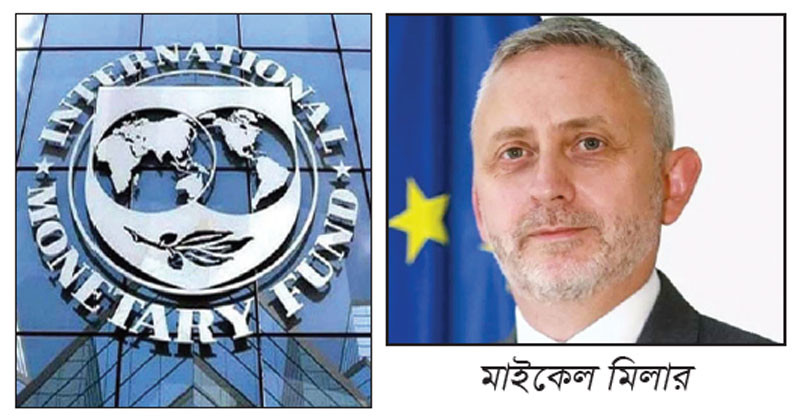
Michael Miller at international conference in Dhaka
Bangladesh Could Become One of the World’s Top 30 Economies
Despite the global economic slowdown, climate-related risks and a range of geopolitical challenges, Bangladesh has continued its pursuit of sustainable growth and economic transformation. The country’s positive economic prospects were reflected in remarks by local and foreign diplomats, economists and policy analysts at the three-day international conference ‘Bay of Bengal Conversation-2026’, held in Dhaka. Discussions highlighted how Bangladesh is moving towards becoming a major global economy by leveraging its strategic geographical location, skilled workforce and expanding international trade opportunities. The conference reflected international confidence in and expectations for Bangladesh’s economic outlook.
Positive assessments by experts from around the world have further strengthened Bangladesh’s economic prospects. The country’s readymade garment industry and various manufactured products remain major export sectors and important drivers of economic growth. British High Commissioner to Bangladesh Sarah Cook, speaking in Dhaka on Sunday, presented an encouraging assessment of Bangladesh’s trade prospects. She said that even after Bangladesh graduates from the least developed country (LDC) category, 92 percent of its products will continue to receive completely duty-free access to the UK market. Currently, 99.8 percent of Bangladeshi products enjoy such access to the UK market, and this will remain unchanged during the three-year transition period following LDC graduation. Subsequently, most products, including garments, will continue to benefit from duty-free access. At the same time, the UK is placing greater emphasis on building a modern strategic partnership with Bangladesh rather than maintaining a relationship centred on development assistance.
Joint initiatives by the two countries to address climate risks and the economic contribution of Bangladesh’s large diaspora in the UK are further strengthening bilateral ties. This partnership extends beyond commercial relations, opening avenues for technology transfer, education, research and innovation. The British high commissioner’s remarks are being viewed as a positive signal for Bangladesh’s export sector. Meanwhile, given Bangladesh’s strategic importance in South Asia and the Indo-Pacific, the European Union (EU) has outlined a framework for treating the country as an increasingly strategic partner rather than limiting the relationship to a donor-recipient model. According to EU Ambassador Michael Miller, Bangladesh, located at the heart of the Bay of Bengal’s economic hub, is one of the world’s most dynamic economies and has the potential to become one of the world’s top 30 economies by 2030.
At this important juncture of LDC graduation, the EU has for the first time proposed exploring the possibility of a free trade agreement (FTA) with a country that has not yet completed its graduation, while also working together to build an open, stable and globally competitive economy. He also called for accelerating Bangladesh’s economic transformation by strengthening institutions, increasing technological capacity and maintaining global standards in policymaking. This new EU approach represents not only an economic opportunity for Bangladesh but also an opportunity to strengthen the country’s international economic and diplomatic position. The partnership could also facilitate Bangladesh’s deeper integration into global supply chains.
Bangladesh’s domestic targets under its national economic roadmap and long-term development plans are also specific and ambitious. Emphasising a new phase of growth and industrialisation, the country has focused on a sustainable model of economic growth and higher productivity. In recent sessions, Prime Minister Tarique Rahman has expressed his determination to place the economy on a stronger foundation. He has announced the goal of turning Bangladesh into a US$1 trillion economy by 2034, while calling for greater investment in technology, innovation, skills development and productivity. In line with this roadmap, strategic initiatives are being undertaken as part of economic reforms, including the ambitious target of creating 10 million new jobs by 2030.
Job creation and productivity growth will play a key role in Bangladesh’s efforts to strengthen its position in the global economy and achieve the US$1 trillion economic target. Although the target is highly ambitious, analysts believe it is achievable in view of Bangladesh’s current growth trajectory and international support. Investment in technology and innovation, human capital and infrastructure modernisation could further facilitate progress towards this goal. Zillur Rahman, president of the Centre for Governance Studies (CGS), has identified Bangladesh’s position as a regional connector and an economic hub of Southeast Asia.
He noted that if Bangladesh can effectively combine the economic importance of the Bay of Bengal with maritime security, the country could become a major economic force in Asia in the coming years, playing a significant role in achieving the target set for 2030. Meanwhile, noted economist Dr Ahsan H Mansur stressed the importance of reforming the country’s macroeconomic framework, maintaining discipline in the banking sector and increasing the tax-to-GDP ratio. He said that if the current structural weaknesses can be addressed, it would be realistic for Bangladesh to enter the ranks of the world’s top 30 economies by 2030. His remarks further highlighted the need for economic reforms while underscoring the country’s growth potential. A combination of structural reforms and improved governance could make Bangladesh’s economy more stable and competitive.
Global research organisations and international financial institutions have also offered positive assessments of Bangladesh’s economic prospects. Analysing Bangladesh’s position in the international economy, former Bangladeshi ambassador to the United States Mohammad Ziauddin has said that Bangladesh will become the world’s 26th-largest economy by 2030 and establish itself as one of the three fastest-growing economies in the world. Such assessments reflect confidence in Bangladesh’s economic progress. They represent projections of the country’s longer-term economic potential rather than established outcomes.
In addition, economists and analysts, citing data from the International Monetary Fund (IMF), say that if the current macroeconomic trajectory is maintained, Bangladesh’s GDP will reach US$677 billion by 2030. Based on this projection, Bangladesh would become the world’s 32nd-largest economy and could overtake emerging economies in South and Southeast Asia such as Malaysia (US$672.5 billion), Vietnam (US$667.5 billion) and Thailand (US$647.5 billion) to strengthen its position in the regional economy. This comparative picture illustrates the projected pace and direction of Bangladesh’s economic expansion. Compared with other South Asian economies, Bangladesh’s progress is being viewed as an encouraging example.
According to various economists and geopolitical analysts, despite global challenges, Bangladesh’s economic prospects and progress are being positively received by the international community. Its strategic location, skilled workforce, growing investment and continued reforms are supporting Bangladesh’s ambition to become a major global economy over the next decade. This progress is not only a story of economic expansion but also a reflection of Bangladesh’s broader development potential. If this trend continues, Bangladesh’s economic transformation by 2030 could become a tangible achievement rather than merely an aspiration. To capitalise on this potential, Bangladesh’s outlook could become even stronger if it remains committed to public-private partnerships, technological innovation and sustainable development strategies.