Bangladesh’s Digital Sovereignty Under India’s Grip
By Faruk Hossain
The rapid expansion of information technology, digital services and internet use has transformed Bangladesh’s demand for international bandwidth. In just over a decade, demand has increased more than 95-fold. Most of it comes from India through International Terrestrial Cable (ITC) operators, sending significant foreign currency out of Bangladesh. Over the past eight years, the amount has reached US$250 million.
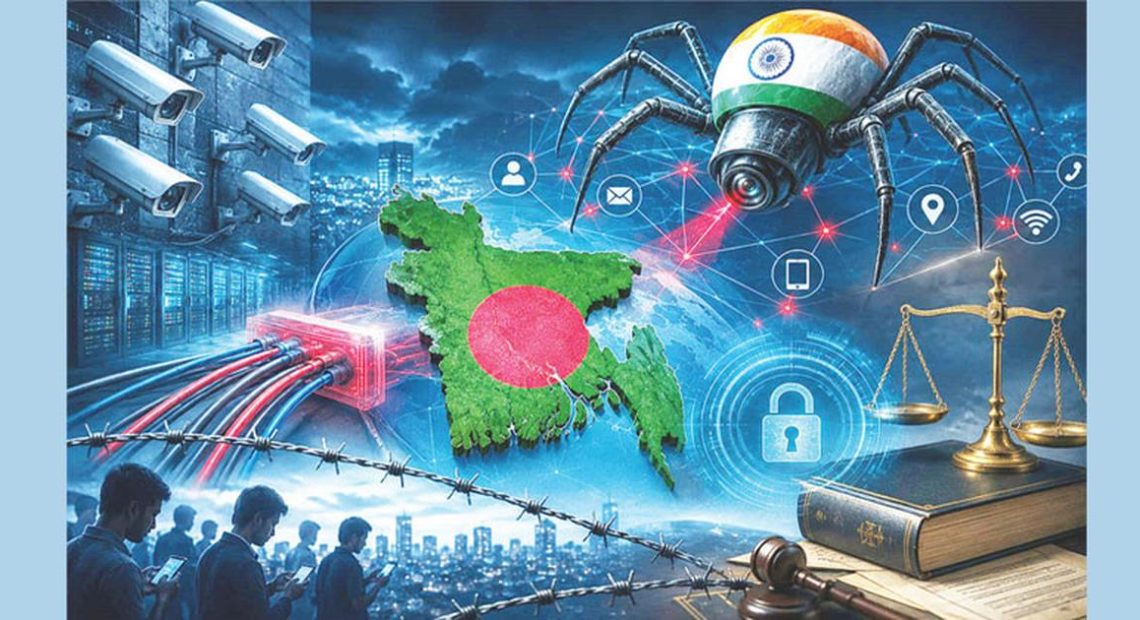
This dependence has created serious risks to Bangladesh’s digital sovereignty. Under India’s Information Technology Act, 2000 and Telecommunications Act, 2023, 10 central intelligence and investigative agencies, including RAW, Intelligence Bureau (IB), National Investigation Agency (NIA) and Central Bureau of Investigation (CBI), can monitor, intercept or decrypt digital data and telecommunications messages passing through Indian territory.
Analysts say such transit could expose Bangladesh’s sensitive state, commercial and civilian communications to foreign surveillance. They warn that when control over information shifts to another state, national independence can be compromised. Bangladesh should therefore reduce ITC imports and increase submarine cable capacity through government or private initiatives. Information technology expert Mahmud Shahed said, “There is no security for the bandwidth coming to Bangladesh from India through ITCs. Because India can monitor any data traffic within its territory. This is the law in India. As a result, Bangladesh is at major risk. They can monitor any confidential and sensitive data of Bangladesh.”
According to BTRC and industry statistics, bandwidth demand was 141 Gbps in 2015 but reached around 13.5 Tbps in 2026, an increase of more than 95 times. Analysts say smart devices, 5G, cloud computing and video streaming will drive further growth. Projections put demand at 27 Tbps in 2028, 54 Tbps in 2030, 108 Tbps in 2032, 216 Tbps in 2034 and 432 Tbps in 2036.
Bangladesh is currently connected to only two submarine cables. Under Bangladesh Submarine Cables PLC (BSCCL), SEA-ME-WE-4 provides 4.6 Tbps and SEA-ME-WE-5 provides 2.5 Tbps, totaling 7.1 Tbps. The remaining 6.4 Tbps comes through seven ITC operators.
The situation could worsen as demand rises. SEA-ME-WE-4, which Bangladesh joined in 2005, had a 20-year lifespan that has expired. Its capacity is expected to decline, while charges have increased. It may remain economically viable until 2030, after which its effectiveness will decrease. Bangladesh is also unlikely to receive bandwidth from its third submarine cable, SEA-ME-WE-6, soon because of complications in the Middle East and Africa. It is unlikely to become operational within two to three years.
Without new submarine cables, Bangladesh may have little alternative but to depend further on India. This would increase data security and digital sovereignty risks. Dependence on one country for such a large volume of bandwidth could also severely affect the financial sector, freelancing, export-oriented industries and general internet services if the connection were disrupted, potentially creating a digital blackout or “kill switch.”
Bangladesh’s limited connectivity is evident regionally. It has only two submarine cables, compared with India’s 20, Pakistan’s 78, Singapore’s 30, Malaysia’s 24, Indonesia’s 61, Thailand’s 12 and Sri Lanka’s eight. Additional cables are also in progress in all these countries.
Mashiur Rahman, former managing director of Bangladesh Submarine Cable PLC and chief executive officer of Cidnet Communications, said the submarine cable Bangladesh joined in 2005 had a 20-year lifespan and its capacity would gradually decline. It would no longer be economically viable after 2030, he said. He also noted complications surrounding SEA-ME-WE-6 and said data demand was continuously increasing, with the initial supply likely to come from India. “If dependence on a single country increases too much, there are economic and security risks,” he said. Mr. Rahman said the government should immediately consider alternatives and increase Bangladesh’s own capacity, including through public-private initiatives to connect to additional submarine cables.
India’s Legal Scope for Data Surveillance
India’s Information Technology Act, 2000 gives the government legal authority to monitor, intercept or decrypt information passing through computer resources or servers within the country. Section 69 allows the central or state government to direct investigative agencies to monitor, intercept or decrypt such information. International transit data passing through servers, submarine cable landing stations or routers located in India could therefore fall under the law.
Similarly, Section 20(2) of India’s Telecommunications Act, 2023 gives the government powers, citing public emergency or public safety, to take control of telecommunications networks, intercept messages and regulate or suspend data flows. With approval from India’s Ministry of Home Affairs, 10 central intelligence and investigative agencies, including the IB, RAW, NIA and CBI, have been granted data surveillance powers.
Experts say that even when internet traffic is encrypted, metadata—including communicating parties, communication times, data volume, IP addresses and geographical locations—may remain visible. Deep packet inspection can identify traffic patterns involving government, military and major financial institutions. They warn that weak or unencrypted protocols could create risks of “man-in-the-middle” interception or DNS spoofing. BGP hijacking could potentially route sensitive Bangladeshi traffic through Indian servers.
Another concern is bandwidth control during a national crisis or bilateral tension. Experts say India could invoke Section 20 on national security grounds to suspend or throttle Bangladesh’s ITC bandwidth.
Although Bangladesh has a National Internet Exchange (NIX), some local data traffic still travels outside the country. If improper BGP configuration routes unencrypted local or government data through India’s ITC network, it could come under foreign laws and surveillance.
Posts, Telecommunications and Information Technology and Science and Technology Minister Fakir Mahbub Anam acknowledged that there is some risk to data and said maintaining complete privacy has become difficult. He said the government is working on long-term plans and expects Bangladesh to connect to a new submarine cable by 2027, potentially providing 17 Tbps of bandwidth.
He also said three companies are working through a consortium to bring another submarine cable and that related policy issues are being considered. “I hope we will be able to arrange more bandwidth in line with demand,” he said.