Biodiversity Under Threat in Moulvibazar As ‘Resort-cottages’ Are Being Built by Cutting into Hills
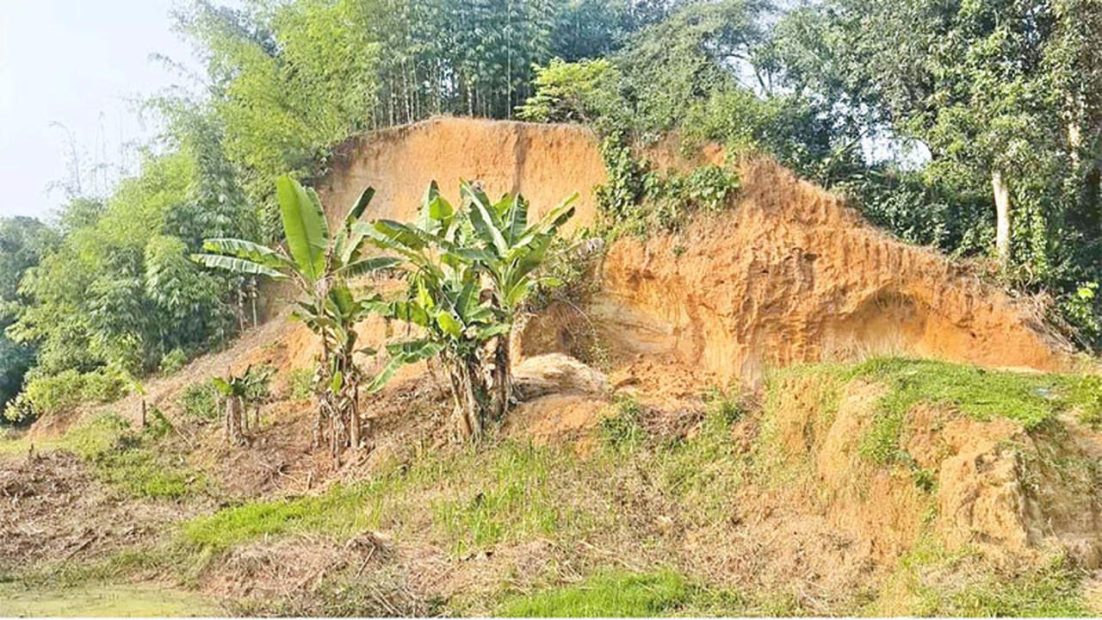
Resorts are being built across Moulvibazar by cutting hills, hillocks and forest areas. The number of such establishments in the district has risen to around 200 in recent years. However, government offices have little information about the approvals and legal status of most of them. While some resorts were developed following proper procedures in the early years, the situation has changed over the past five years. Houses and small buildings with only a few rooms are now being converted into resorts.
The expansion of resorts is putting increasing pressure on hills, hillocks and forests. Elevated land is being cut and levelled, while cottages and other structures are being built deep inside forests. Trees and vegetation are also being cleared to make roads and construct buildings. As a result, many wild animals are entering human settlements.
Environmental activists fear that continued destruction of hills and forests will shrink wildlife habitats, disrupt natural movement routes and reduce food sources for wild animals. In 1996, an area of 1,250 hectares in the Lawachara forest of Kamalganj Upazila was declared Lawachara National Park. It is one of Bangladesh’s major protected evergreen forests and nature conservation areas.
After Moulvibazar was declared a tourism district in 2008, the country’s first five-star resort, Grand Sultan Tea Resort and Golf, opened in Sreemangal in 2013 on 13 acres of land. Since then, resort and cottage development has expanded rapidly across the district’s hills and hillocks, particularly in Sreemangal, where more than 100 such establishments are reportedly operating. The Radhanagar area alone has around 40 to 45 resorts. The growing number of visitors has increased pressure on the biodiversity of Lawachara National Park and surrounding forests.
Large companies and wealthy individuals from Dhaka and Chattogram, along with lawyers, bank employees, government officials and several celebrities, are reportedly investing crores of taka in these resorts, sometimes under other people’s names. Established resort operators allege that some businesses are buying only two to three decimals of land from local residents and operating small establishments under the name of resorts.
Swapan Dev Sajal, director of the Bangladesh Wildlife Service Foundation, and environmental activist Rajdeep Dev said a significant number of snakes and other wild animals had entered human settlements from Lawachara in August and September this year. Rescued animals included pythons, monocled cobras, eyed cat snakes, green vine snakes, civets, monkeys and fishing cats. The animals were rescued from different areas and handed over to the local Forest Department.
They said indiscriminate cutting of hills and forests, along with increased human activity near wildlife habitats, had made the animals feel unsafe. As a result, many were leaving the forest and entering populated areas. A S M Saleh Sohel, a former member of the national council of Bangladesh Poribesh Andolon (BAPA), said every animal needed a safe habitat. However, continued destruction of hills and forests was making wildlife increasingly insecure in its natural environment.
Numerous resorts and cottages have also been built near wildlife habitats. High-powered artificial lighting used at these establishments spreads over large areas, disturbing the natural behaviour of wild animals and threatening their shelter. The resulting disturbance is seriously affecting wildlife movement, environmental activists said. They noted that the situation might have been different if there had been only 10 to 20 resorts, but the number has now reached around 200. Food shortages in Lawachara and nearby forests have added to the problem.
Wild animals generally prefer quiet surroundings. With their natural habitats becoming noisier and less secure, and few alternative places available, many are being forced to enter human settlements. S K Das Sumon, general secretary of the Sreemangal Tourism Services Association, said there were around 103 resorts in Sreemangal. Establishing a resort in a hilly area or elsewhere requires permission from the deputy commissioner, the Department of Environment and the relevant union parishad, he said.
However, he estimated that only 10 to 12 establishments in Sreemangal qualified as full-fledged resorts. A resort owner in Sreemangal, speaking on condition of anonymity, said the launch of five-star establishments such as Grand Sultan had initially aimed to develop tourism in Moulvibazar. Resorts and cottages of different categories gradually followed.
“We are operating our resort in compliance with all government laws. Yet now we see resorts being built recklessly. It is essential to monitor how these resorts are being established and whose permission they have received,” the owner said. Selim Ahmed, owner of Grand Selim Resort in Sreemangal, also expressed concern. He said only around 10 to 15 establishments in the area could genuinely be considered resorts.
He added that businesses paying taxes and complying with government regulations were being harmed by illegal or substandard establishments operating under the resort label. Mohammad Maidul Islam, assistant director of the Department of Environment in Moulvibazar, said around 50 resorts had obtained environmental clearance from the department.
Legal action, including fines and cases, had been taken against establishments operating without the required clearance, he said. However, some operators continued to cut hills to build resorts, and legal loopholes made it difficult to hold them accountable. According to the official, the department issues environmental clearance to resorts with 20 rooms or more, while establishments with fewer than 20 rooms do not require such clearance.
Sreemangal Upazila Nirbahi Officer Mohammad Ziaur Rahman said the administration investigated complaints about the cutting of hills and hillocks. He said authorities were preparing a comprehensive list and database of hotels and resorts in Sreemangal, including their land ownership, approval and licensing status.
Establishments would not be allowed to change the classification of land or hillocks without the required permission, he said. Recently, the administration shut down the operations of two establishments for violating regulations.