Chinese Solar Panels Successfully Generate Power Even at 33 Feet Underwater
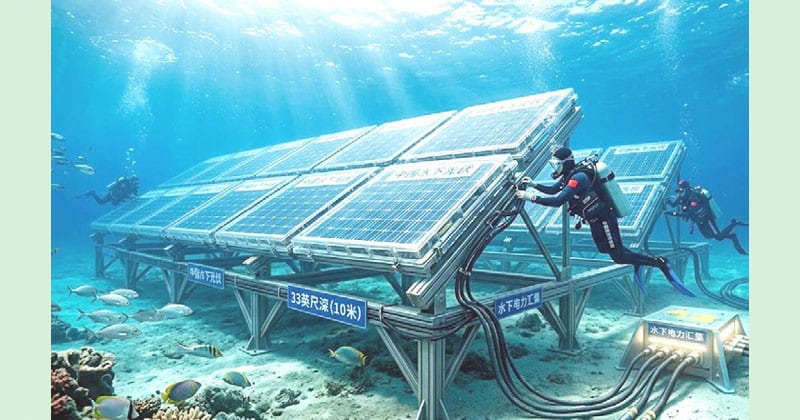
Chinese scientists have successfully generated solar power at a depth of 10 meters (approximately 33 feet) under the sea, opening up new possibilities for underwater solar energy generation, according to researchers. A team of researchers from Yunnan University experimented in the South China Sea using a perovskite-based solar panel. Using a robot, the 115-square-centimeter panel was tested at depths of two, six, and 10 meters underwater. The study revealed that the panel generated 1,416 milliwatt-hours of electricity at a depth of two meters, 752 milliwatt-hours at six meters, and 324 milliwatt-hours at 10 meters. The generated electricity was used to charge batteries and power LED lights.
Researchers explained that as water depth increases, a significant portion of red light is absorbed by the ocean. Consequently, blue and green wavelengths predominantly reach depths between 5 and 10 meters. Keeping this in mind, the new solar panels were specially designed to harness light wavelengths ranging from 400 to 600 nanometers. The panels were built using a special semiconductor material called lead-halide perovskite, combined with a polymer named polyhexamethylene guanidine hydrochloride. According to the researchers, this polymer integration enhanced the panel’s electron-retention efficiency. Researcher Mr. Wen-Hua Zhang noted that most previous studies on underwater solar power were limited to depths of two meters or less, whereas this study tested the technology’s effectiveness at nearly 10 meters.
Published on September 11 in the scientific journal Joule, the study highlights that these new panels can remain operational for up to five and a half years. Researchers believe this technology could be used to provide long-term power to stationary underwater sensors, detection devices, and other autonomous equipment in the future. Additionally, it creates potential for developing self-sustaining underwater power systems for marine monitoring, communication networks, and scientific exploration.
Source: Reuters.