Dhaka Air Quality Improves, Lahore Tops Pollution List
Dhaka residents are getting some relief from air pollution compared with recent days. Between 7am and 8am on Tuesday (September 22), Dhaka recorded an Air Quality Index (AQI) score of 69 on the index of international air-quality monitoring organisation IQAir.
According to the score, Dhaka’s air was in the “moderate” or “tolerable” category. At the same time, Dhaka ranked 34th on the list of the world’s major cities with the highest levels of air pollution.
The latest live data from IQAir also showed Dhaka’s air quality in the “moderate” category. Around 5am, Dhaka’s AQI was 61, with fine particulate matter, or PM2.5, identified as the main pollutant.
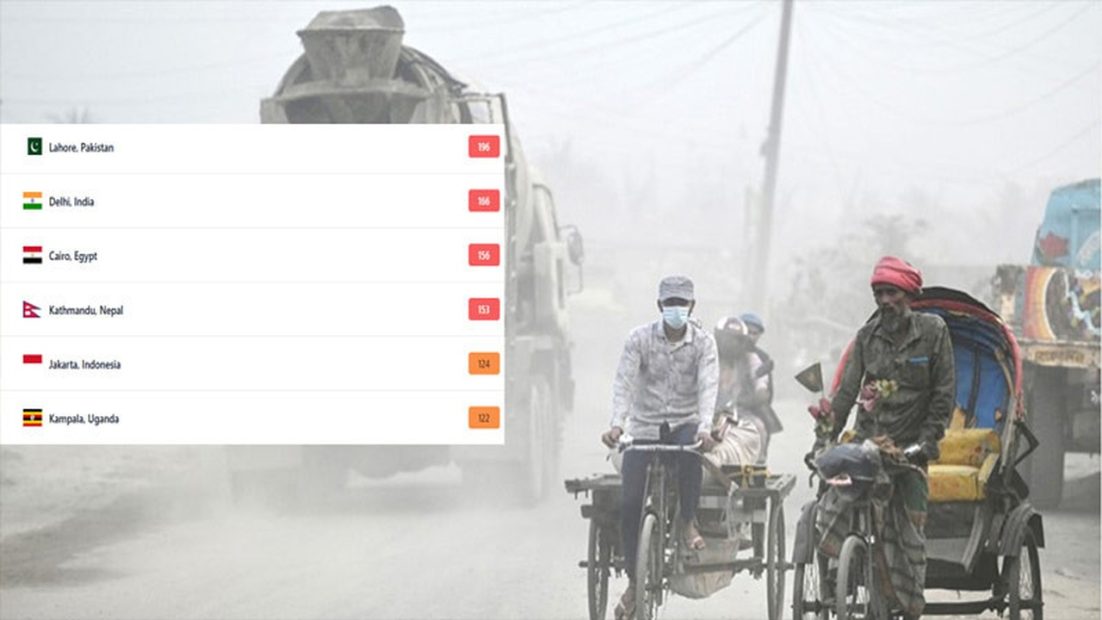
At that time, the concentration of PM2.5 in Dhaka’s air was 14.5 micrograms per cubic metre. Among major cities around the world, Lahore, Hanoi, Delhi, Kuching and Jakarta, among others, recorded much higher pollution levels than Dhaka.
According to the IQAir list published on Tuesday morning, Lahore recorded an AQI of 208, Delhi 191, Hanoi 184, Jakarta 159 and Kuching 157. The air quality in these cities ranged from “unhealthy” to “very unhealthy.”
However, IQAir’s global live ranking changes every hour. As a result, a city’s position and AQI score can vary significantly at different times on the same day. The latest global ranking also showed several Asian cities, including Lahore, Singapore, Kuching, Kolkata and Kuala Lumpur, with relatively higher levels of pollution.
Relevant authorities believe recent rainfall and changes in weather conditions have contributed to the improvement in Dhaka’s air quality. Rainwater can bring dust and various harmful particles suspended in the air down to the ground, temporarily reducing the level of air pollution.
The weather forecast also predicts moderate to heavy rain accompanied by thunderstorms in Dhaka from morning to noon today. According to weather forecasts, a thunderstorm may pass over the capital. If rainfall continues, the levels of dust and fine particles suspended in the air may temporarily change further.