DU Researchers Develop Device to Detect Dengue-Carrying Aedes Mosquitoes
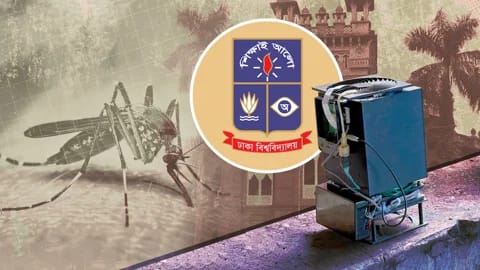
Researchers at the University of Dhaka (DU) have developed an Artificial Intelligence (AI) and Internet-of-Things (IoT)-enabled smart mosquito trap named ‘MAST-CloudNet’. Jointly created by the Microsystems and Nanoengineering Lab under the Department of Electrical and Electronic Engineering (EEE) and the Mueid Research Group under the Department of Zoology, the device is designed to detect and remotely monitor Aedes mosquito populations. Funded by the DU Research Fund, the research findings were published on October 8, offering a promising solution to track the vector responsible for transmitting dengue fever.
The device operates by emitting sound waves in the frequency range of 350 to 500 Hz, mimicking the wingbeat frequency of female Aedes mosquitoes. Attracted by this acoustic signal, male Aedes mosquitoes approach the trap, where an internal fan pulls them inside onto yellow sticky paper. An integrated camera captures images of the trapped insects and transmits them via the internet to a cloud server. There, an AI model identifies the species and counts their numbers, presenting real-time data on a web dashboard for remote inspection.
Targeting male mosquitoes provides a strategic advantage for early dengue vector control. While female mosquitoes bite humans and spread disease, male Aedes mature earlier and stay near breeding sites. Therefore, a sudden rise in the male population acts as an early warning signal for potential breeding surges in specific localities. In laboratory cage trials, the sound-assisted mechanism captured nearly five times more mosquitoes than silent traps. During a three-day field trial on the DU campus, it remained operational despite rain, wind, and urban noise, successfully capturing 49 Aedes mosquitoes.
Built at a component cost of approximately BDT 12,000, MAST-CloudNet is significantly more affordable than traditional survey devices like the CDC Light Trap (BDT 25,000) and BG-Sentinel Trap (BDT 20,000). Since a single central cloud server can simultaneously process data from multiple devices, operational costs per unit will decrease further when scaled. Additionally, the smart trap features a built-in battery backup system capable of maintaining operations for up to four and a half hours during unexpected power outages.
The collaborative development team includes Prof. Dr. Sayeed Mahmud Ullah, Associate Prof. Dr. Md. Ahsan Habib, A M M Munif Khan, Fahad Arefin, Asif Rahman Depto, and Atiq Bin Zakir from EEE, along with Associate Prof. Dr. Kazi Khondoker Asfaqul Mueid, Lecturer Atia Sanjida Shoremee, Md. Siam Sarkar, and Niloy Howlader from Zoology. Commending the team, Dhaka University Vice-Chancellor Prof. Dr. A. B. M. Obaidul Islam noted, ‘Identifying areas experiencing a surge in the population of Aedes mosquitoes, the vector for dengue, will significantly facilitate proactive prevention and containment measures.’