China-Myanmar-Bangladesh Corridor: A Strategic Golden Gateway for Bangladesh
China’s Partnership Offers Bangladesh an Economic, Geopolitical Superpower Ally
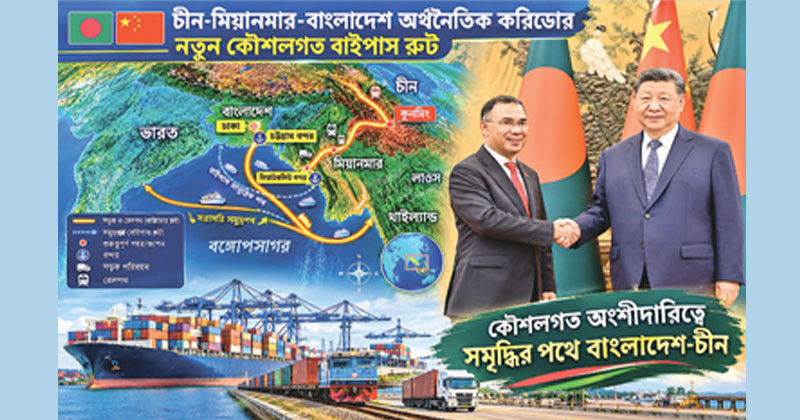
Across the globe, regional economic blocs are actively driving trade expansion, and among these, the China-Myanmar-Bangladesh Economic Corridor (CMBEC) proposal has generated significant strategic interest. The initiative gained momentum during Prime Minister Tarique Rahman’s official visit to China, where President Xi Jinping presented the initial framework at the Great Hall of the People on June 26. The proposed corridor holds monumental strategic value for Bangladesh, China, and Myanmar, adding a compelling new dimension to global geopolitical discussions. Prominent economists and connectivity experts highlight that this corridor could transform Bangladesh into one of Asia’s premier regional gateways, bolstering its trade, energy, and defense capabilities.
Connectivity expert Prof. Dr. Md. Shamsul Hoque emphasizes that the CMBEC extends far beyond a standard economic passage, serving as Bangladesh’s primary gateway to Southeast Asia with major geopolitical and security implications. He notes that the corridor will integrate regional economies through a modern, multimodal transportation network that maximizes the strategic potential of the Matarbari Deep Sea Port as a major regional hub. Drawing parallels with the China-Pakistan Economic Corridor (CPEC), Prof. Hoque argues that this partnership will enhance Bangladesh’s economic leverage without military risks, given China’s primary focus on trade and infrastructure development.
Highlighting the practical economic impact, former Vice-Chancellor Prof. Dr. Md. Jahangir Alam explains that connecting Kunming to Bangladesh via Myanmar will significantly reduce logistics costs and transit times. This comprehensive integration encompasses cross-border transport roads, railways, inland waterways, deep-sea ports, and Special Economic Zones across frontier regions. Furthermore, Prof. Alam underscores that the CMBEC serves as an effective practical alternative to the stalled Bangladesh-China-India-Myanmar (BCIM) framework, while simultaneously enhancing regional energy security through joint oil and gas exploration, renewable projects, and cross-border power transmission grids.
From an economic and diplomatic perspective, Ekushey Padak-winning economist Dr. Moinul Islam asserts that strong Chinese financing and technical expertise will yield long-term economic dividends and elevate Bangladesh’s geopolitical standing. He points out that active Chinese engagement through the corridor offers a realistic pathway toward resolving the Rohingya refugee crisis and stabilizing the Rakhine region. While acknowledging the diplomatic challenge posed by opposition from neighboring India, Dr. Islam stresses that maintaining a firm and independent policy stance is essential for Bangladesh to fully realize these strategic economic gains.
Representing the business community, Mohammad Amirul Haq, President of the Chittagong Chamber of Commerce & Industry, strongly endorses the corridor, anticipating rapid industrialization and employment growth along the Mirsarai-Moheshkhali belt. He notes positive diplomatic developments in Myanmar, highlighting ongoing outreach to Myanmar’s trade and foreign ministers to explore shared energy resources and cross-border commerce. Mr. Haq concludes that prompt adoption and decisive execution of China’s flagship proposal will permanently solidify Bangladesh’s standing as a robust economic power in the region.
Ultimately, expert consensus indicates that the China-Myanmar-Bangladesh Economic Corridor represents a historic opportunity to elevate Bangladesh’s economic resilience, diplomatic stature, and regional connectivity. To capitalize on this proposal, experts urge the government to treat the flagship initiative as a fast-track national priority. By forming a dedicated administrative committee to eliminate bureaucratic delays and leveraging a strong mandate, Bangladesh can execute the corridor decisively, unlocking direct access to ASEAN markets and ushering in a transformative era of regional peace, balance, and prosperity.