Economy on track to rebound
- Grand plan for Chinese investment in Mongla Port
- Port operations and import-export activity to multiply many times over, creating new employment for over 100,000 people
- Ample job opportunities to open up in port-centered logistics, C&F, and transport sectors
- New industries, skilled manpower, technology and management knowledge to grow
Abu Hena Mukti
A grand plan has been undertaken to transform Mongla Port into an internationally standard, modern, automated port through Chinese investment, one that could completely transform the region’s economy. Its impact could extend beyond the southwestern region to the country’s overall import-export system as a whole. Faster transport of industrial and agricultural goods from Khulna, Jessore, Barisal, and other parts of the southwest is also expected to boost the prospects for setting up new industries there.
Recent high-level bilateral talks and agreements between the two countries have opened new horizons for major investment centered on Mongla Port. Bangladesh and China have signed a loan agreement and commercial agreement worth about $335 million for the modernization of Mongla Port. Under the project, two new container jetties, a loaded-container yard, and an empty-container yard will be built. To speed up container handling at the port, a total of 33 pieces of modern jetty equipment will be added, including four gantry cranes and seven rubber-tyred gantry cranes. This is expected to increase the port’s annual container-handling capacity by about 394,000 TEUs.
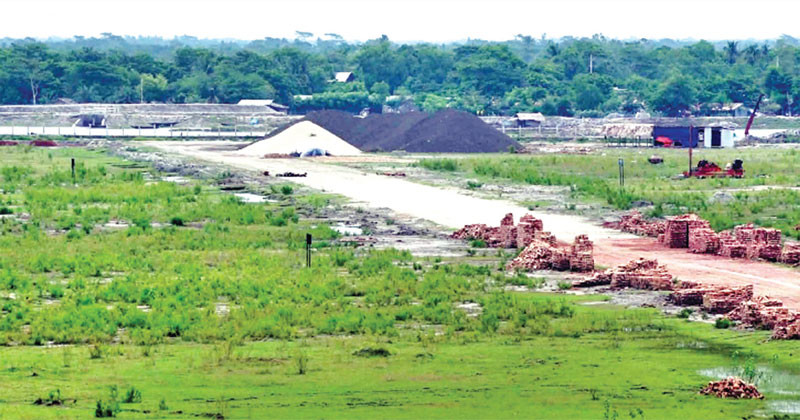
Next to Mongla Port, the China-Bangladesh Mongla Port Economic Zone is being built on 110 acres of land, under a memorandum of understanding signed between the Bangladesh Economic Zones Authority (BEZA) and China Civil Engineering Construction Corporation (CCECC).
About 30 Chinese companies are planning to invest $500 million in this zone. The Chinese economic zone, the Mongla EPZ, and the modernization of the port are expected to create new employment for roughly 60,000 to 100,000 local people. As the port’s capacity grows, new business opportunities are opening up in agro-processing, logistics, and hospitality.
According to sources, building the Chinese economic zone will play a groundbreaking role in reducing unemployment in the Mongla coastal region and will generate large-scale employment. This special economic zone is being developed on 110 acres of land adjacent to Mongla Port in Bagerhat, under the MoU signed between BEZA and China’s state-owned CCECC. The work on this special economic zone will be completed in two phases, expected to create employment for around 60,000 people overall, with about 25,000 jobs created in the first phase alone. In addition, Mongla Port’s activities and import-export volumes are set to multiply, creating ample job opportunities for locals in port-centered logistics, C&F, and transport sectors. Various training programs are being launched to build the technical and technological skills of local youth as new industries are set up, which will enhance their long-term employability. Major infrastructure — including a Bangladesh-China Friendship Bridge over the Mongla River and a 23-kilometer gas pipeline — is being built around this zone, which will energize the local economy.
On 16 August, the Energy Adviser to the Prime Minister, along with the energy minister, the minister for shipping, roads, and bridges, and the BIDA chairman, visited the proposed project site. During the visit, Minister for Shipping, Road Transport and Bridges, and Railways, Mr. Sheikh Rabiul Alam, said construction of the economic zone is officially expected to begin from this coming October. He noted that once implemented, the project is expected to create employment for around 60,000 people.
Diplomatic and economic analysts say Chinese investment means more than just strengthened diplomatic ties — it can also have a real economic impact, since Bangladesh currently stands at a point where investment, employment, export diversification, and technology transfer are all critical to its economy. They say Chinese investment could bring Mongla three major benefits: new industry, skilled manpower, and technology and management knowledge.
Mr. Ali Azgar Lobi, MP for Khulna-5, told Inqilab that the government’s goal is to transform Bangladesh into a high-income, export-oriented, industrialized, and innovation-driven economy. He called on Chinese investors to become long-term partners in Bangladesh. He noted that China has been Bangladesh’s largest trading partner for 16 consecutive years, with about 700 Chinese-funded enterprises currently registered in Bangladesh, and that CCPIT will continue working to increase engagement between the business communities of both countries and attract more Chinese investment.
Businesspeople say this agreement with the Chinese company to build the economic zone at Mongla Port signals a shift in the country’s investment policy, indicating that Bangladesh is now placing greater emphasis on attracting large-scale Chinese investment. They say more Chinese investment centered on Mongla Port could follow in the future, which would help increase employment and reduce unemployment in the coastal area — adding that training programs are needed to build local skills for this purpose.
This 110-acre plot of land given to China was originally allocated in 2015, under a bilateral initiative, for an Indian economic zone. However, the developer nominated by the Indian government failed to begin land-development work within the stipulated time. Even after Bangladesh’s political change in August 2024, no real progress was made on the project. BEZA officials said the Indian developer failed to begin the main land-development work even within the two years specified in the agreement. Subsequently, in October 2025, the interim government removed the project from its list, effectively cancelling it.