Empowering the General People is Key to Peace in the Hills
On September 10, the government formed three crucial committees regarding the Chittagong Hill Tracts (CHT): the 9-member CHT Advisory Committee headed by the Chairman of the CHT Accord Implementation and Monitoring Committee, the 15-member CHT Executive Committee headed by the Secretary of the Ministry of Home Affairs, and the 19-member CHT National Committee headed by the Honorable Prime Minister. Alongside this structural framework, the terms of reference (ToR) for the committees have been stipulated in the relevant gazette to address development, security, counter-terrorism, and communal harmony.
The ToR of the Advisory Committee states: ‘To submit recommendations to the CHT Executive Committee within the next two months for the development, security assurance, counter-terrorism, and preservation of communal harmony in the CHT.’ This committee acts as the foundational advisory layer for regional stabilization.
The ToR of the Executive Committee specifies: a) Determining specific responsibilities of relevant ministries/divisions and subordinate agencies; b) Formulating a national strategic framework regarding the suppression of terrorism and separatism, ensuring border security, enhancing communal harmony, and improving the living standards of all communities residing in the CHT; c) Reviewing existing laws, accord conditions, and rules and regulations to ensure sustainable security in the CHT, providing recommendations for necessary amendments and reforms, and formulating new laws and regulations; and d) Submitting a draft of the national strategic framework for the CHT to the CHT National Committee within the next three months.
The ToR of the National Committee outlines: a) Determining priorities on various important issues concerning the CHT and supervising inter-agency implementation; b) Defining the jurisdiction and operational fields of security forces, law enforcement agencies, and other bodies on various CHT-related matters; and c) Finalizing and executing the CHT National Strategic Framework. These integrated ToRs indicate the government’s strong intent to implement comprehensive measures.
The Beginning of ‘Opposition’
Considering the inherent significance of the government’s initiative, it can be deduced that the government aims to bring the unstable situation prevailing in the CHT under control, establish communal harmony among all residing populations, and foster peace through development. The hills have witnessed bloodshed for decades due to separatist terrorists, with separate armed factions of JSS (Santu), JSS (Reformist), UPDF (Prasit), UPDF (Democratic), MNP, and KNF currently active. Each of them is being provided with safe shelter, patronage, and training by neighboring India, which uses them as tools to serve its own interests, making the daily lives of hill residents intolerable through extortion, forced disappearances, killings, and kidnappings.
However, the regrettable reality is that a certain segment of people cannot reconcile themselves with this, as evidenced when a joint statement was issued on September 14 on behalf of 52 citizens expressing concern and attempting to cast doubt on the government’s initiative right from the outset. Although they expressed concern over the peace-building initiative, they never once raised their voices against the armed terrorist activities of the separatists in the CHT. The essence of their joint statement opposing the government’s peace initiative becomes even more apparent when similarities are found between the language of their statement and the protest note issued by the Chittagong Hill Tracts Janasanghati Samiti (JSS) on September 27.
Furthermore, a press conference held on September 28 at a Rangamati restaurant under the banner of all strata of people in the CHT put forward a four-point demand, including the cancellation of the government’s initiatives and the announcement of a roadmap for implementing the accord. The reality is that there is no difference between the statement of the 52 citizens, the protest note of the JSS, and these so-called statements from all strata of people, as all of them are cut from the same cloth.
Where Opposition is a Natural Tendency
This opposition is merely the beginning, and as the history of the CHT bears witness, any positive step taken there has invariably faced ultimate opposition, ranging from historical resistance against schools and Rangamati College to recent vehement opposition against the establishment of a university, a medical college, and public roads like the Rangamati-Longudu road. Although initial earth-cutting work had been completed and people had begun using the road, miscreants dug deep trenches across various sections within days to prevent vehicular traffic and access to the prominent tourist destination, Sajek.
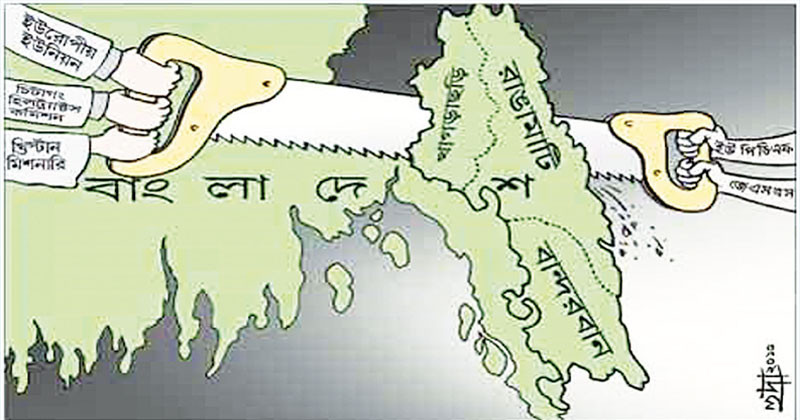
Regrettably, opposition to these development works does not come solely from armed factions, as certain quarters from the plains join hands with them, including left-leaning factions who consider the Rangamati Communist Party founders of JSS and Shanti Bahini as kindred spirits and blindly support them. Identified media outlets, media personalities, NGO entrepreneurs, Christian missionaries, and their domestic and foreign patrons remain equally vocal, echoing the same tune, meaning opposition is a natural tendency that must be factored into any initiative undertaken.
Empowering the People
Among the various reasons behind the crisis and problems in the CHT, one is keeping the general population destitute, particularly through a special traditional system under the 1900 British-enacted Regulation where circle chiefs, hundreds of headmen, and village karbaris hold landlordship and allocate temporary cultivation plots. Because residents possess no independent, permanent land ownership or land documents, they hold no permanent assets, infrastructure, voice, or influence in society and the state.
Through this zamindari system, all power and influence are exclusively enjoyed by the elites, while marginalized residents are treated as puppets easily controlled by armed factions to keep the hills unstable and amass wealth at home and abroad. To alter this situation and bring peace to the hills, the zamindari system operating under the guise of the circle system must be abolished, and the general populace must be empowered by granting them true ownership of land and assets.
Conducting a Land Survey
To ensure land ownership for every individual residing in the CHT, the government must ascertain the total amount of land available, determine habitable, cultivable, and reserved forest classifications, identify the number of landless people, and realistically register and deed land ownership using state-of-the-art methodologies. Although the government has attempted land surveys previously, armed factions and privileged elites benefiting from the zamindari system have consistently attacked and abducted personnel to foil these initiatives and protect their dominance.
Because elite resistance will thwart civilian administration surveys at any cost, an alternative path must be pursued: the responsibility for land surveys in the hills must be entrusted to the army, and the survey must be completed expeditiously. Simultaneously, land service offices should be established at the union level, providing corruption-free, digital, and prompt services to build public trust in the state and permanently sever the floating population’s reliance on armed factions.
(to be continued)
Author: Researcher and Journalist on Chittagong Hill Tracts Affairs
sayedibnrahmat@gmail.com