Erosion Threatens Kuakata Tourist Spot
- Locals Blame Poor Planning and Corruption Under Past Fascist Government
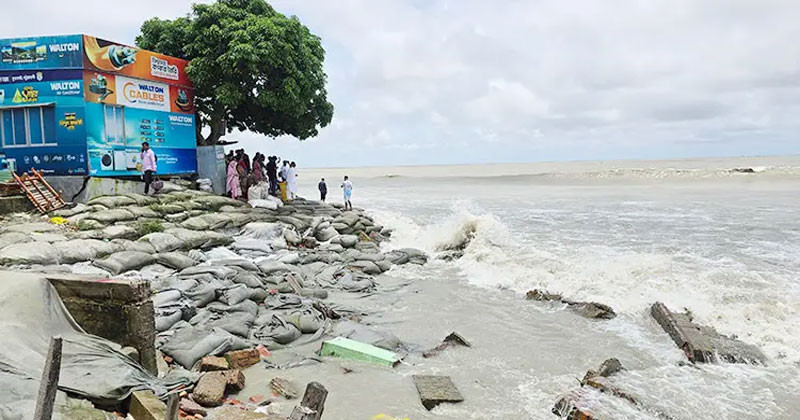
For over a decade, authorities failed to take proper planning steps for the sea facing embankment at Kuakata in Patuakhali. Irregularities and corruption in construction and repair work meant that money meant to protect the Kuakata beach simply washed away with the sea. Continued erosion has turned protective structures into death traps, and it now threatens the embankment and other nearby structures.
Kuakata sea beach sits in Kalapara upazila of Patuakhali district and holds huge tourism potential. During the past fascist government, the Kalapara constituency had two members of parliament. One served as state minister for water resources and the other as relief minister. Despite having these two influential ministers, no long term project was ever taken to stop the erosion. Instead, officials say corrupt staff and dishonest officials looted crores of taka under the name of repair work.
Toward the end of the past government’s term, about one third of a 1,300 meter road near Kuakata’s Zero Point, built by the Kuakata municipality along the beach, was destroyed. A mayor at the time had built this road on his own initiative without proper planning, spending four and a half crore taka. A five member investigation committee was later formed and asked to submit its report within seven days.
Officials had also used geobags and geotubes at different times to stop beach erosion, with rules requiring sand from outside sources to fill them. Locals allege that during the past fascist government, party affiliated workers ignored these rules and filled the bags with sand taken directly from the beach itself, working under cover of night. As a result, locals say these geobags and geotubes did not last.
Walking safely on Kuakata beach has now become dangerous for tourists, especially while swimming. Tourists usually gather within about two kilometers of Zero Point in both directions. This stretch of sand is now littered with broken concrete, bricks, stones, and even broken glass. Torn fishing nets are also scattered across the beach. As a result, tourists get injured almost every day during high tide, with children facing the greatest risk.
Local business owners say that since mid July, unusually strong waves have repeatedly damaged the beach area and its structures. Broken bricks, stones, rods, and other debris from these structures now lie scattered across the sand, causing problems for tourists. Torn fishing nets drift and get stuck in different spots, adding to visitors’ frustration and making it hard for them to move around freely.
A local resident named Mr. Imran said sea erosion now threatens shops and a police box near the beach. Public toilets and other structures have already been washed away, exposing broken debris, bricks, stones, and rods underneath. He said this creates serious problems for tourists, along with algae covered geobags and geotubes still lying around. Mr. Imran said this is why tourists get hurt during high tide, adding that daily cleanup of the debris is needed but is not happening.
A tourist couple, Mr. Azam and Ms. Sweety, said the beach is now in very poor condition and difficult to walk on. They said bricks, stones, torn nets, and even broken glass litter the area, and people often slip on algae covered, torn sandbags. They said they had never seen the beach in such bad shape before, adding that broken rods and blocks cause constant trouble, with someone getting hurt almost every day.
The flood control embankment at Polder 48, next to Kuakata beach in Kalapara upazila, now faces serious risk. Strong tidal surges during new moon and full moon periods, a low pressure system in the Bay of Bengal, and rough sea waves have caused the slope blocks of the embankment, built under the CIP 1 project west of Kuakata Zero Point, to sink and collapse, raising fears that parts of it may disappear into the sea.
According to the Water Development Board, a 400 meter stretch of the coastal embankment between kilometers 31.250 and 34.280, covering Latachapli, Dhulasar unions and Kuakata municipality, has suffered serious damage. In the damaged areas, the stone base, geo textile layer, sand filter, and soil beneath the blocks have washed away, creating large holes.
If this damage is not addressed urgently, officials fear that many important government and private structures near the beach could be lost to the sea.
For unknown reasons, the Water Development Board’s Patuakhali and Kalapara offices currently hold no information on this issue. However, one source says a coastal embankment development agency, funded by the World Bank and working through Chinese contractors, had placed blocks along 39 kilometers of embankment and carried out various repair and compensation work. Local Water Development Board oversight of this work later suffered damage.
Mr. Md. Shah Alam, executive engineer at the Kalapara office of the Water Development Board, said repair work on the damaged 400 meter stretch has been planned under the operations and maintenance budget for fiscal year 2026-2027. Under the initial plan, workers will remove the old blocks from the damaged site, refill the area with soil, and install a new sand filter, geo textile layer, and stone filter before placing new blocks. He added that installing dumping blocks along the shoreline has also become urgent to protect the shore.
To carry out this work, a budget request has been sent under the operations and maintenance category, and formal repair work will begin once the design gets quick approval. Separately, a project worth 756 crore taka was sent to higher authorities in 2024 but was not approved. Officials are now working to revise and resubmit this proposal.