Floods must not recur, sustainable solutions needed
Dr A. R. M. Mainuddin Chowdhury Liton
Floods are not a new phenomenon in Bangladesh, but their nature and intensity have changed alarmingly in recent years. Once a seasonal and relatively short-lived natural phenomenon, floods have now become a complex national crisis due to climate change, abnormal rainfall, upstream water flows, declining river navigability and unplanned development. Every year, floods remind us that disaster management cannot depend solely on relief distribution; science-based and long-term planning must become a central state commitment.
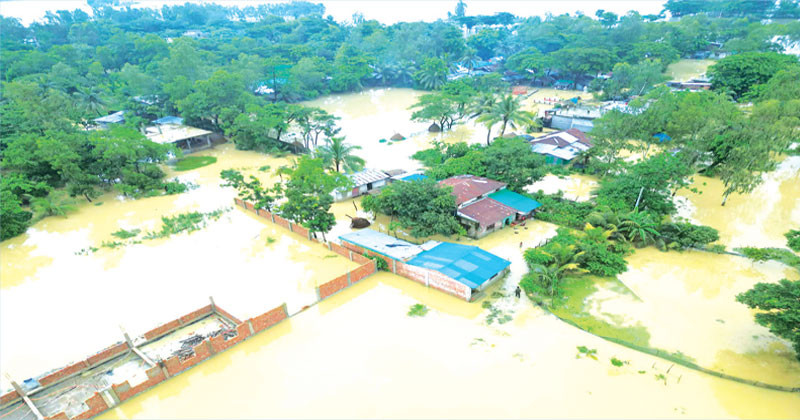
During the current monsoon season, widespread flooding has affected the country’s southeastern region, including Chattogram, Cox’s Bazar, Bandarban, Khagrachhari, Rangamati, Moulvibazar and Habiganj, following continuous heavy rainfall and mountain runoff. Hundreds of thousands of people have been stranded, many families have been forced to move to shelters, and roads, bridges and communication networks have been damaged. In some areas, electricity supplies have been disrupted, safe drinking water has become scarce and the risk of waterborne diseases has increased. The army, navy and various government agencies have joined rescue and relief operations, but damaged communication networks have created obstacles to reaching remote areas.
The government has distributed dry food, rice, safe drinking water, medicines and emergency medical supplies in affected areas, while operating shelters and conducting rescue operations. The Ministry of Disaster Management and Relief, local administrations, the armed forces and volunteers have worked together. Experience, however, shows that while an immediate relief response is important, disaster preparedness and long-term infrastructure investment are even more essential. An analysis of data from recent years shows that floods in Bangladesh are no longer merely seasonal disasters; because of climate change, they are becoming increasingly frequent, prolonged and devastating.
The devastating floods in the Sylhet-Sunamganj region in 2022 affected nearly 7.3 million people. Thousands of educational institutions, homes and croplands were submerged, while economic losses exceeded several thousand crore taka. In 2024, floods in the eastern and southeastern parts of the country affected around 5.8 million people and killed more than 70. Many roads, bridges, agricultural lands and critical infrastructure were severely damaged. In July 2026, continuous rainfall, upstream flows and heavy rainfall in hilly areas caused severe flooding in Chattogram, Cox’s Bazar, Bandarban, Rangamati, Khagrachhari, Moulvibazar and Habiganj. Government and international situation reports showed that more than 1 to 1.2 million people were affected, more than 267,000 families were stranded and over 50 people died. Hundreds of shelters had to be opened, while hundreds of thousands of people received emergency assistance. According to Water Development Board estimates, damage caused by breaches in embankments and sluice gates in the Chattogram region amounted to around Tk 150 crore. In southern Chattogram, including Banshkhali, Satkania and Chandanaish, around 20,000 tube wells and more than 5,600 toilets were submerged or damaged, creating serious public health risks. According to the Ministry of Disaster Management and Relief, floods caused total damage of Tk 29,277 crore in Bangladesh over the five years from 2021 to 2025. These figures prove that floods in Bangladesh are no longer simply natural disasters; climate change, unplanned development, river encroachment and environmental degradation are making their impacts more severe. Although floods are natural disasters, much of the damage can be reduced. For this, long-term planning must accompany short-term relief measures.
Unplanned human activities are significantly increasing the damage caused by floods. River encroachment and filling reduce rivers’ water-holding capacity. Filling canals, wetlands and water bodies to build settlements and structures blocks natural drainage routes. Deforestation reduces the soil’s ability to retain water, causing mountain runoff to reach low-lying areas more rapidly. Unplanned urbanisation and weak drainage systems create waterlogging and flash floods in cities. Industrial waste and plastic clogging drains and sewerage systems further worsen the situation.
Climate change is becoming one of the main causes of flooding in Bangladesh. Excessive and irregular rainfall has increased. Himalayan glaciers are melting rapidly, causing more water to flow downstream. The risks of cyclones and storm surges are increasing. Rising sea levels are causing prolonged waterlogging in coastal areas. As a result, floods are becoming more frequent, prolonged and destructive than before.
Long-term plans are essential to reduce flood damage. Rivers and canals should be dredged regularly and freed from encroachment. Wetlands must be protected and natural drainage routes preserved. Sustainable embankments and modern flood-control infrastructure should be built. Modern weather forecasting and early-warning systems must be strengthened. Disaster-resilient homes, shelters and roads should be constructed. People should receive greater training and awareness on disaster preparedness. Coordinated initiatives should be taken at both national and international levels to address the impacts of climate change.
Almost the entire geographical landscape of Bangladesh is a river-borne delta, and much of the country consists of flood-prone plains. Therefore, it is impossible to prevent floods entirely, but their damage can be reduced significantly. Our awareness is the path to our protection.
The writer is a former student leader at the University of Dhaka and a former researcher at Hokkaido University, Japan.