Following the Ideals of Ghaus-e-Pak (R.A.) Essential for Human Salvation, Says Baitush Sharaf
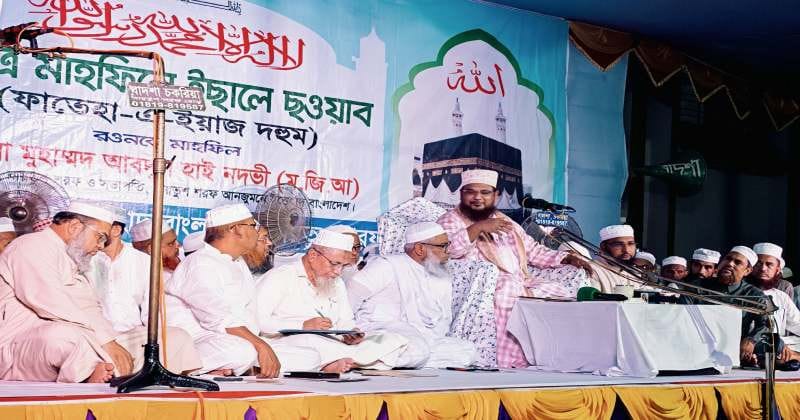
The life and teachings of Ghaus-e-Pak Hazrat Shaykh Abdul Qadir Jilani (R.A.) remain vital for human liberation and spiritual purification, as he strictly followed the ideals of Prophet Muhammad (S.A.W.). Speaking as chief guest at the annual Esaale Sawab Mahfil organized by the Cox’s Bazar Baitush Sharaf Complex for Fateha-e-Yazdaham, Rahbar-e-Baitush Sharaf Allama Shaykh Abdul Hai Nadvi (M.Z.A.) stressed that his order serves mankind. He highlighted that the Baitush Sharaf Darbar stands on the foundation of the Qadiriyya order, integrated seamlessly with the Naqshbandiyya-Mujaddidiyya and Muhammadiyya spiritual orders to promote human welfare across the nation.
During his address, Allama Shaykh Abdul Hai Nadvi (M.Z.A.) formally announced his personal spiritual connection and lineage to these traditional orders. He shared that approximately three years ago, Allama Sayyid Salman Hussain Nadvi (R.A.) conferred upon him the essential lessons, khilafat (spiritual lineage), and Hadith sanad of various Islamic orders. Reflecting on the historic significance of the day, he explained that Ghaus-e-Pak passed away on the 11th of Rabi’ al-Thani in 561 AH, which is why the annual Esaale Sawab Mahfil is traditionally organized on this date to observe Fateha-e-Yazdaham with deep reverence.
Recounting the remarkable life of Ghaus-e-Pak, the chief guest detailed his childhood and early academic achievements. Born on the 1st of Ramadan, Hazrat Abdul Qadir Jilani displayed miraculous spiritual traits from his early years, including instances where seating space was miraculously created for him at the Maktab. He successfully memorized 18 paras of the Holy Quran during childhood before traveling to Baghdad to master Islamic education, Hadith, and Fiqh. His foundation laid the groundwork for an order deeply focused on public service, which modern spiritual leaders uphold by establishing hospitals, academies, orphanages, and service centers.
Regarding organizational development, Allama Shaykh Abdul Hai Nadvi shared that over 700 institutions are currently operating across the country under the central Baitush Sharaf management. The massive gathering included extensive discussions on the spiritual virtues of reciting Darood Sharif upon Prophet Muhammad (S.A.W.). Jointly moderated by Qazi Maulana Shihab Uddin and Maulana Omar Farooq, the event featured prominent Islamic scholars who discussed the significance of devotion, service, and spiritual growth in contemporary society.
The Esaale Sawab Mahfil involved rigorous acts of devotion, including Khatam-e-Quran, Khatam-e-Khajegan, endless recitations of Darood Sharif, and Khatam-e-Bukhari Sharif. Following the Maghrib prayers, attendees participated in a Zikr mahfil, which extended into late-night Tahajjud prayers and further Zikr sessions. The next day concluded with rituals of Tauba-Istighfar, Ba’iat, and a special Munajat offered for global Muslim unity, peace, and national prosperity.
Addressing contemporary challenges, Rahbar-e-Baitush Sharaf expressed deep concern over the moral decay and lack of Islamic foundation among today’s youth. He stated that youth in present-day society have lagged in acquiring Islamic knowledge and must be trained with proper religious education. He emphasized that to eradicate social superstitions, establish an Islamic social order, and build an advanced community, the youth must enrich themselves through the study of the Holy Quran, Hadith, and authentic Islamic literature.
In his concluding advice, Allama Shaykh Abdul Hai Nadvi recommended his authored Islamic literature as valuable educational resources for the younger generation. He called upon religious scholars, community leaders, and parents to step forward proactively to guide and assist young people in acquiring proper Islamic knowledge. He reaffirmed that grounding the youth in authentic religious teachings and public welfare is the most effective pathway toward building a moral, reformed, and progressive society.