Order to Return to Food Market Through Mandatory Registration of Food Businesses and Products
Eklas Haque and Md. Zahidul Islam
Hotels fill every lane, and restaurants stand at every street corner. Fancy rooftop restaurants rise on top of buildings, and motels serve travelers at rest stops on long routes. At night in Dhaka, the signboards of hotels and restaurants glow. Inside, the menus offer everything from tea and coffee to local and foreign dishes.
Demand keeps rising, so prices keep rising too. Even so, a family finds it hard to get a table on a holiday. On the other side, roaming sellers now hold the footpaths of many roads in the capital. Food stalls do business from morning until late at night.
But nobody watches over these food shops, and nobody controls their quality. Data shows that unsafe food costs the economy 3.5 billion dollars. More than 1 billion dollars of this goes to medical treatment. The government has now moved to bring these businesses under registration. It wants to ensure food safety, avoid health risks, add working hours, grow the economy and bring order to the supply system.
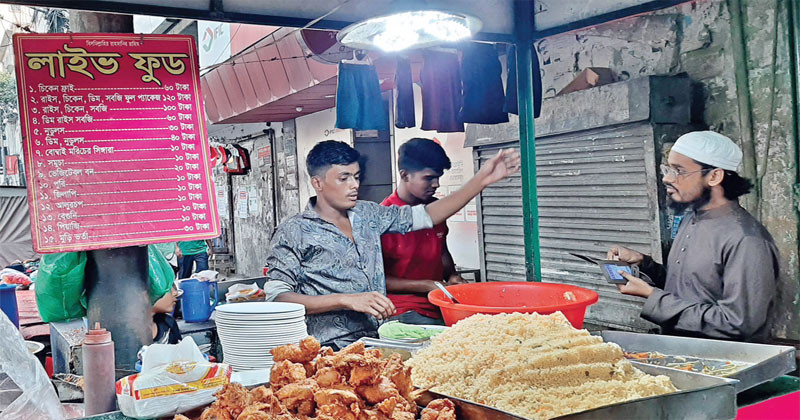
Sellers on different footpaths sell tea, biscuits, bread, bananas, parota, lentils, vegetables, khichuri, rice and bhorta. They also sell eggs, singara, samosa, puri, fuchka, chotpoti, jhalmuri and many kinds of fried snacks. Seasonal fruits, sherbet, juice and drinks are on sale too. These shops meet a large part of the demand for breakfast and lunch among working people in office areas and business areas.
Footpath food shops are an easy choice for passengers and transport workers near bus stands, railway stations and transport hubs. Students and guardians also eat food from these shops near schools and colleges. The government has put stress on bringing these food shops in the capital under registration, because people need them and order is needed. A gazette published a few months ago carries the “Safe Food (Registration and License) Regulations, 2026”. These regulations make registration and licenses a must for fixed classes of food businesses and food products.
The rules set registration for 16 kinds of food businesses and food sites. These include restaurants, bakeries, pastry shops, fruit juice shops, catering service firms and sweet shops. They also include makers of dairy products and makers of packaged food. Wholesale grocery food businesses, food stores and cold storage will also come under this system. So will the import, production, processing, storage, export and marketing of fixed classes of food.
The authority will also register temporary and roaming sellers who sell pitha, puri, onion fritters or other food by the road, if they want to register. In short, the system covers everyone from roadside temporary food stalls to restaurants, bakeries, sweet shops, food makers and importers of fixed classes. The Bangladesh Food Safety Authority has said that registration will become a must from the start of next month.
Food safety is the big worry in food sales at footpath shops. The authority says it will be easier to keep data on each shop once sellers come under registration. It will also be easier to give guidance on hygiene and to carry out regular visits. The authority will record the seller’s identity, the shop’s location, the kind of food sold and basic facts about the business at registration. This will make it easier to find the shop involved if any wrong is done.
Mr. Md. Anwarul Islam Sarker, Member (Law and Policy) of the Bangladesh Food Safety Authority and a Joint Secretary, spoke to Inqilab. He said the authority is working to bring food businesses into a database through registration. He said the rules require registration for food businesses and food sites. These include restaurants, bakeries, pastry shops, fruit juice shops, catering service firms, sweet shops, makers of dairy products and makers of packaged food.
Mr. Sarker said this step will play an important part in keeping data on footpath food shops and small businesses. These small businesses have so far stayed outside any watch. He said the registration will keep data on which kind of food business runs in which area. It will also keep the identity of the owners, the identity of the business and its location. This will make it easier to look into food safety complaints, to watch the businesses and to take needed steps.
He said the authority takes no fee in the registration process. He said the process will keep going. He said, “We also want sellers to come into a system.”
Officials of the authority say they will not start with raids and punish traders right away. First, they will run campaigns, hand out leaflets and spread the word in the media to build awareness of the law. After that, they will give traders a fixed time to get ready. When that time ends, they plan to carry out raids.
The rules also require licenses for fixed businesses that deal in special food products. These businesses make, process, store, import and market such products. The products include health support and supplement food, special diet food and medical special diet food. They also include probiotic and prebiotic food, nutraceuticals and related products. Makers of baby formula milk, and of special food for people with certain diseases, must also follow the rules that apply.
Not every food business needs the same kind of approval. A business must take registration or a license by the kind of business and the class of product. The authority says this step will bring openness and accountability to registration and licensing of food businesses. It says production and marketing of food will become more orderly. It also says the work of ensuring safe food to protect public health will become more effective.
Registration and licenses will last three years, and owners must then renew them. Under the rules, the first registration of the 16 common kinds of food business is free. The premises license fee for firms that make superfood will depend on the size of the floor. A firm of 100 square meters or less will pay Tk 10,000. A firm bigger than 10,000 square meters will pay Tk 60,000 for a new license.
The 2024 Economic Census of the Bangladesh Bureau of Statistics (BBS) shows that both units and jobs grew in industry and services in the last decade. According to the census, economic units in cities and villages have grown to more than 1 crore 17 lakh. Of these, 1 crore 5 lakh 34 thousand 443 units belong to the service sector.
If the average minimum registration fee is Tk 10,000 for each unit, the amount comes to Tk 3,333 a year. At this minimum rate, collecting the fee from 1 crore 5 lakh 34 thousand 443 firms would add Tk 3,511 crore 48 lakh 10 thousand to the government’s treasury. If the average fee is Tk 5,000, the treasury would get an extra Tk 5,267 crore 22 lakh 15 thousand. The government could spend this money on social protection, health and education.
According to the World Health Organization, eating unsafe food that holds harmful bacteria, viruses, parasites or chemicals causes more than 200 diseases. One in every 10 people falls ill, and 420,000 people die every year. Children under five years of age carry 40 percent of the food borne disease. Because of this, 125,000 children die every year around the world.
In Bangladesh, 35,000 people die every year from eating unsafe food. Unsafe food also causes heavy medical costs and lost working hours. It also blocks the country’s gross domestic product (GDP) and economic growth in an indirect way. World Bank data says people in Bangladesh lose more than 1.5 billion dollars of productivity every year because of unsafe food. In Bangladeshi money, this is more than Tk 12,000 crore. Diseases from unsafe food mainly cause this loss of productivity.
A survey of the Bangladesh Food Safety Authority says unsafe food causes an estimated economic loss of 3.50 billion dollars a year in the country. This is about 1.20 percent of the GDP. Direct medical costs make up about 1.10 billion dollars of it.
Experts say that if footpath food shops come under registration in a planned way, it can ensure food safety. It can also bring order to business, raise the accountability of sellers and increase government revenue. But registration alone will not solve the problem. The country also needs regular watch and training on hygiene. It needs to encourage the use of materials for safe food making, and it needs waste management. It also needs a clear policy on the use of footpaths.
If the government can find and bring a huge number of small businesses under rules, revenue management can change for the better. Income can also come from other charges allowed by law. A clear business structure will also bring order to the related administrative work. The government must collect revenue, and it must also make sure it answers for how it spends the money. Sellers and ordinary people can both gain if the money goes to cleaning footpaths, collecting waste and supplying safe water. It can also go to improving fixed selling places and watching food safety.
Mr. Siddique sells tea, biscuits and other food on the footpath of Motijheel Colony Bazar in the capital. He told Inqilab that he opens his shop every day from morning until night. He said, “The money my family of four needs each month comes from here. But I have not yet heard the news that a food shop needs registration. If we must take registration to run our shop, we have no problem. We want to do business even if we pay the fixed fee to the government.”
Food shops stand beside every road in Gulistan in the capital. Sherbet seller Mr. Imam Hossain told Inqilab there is no problem for them if the government moves to bring all small and big food shops under registration. He said, “Now we run our shops by paying money to powerful people. After registration, we will run our shops even if we must pay the fixed fee to the government. But if a clear policy exists, order will return to the footpath shops. A race to sell healthy food will also grow.”