Govt to Build Food Reserves of 3.4 Million Tonnes by 2030
The government plans to increase its food grain storage capacity to 3.4 million tonnes by 2030 to strengthen food security and expand storage facilities.
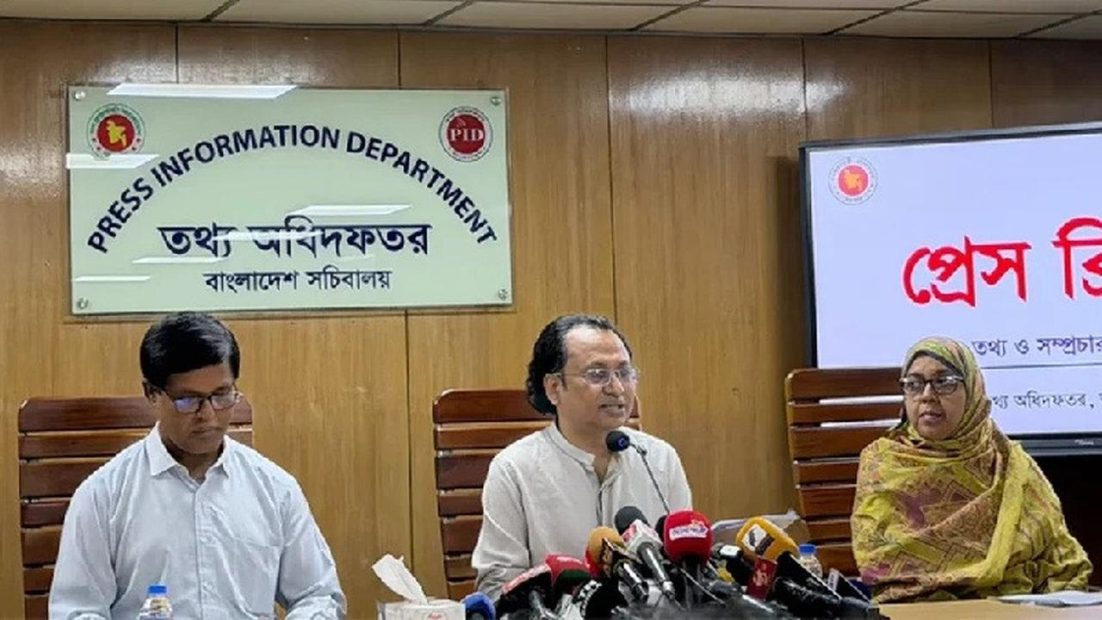
Prime Minister’s Adviser on Information and Broadcasting Dr Zahed Ur Rahman disclosed the plan at the weekly press briefing at the Department of Information on Tuesday (October 13).
At the briefing, Dr Zahed outlined key decisions and progress across several ministries, including food, railways, commerce, energy, power, sports and environment.
Presenting information from the Ministry of Food, he said the country’s food grain stocks were currently at a satisfactory level. Facilities under the Directorate General of Food, including central storage depots (CSDs), local storage depots (LSDs), silos and warehouses, have a combined storage capacity of 2.409 million tonnes.
However, around 92,000 tonnes of storage capacity is currently unusable due to dilapidated conditions, ageing infrastructure and river erosion. The government has taken steps to repair and renovate the warehouses so they can be used again.
Dr Zahed said a special meeting had recently been held with all deputy commissioners (DCs) to prevent an artificial shortage of liquefied petroleum gas (LPG) cylinders and ensure sales at fixed prices. The DCs were instructed to prepare lists of distributors and dealers in their respective districts, ensure supplies through proper channels and promptly identify irregularities for legal action.
In his written statement, Dr Zahed said the Directorate of National Consumer Rights Protection, under the Ministry of Commerce, had conducted 368 monitoring drives across the country during the first 11 days of October to curb irregularities in the markets for essential commodities and LPG cylinders. A total of 728 businesses were fined Tk 71 lakh for violating consumer rights.
10 handloom products receive GI registration
Dr Zahed said 10 products had received geographical indication (GI) registration in favour of the Bangladesh Handloom Board to protect the country’s traditional textiles and handloom industry.
The products are Dhakai muslin, Dhakai phuti karpas, Sylhet’s Manipuri saree, Mirpur’s katan saree, Comilla’s khadi, Sirajganj’s gamcha, Sirajganj’s lungi, Kumarkhali’s bedsheet, phuti karpas cotton seeds and plants, and Kaliganj’s towel.
Highlighting progress at the Rooppur Nuclear Power Plant, Dr Zahed said Unit 1 achieved criticality at 3:34pm on October 11, 2026, marking a major milestone for the Ministry of Science and Technology.
Criticality means a self-sustaining nuclear fission chain reaction has begun. The unit is expected to start supplying electricity to the national grid in phases soon, he said.
The briefing also said the administrative process had been completed to approve operations at 21 new daycare centres in the 2026–27 fiscal year under the Ministry of Women and Children Affairs’ project to establish 60 daycare centres. The project aims to support working women and protect children.
Dr Zahed also said the prime minister had instructed the Ministry of Youth and Sports to establish at least one sports ground in every union in phases. Social security and insurance benefits were also announced for national-level athletes.
Meanwhile, he said 35.7 million saplings had been planted over the past seven months as part of the Environment Ministry’s target of planting 250 million trees over five years.