

Humanity Is Disappearing from Society
Hasan-uz-Zaman
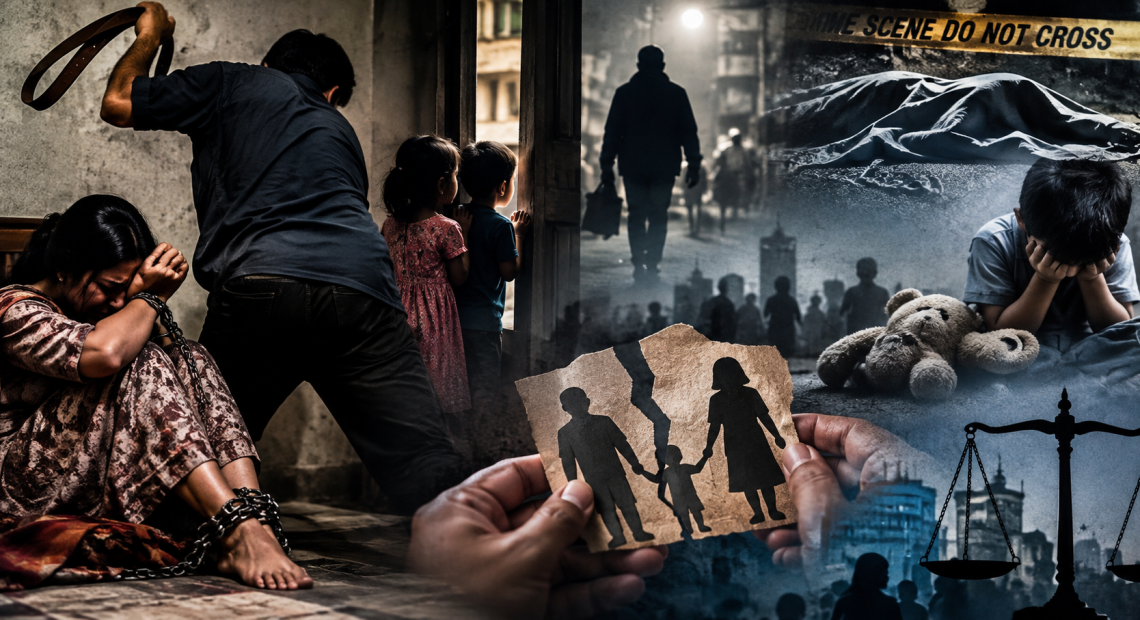
Housewife Ms. Mukta’s feet were chained to a bed. She was then subjected to brutal torture. Trapped and helpless, Ms. Mukta could do nothing as her husband, Sohel Sikder, repeatedly beat her with a leather belt. Hearing their mother’s screams, the couple’s two innocent children, aged four and five, were crying in the next room. The children went to the door and saw their mother being brutally tortured. Even that did not soften Sohel’s heart. At one point, Ms. Mukta died from the torture.
In Old Dhaka,Mr. Rony was killed by his friend Masum when he went to ask for money he was owed. After killing Mr. Rony, Mr. Masum tied his hands and legs, wrapped his face with Scotch tape, buried the body and then covered the spot with cement. In Khilgaon, a young man named Judge Mia was hacked to death over an extramarital affair, and his body was thrown into a canal.
Thousands of brutal incidents are taking place in society every day. People are becoming increasingly violent and aggressive even over trivial matters. Arrest, imprisonment or punishment can no longer prevent people from committing such acts of brutality.
Crime and social science experts say such brutal incidents leave us shocked, angry and deeply saddened. Our eyes become filled with tears. We have seen people being hacked to death in broad daylight. We have also seen people being burned alive in buses and children being brutally killed by forcing air into their rectums.
Such inhuman behaviour is essentially a reflection of the brutal instincts within people. Tolerance among people is declining day by day. A culture of impunity and rising criminal tendencies are creating an atmosphere of fear in society. People are now becoming accustomed to seeing serious brutality and crimes around them. A lack of values within families and the spread of criminal behaviour are contributing to the increase in such incidents.
Another recent incident that drew widespread attention was the triple murder in Jamgara, Ashulia. On September 1, after the factory closed, garment worker Mosammat Nazma Khatun and her husband, small businessman Alamgir Kabir, returned home together. Ms. Nazma was seven months pregnant.
On the day of the incident, they had called an acquaintance to their home to settle an issue. During an argument with the acquaintance, Mr. Alamgir was killed. Ms. Nazma, who was seven months pregnant, was then assaulted with the intention of killing her. The assault caused her to give birth to a newborn.
The accused then killed Ms. Nazma and her newborn child, locked the house from outside and fled. After the bodies were recovered on September 5, the Police Bureau of Investigation (PBI) began investigating the completely mysterious case and eventually uncovered the main motive and details of the crime.
Another horrifying incident involved a mother killing her own newborn child. On August 17, the body of a 14-day-old newborn was recovered after being found submerged in water inside a plastic drum in Begumganj, Noakhali.
During questioning about the child’s death, the mother, Fatema Begum, gave incoherent statements. She eventually confessed to drowning her child. Explaining the reason, Ms. Fatema said she could not sleep because of the newborn’s crying. Irritated by the crying, she threw the baby into a water drum and killed the child.
On Wednesday night, miscreants poured petrol over the body of a young man named Farhad Hossain in Muktagacha, Mymensingh, and set him on fire. Despite jumping into nearby water in unbearable pain, he could not save himself. Mr. Farhad died while undergoing treatment at Mymensingh Medical College Hospital on Thursday afternoon. Locals said Farhad Hossain had been involved in various social movements, including campaigns demanding employment for unemployed people. He had also organised various programmes against drugs. He had disputes with some people over these activities.
How cruel must a person become to kill a friend, bury his body and then cover it with cement? A similar incident took place in Lalbagh in the capital. Early yesterday, the body of businessman Mr. Rony was recovered from an empty space on the ground floor of a house at 9 BC Das Street in Lalbagh after police dug through sand and cement. His hands and legs were tied, and his face was wrapped in polythene.
Police and Mr. Rony’s family said Mr. Rony had a business-related debt of Tk 300,000 with Mr. Masum, an imitation jewellery trader at Ashiq Tower in Chawkbazar. Mr. Rony was killed at Mr. Masum’s home when he went there to collect the money. What is particularly shocking is that after Mr. Rony went missing, his killer Mr. Masum also joined the search for his friend with Mr. Rony’s family. Such brutal incidents are occurring one after another in society.
Speaking about such incidents of brutality, Dhaka University Department of Psychology Professor Dr Nazrul Islam told journalists that most people in society are controlled not by law but by their conscience. Some influential people violate the law, and their actions affect others. As a result, people begin to lose their ability to distinguish between right and wrong.
Dhaka University Department of Sociology Professor Dr Md Anwar Hossain told Inqilab, “Day by day, we are losing our mentality and humanity. In the past, we had a beautiful community-based life where we shared everything with one another and had strong family and social bonds. This was deeply connected with Islamic values. But now our sense of compassion is being destroyed. This is the main reason for disorder in society.”
A senior psychologist at the Health Sector of Dhaka Ahsania Mission told Inqilab, “It is particularly important to remember that it is not scientifically correct to consider any mental illness or psychological stress as a direct cause of brutal murder. Most people with mental illnesses are never violent. In cases of crime, a person’s history, motive, circumstances, power relations, behavioural characteristics and social context must be assessed together.”
According to the psychologist, when a person’s ability to feel or understand another person’s suffering decreases, they may ignore another person’s fear, crying or pain. In particular, violence can increase when someone has a long-standing tendency to view others not as human beings but as people under their control. The psychologist said that when a child witnesses a murder or serious violence, they do not simply become witnesses to a crime. They may also suffer deep psychological trauma.
Therefore, punishment after an incident is not enough. Risks must be identified and prevented before violence occurs. Brutal violence is generally the result of a complex combination of personal psychology, the desire for power and control, distorted thinking, failure to regulate emotions, a history of previous violence, and social and structural risks. “Our position against violence must be clear: not silence, but awareness. Not tolerance, but prevention. Not fear, but safety. Alongside punishment, we need prevention and psychological change.” He said.
Khandaker Farzana Rahman, Chairperson of the Department of Criminology at Dhaka University, told Inqilab, “Our family system is breaking down. As a result, social values are declining among us. We now think about our own benefits. People cannot think about anything beyond their own interests. The values that we learned from our families and society are now increasingly lacking.”