‘Implementation Summit’ COP31: Bangladesh Heads to Antalya with Fair Expectations
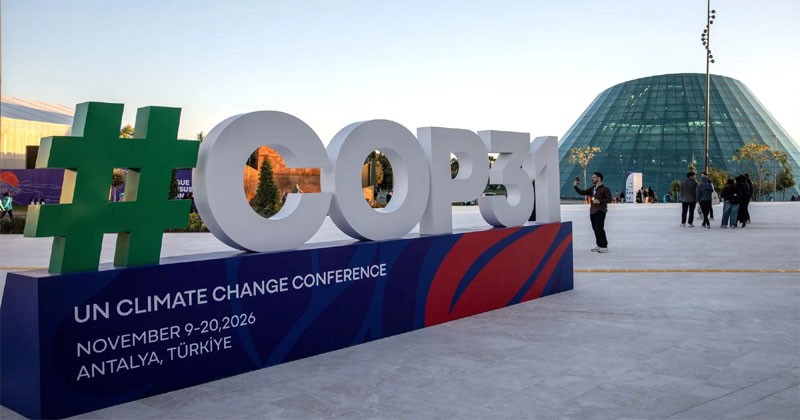
The 31st United Nations Climate Change Conference (COP31) began yesterday in Antalya, Turkey, and will continue until 20 November. About 200 countries will take part in the two week event at a huge exhibition centre in the Mediterranean coastal city. Heads of state and government, policymakers, climate experts, researchers and civil society representatives will join.
Turkey is presiding over the conference, but Australia is leading the negotiations. This was arranged through an unusual compromise to end a dispute over choosing the host country. Turkey and Australia are presenting this event as a “conference of implementation”. Its main goal is to turn the promises and ambitious announcements of many years into real action.
A high level Bangladesh delegation, led by Prime Minister Mr. Tarique Rahman, is attending the conference. His wife Dr. Zubaida Rahman, the environment minister, two ministers of the Ministry of Foreign Affairs and Dr. Md. Saimum Parvez, special assistant on forest and environment, will also be in the team. The Prime Minister will leave Dhaka for Turkey today. He will return home after speaking at the main session on 12 November.
On the sidelines, he will hold bilateral meetings with the President of Uzbekistan, the Vice President of China, the Foreign Minister of the United Kingdom and the Assistant Administrator of the United Nations Development Programme (UNDP). He will also meet other heads of government and representatives. Issues of overall relations with Turkey, especially trade, investment and defence cooperation, will get importance in the talks.
The possibility of Turkish cooperation to set up a drone factory in Bogura may also come up, although the final location of the factory is not yet fixed. Newly appointed Foreign Secretary Mr. Salahuddin Noman Chowdhury said this at a press briefing of the Ministry of Foreign Affairs yesterday Monday.
The conference will have two important areas, called the Green Zone and the Blue Zone. In the Green Zone, the potential of Bangladesh’s jute and jute products will be shown. An agreement between Bangladesh and Turkey on jute and jute products is also part of the plan. In the Blue Zone, various discussions on climate change will be held on 12 and 13 November. The potential of jute based, environment friendly and biodegradable polymer products will be presented there. Australia is presiding over this event.
The Bangladesh government is setting up a pavilion of 100 square metres at the venue. It will show Bangladesh’s climate risks, adaptation experience, NDC 3.0, the National Adaptation Plan, climate finance, loss and damage, carbon market, renewable energy and local community initiatives. The pavilion will be used to share experience, hold policy dialogue and create chances for international cooperation. A jute pavilion will also be set up beside it.
Bangladesh’s main aim is to ensure effective cooperation from the international community. Bangladesh is responsible for only 0.05 percent of climate change, yet the country suffers huge losses from it. The impact of shrinking farmland, environmental disasters, sea level rise, salinity risk and various natural disasters will be shown to the international community. By showing this contrast, Bangladesh will strengthen its demand for climate justice and compensation.
Developed countries promise climate cooperation to Bangladesh, but in reality this help is not always received. This time Bangladesh wants to show not only its own needs but also what kind of cooperation developed countries will actually give. The Prime Minister will give special importance to climate compensation, finance and technology transfer.
At COP31, Bangladesh will demand that the fund for climate adaptation be tripled. It will also raise the issues of increasing finance to face climate related loss and damage, the goal of keeping the rise in global temperature within 1.5 degrees Celsius, and ensuring the money needed for adaptation. Environment, Forest and Climate Change Minister Mr. Abdul Awal Mintu has stressed grant based climate finance.
He said Bangladesh will demand more grants instead of loans for adaptation and loss and damage, so that the burden of debt does not grow. It will also demand an easier process for applying for and approving climate funds. According to the minister, Bangladesh’s economic loss from climate change is about 15.2 billion dollars a year.
Department of Environment Director Mr. Mirza Shawkat Ali said the National Adaptation Plan (NAP) made in 2022 has not yet received much international finance for its implementation. He said Bangladesh is among the 27 LDC countries that have submitted the plan. He referred to the Baku decision of COP29 in 2024. Under the New Collective Quantified Goal (NCQG), total climate finance will be 300 billion dollars by 2035. Bangladesh wants a good share of resilience finance and wants it to be tripled.
He also said the Bangladesh government itself gives about 4.2 billion dollars a year from the ADP for the climate related budget. He said Bangladesh is in a better position than LDCs and other developing countries in terms of national level preparation and capacity.
Earlier, Dr. Md. Saimum Parvez, special assistant to the Prime Minister on environment, forest and climate change, said at a press briefing at the Secretariat that Bangladesh’s position paper has been prepared. It took opinions from related ministries, divisions and agencies and advice from climate experts. He said the Bangladesh delegation will work for national interest in coordination with the group of Least Developed Countries, the G77 and like minded climate vulnerable countries.
He said Bangladesh expects specific progress on finance and implementation support from COP31. This progress should protect the lives and livelihoods of people against climate risks. He also said steps have been taken to increase contact with countries at risk of sea level rise and salinity. On the sidelines of the conference, the Prime Minister may hold bilateral talks with the chief representative of Turkey and representatives of partner countries including Australia, Canada, England and Barbados.
Experts say Bangladesh can use BBIN, a regional bloc of four countries including Nepal, to show the climate losses of South Asia to the world. Mr. Md. Shamsuddoha, chief executive of the Centre for Participatory Research and Development (CPRD), said Nepal and Bhutan have given a joint statement to include the issue in the COP agenda. But Bangladesh is not mentioned in it.
He thinks Bangladesh did not show as much diplomatic activity and role in this matter as it should have. He said the climate risk of Nepal will also harm Bangladesh. So Bangladesh should not be left out of any regional alliance of Nepal, Bhutan and India. He also advised that steps be taken from now so that Bangladesh does not lose climate finance after leaving the LDC list in three years. He said climate finance should be decided on the basis of a country’s vulnerability.
Climate expert Mr. Ainun Nishat explained how discussions and decisions work at COP. He said there are two clear streams. One is the Blue Area, where heads of state and representatives hold the main policy talks based on the Paris Agreement and global law. The other is the Green Area, where ordinary civil society, NGOs and various representatives raise their demands.
He thinks Bangladesh has limited scope for separate talks. The main discussion and bargaining happen at the state level. The head of government, the environment minister, the state minister for environment, the environment secretary and ministry officials will hold the main responsibility. In bilateral meetings, heads of state can raise their problems and the issue of finance and make an impact.
According to Professor Dr. AKM Saiful Islam of the Institute of Water and Flood Management at BUET, efforts for climate finance and emission cuts face challenges. He named the withdrawal of the United States from the Paris Agreement, wars around the world and obstruction by oil rich countries as the reasons.
He said finance for coastal adaptation and for carrying out the National Adaptation Plan may come up at this conference. Direct grants and technical help to face climate related loss and damage may also be discussed. So may a new goal for finance, and alternative livelihoods and social security for communities hurt by the energy transition.
In the international context, global investment in clean energy is rising, but its benefits are not shared equally. According to a United Nations report, emerging and developing economies excluding China are home to about two thirds of the world’s people. Yet these countries received only 18 percent of global clean energy investment in 2025. Africa has huge potential for renewable energy, but investment is low and about 600 million people still have no electricity.
Mr. Selwin Hart, United Nations Special Adviser on Climate Action and Just Transition, said one of the biggest barriers for developing countries is raising money for investment. He said even with the same technology, renewable energy projects in these countries can cost several times more to finance than in developed countries. The situation is even harder for countries burdened with debt.
Scientists have warned that the 1.5 degrees Celsius limit of the Paris Agreement on global temperature rise may be crossed for a time. This is called “overshoot”. But Mr. Hart said it does not mean the fight is over. He said it is a signal to cut carbon emissions fast and take more urgent steps to protect people at risk.
According to various geopolitical analysts and environmentalists, Bangladesh’s position at COP31 is clear. It will strengthen the demand for climate justice, triple the adaptation fund and ensure grant based finance for loss and damage. It will also seek technology transfer and an easier process to get international funds. Bangladesh also wants to show its implementation based priorities by promoting jute and jute products and jute based environment friendly polymer products.
The Ministry of Environment, Forest and Climate Change can tell in detail how much finance or cooperation Bangladesh will be able to get from the conference. But Bangladesh’s main goal is to ensure effective cooperation from the international community. It also wants specific progress in protecting the lives and livelihoods of people against climate risks.