The Teesta Reduced to Knee-Deep Waters, Millions Eagerly Await Teesta Mega Project Inauguration
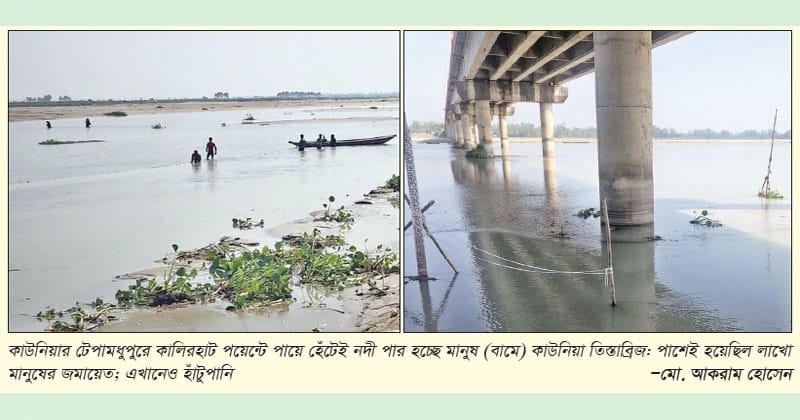
The treacherous Teesta River presents an alarming spectacle as waist-deep to knee-deep water flows through its bed as early as the month of Kartik, recalling Rabindranath Tagore’s iconic lines about seasonal meandering streams. Beneath the Teesta rail bridge in Rangpur’s Kaunia upazila, as well as at the Kalirhat spot in Tepa Madhupur union, the once-mighty waterbody has turned extraordinarily shallow. Although boats remain available, most residents, including small children, now cross the riverbed on foot. A recent three-day on-the-ground survey traversing 30 to 35 kilometers along the riverbanks revealed that residents fear the river might completely dry up by the upcoming months of Poush and Magh.
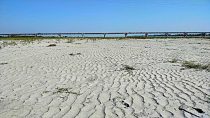
Looking northward from the riverbank in Char Gonai, the new Teesta Bridge and the old rail bridge stand against a backdrop that resembles a vast, dusty desert rather than a flowing river. Local people carry small bundles across the dry stretches, adjusting their lungis to avoid getting wet in the remaining shallow channels. Observing the surprising scene, local woman Shefali shouted, ‘Brother, walk a little towards the south; the water is lower there, and your clothes won’t get wet.’ Accompanied by her sisters Rupali and Dipali, she was traveling to her paternal home to secure her portion of ancestral land ahead of expected development.
The urgency among local families stems from rumors surrounding the upcoming Teesta Mega Project, which promises land acquisition, compensation, dredging, and city planning. Local college professor Amal Kumar Sarkar approached the reporting team to highlight the everyday struggles faced by the surrounding communities. Mr. Sarkar stated, ‘Brother, you’ve come in the month of Kartik, and already the Teesta River has knee-deep water that can be crossed on foot. Every day, hundreds of people from Burirhat, Hazrat Kha, and Gonaichar cross the Teesta on foot to go to markets and bazars. If you came in Falgun or Chaitra, you could ride your motorcycles right across the water of the Teesta.’
Professor Sarkar further expressed his deep frustration over the long-standing political negligence regarding the region’s primary waterbody and its ongoing severe degradation. He added, ‘Because we lack capable leaders in Rangpur, the suffering of the people along the Teesta River never ends. We hear that PM Tarique Rahman is coming to Lalmonirhat on November 19 to inaugurate the work on the Teesta Mega Project. Once the Teesta Mega Project is implemented, the suffering of the riverbank people will be no more. However, this project cannot be implemented without political decisions.’
Visiting various spots along the riverbanks confirmed that residents from all walks of life are eager for the Chinese-funded Teesta Mega Project to begin. Although some pockets of silt support temporary agricultural cultivation, the surrounding population strongly demands systematic dredging to alleviate their endless seasonal misery permanently. Speaking anonymously, a local BNP leader in Kaunia upazila stated, ‘The Teesta River is the sorrow of a crore of people. That sorrow will be dispelled once the river is dredged. We have heard that PM Tarique Rahman will come to Lalmonirhat on November 21. He will clarify the government’s stance on the Teesta.’
The political stakes surrounding the project remain exceptionally high across northern Bangladesh, where political promises heavily influenced past electoral outcomes. The local BNP leader warned, ‘If the PM inaugurates the mega project that day, the people of greater Rangpur will vote for the BNP in the future. And if he delivers a message about forming a joint commission coordinated by China, Bangladesh, and the Netherlands, it will mean the Teesta Mega Project will never happen. The BNP has walked into India’s trap.’ Other gathered bystanders voiced strong support for his critical political assessment.
In the villages of Harishwar and Arji Harishwar in Balapara union, residents recalled previous long marches and rallies demanding the project’s execution—local farmer Md. Dulal Hossain described how he traveled from Char Kashiabari to harvest paddy and actively participated in regional movements led by Asadul Habib Dulu. Mr. Hossain noted that out of 22 parliamentary seats in Greater Rangpur, the BNP secured three seats in Lalmonirhat primarily by promising to implement the Teesta Master Plan with Chinese funding within months of assuming power, drawing comparisons to China’s successful dredging of the Yellow River.
Standing near the Kaunia rail bridge, resident Ohidul Islam recalled the massive public political pledges delivered via teleconference from Dhaka that mobilized regional voter turnout. Islam explained that people voted for the Sheaf of Paddy symbol specifically to see the mega project executed after participating in human chains spanning 100 spots along a 110-kilometer stretch. He emphasized that Chinese technical experts had previously conducted feasibility studies and indicated readiness to start work immediately upon receiving the official governmental green signal. At the same time, former interim advisers had also promised rapid implementation.
The drying river has severely disrupted traditional livelihoods, forcing fishermen and farmers to abandon their historical professions and migrate to urban areas. Speaking on behalf of local farmers, Hemayetuddin, Pradip Roy, Shashanka Paul, Rafiqul Islam, Sohel Arman, and Jomir Uddin noted that many fishermen have moved to Dhaka to pull rickshaws or operate small tea stalls. They explained that dredging the river would permanently end forced outward migration by restoring fishing, establishing solar power, enabling modern irrigation, and building satellite cities and river ports.
Environmental activists and civil society leaders continue to urge the government to launch the infrastructure works immediately to prevent geopolitical complications. Halim Ansari, staff reporter for Inqilab in Rangpur, facilitated a meeting with Professor Nazrul Islam Hakkani, president of the ‘Teesta Bachao Nadi Bachao Sangram Parishad.’ Mr. Hakkani has long spearheaded civil movements demanding fair water sharing, erosion control, and project execution. He organized synchronized human chains across 60 locations involving hundreds of thousands of voluntary participants to champion the mega plan announced in 2020.
Professor Hakkani expressed lingering disappointment over the current administrative delays despite prior assurances from political leaders and former interim advisers. Mr. Hakkani remarked that he had been extremely hopeful that the new administration would swiftly launch the mega project with Chinese funding to relieve the intense suffering of two crore people along the Teesta basin. However, with no visible progress on the ground even after nine months in office, the environmentalist continues to urge the government to initiate actual construction without any further delay.
Shofiar Rahman, member secretary of the ‘Teesta Bachao Nadi Bachao Sangram Parishad,’ highlighted the catastrophic climate refugee crisis caused annually by relentless riverbank erosion. Mr. Rahman stated, ‘Highlighting the massive losses and climate refugee crisis inflicted upon the people of northern Bangladesh by Teesta River erosion every year, we are raising our voices to demand the implementation of the Chinese-funded Teesta Master Plan.’ He stressed that comprehensive river restoration is vital for the survival of communities across Lalmonirhat, Nilphamari, Rangpur, Kurigram, and Gaibandha.
The proposed Teesta Master Plan outlines dredging approximately 110 kilometers of the riverbed to increase depth by nearly 10 meters and fully restore navigability. The management plan includes building 224 kilometers of flood control embankments functioning as roadways, constructing or renovating 67 erosion control structures, reclaiming 170 square kilometers of char land, and expanding irrigation across 540,000 to 750,000 hectares. Leaders emphasize that while canal excavation projects continue, implementing the master plan is the only way to safeguard biodiversity and permanently protect northern Bangladesh.