Lack of coordination among service agencies causes public suffering
Eklas Haque
Several service agencies provide civic services in Dhaka, but a lack of coordination among them is increasing public suffering. Water supply, sewerage, waste management, road construction and repair, public transport, drainage and public health are handled by different agencies. However, inadequate coordination in planning, repair and construction work is causing inconvenience to citizens and wasting public money and resources, according to those concerned.
Asked about the issue, Dhaka South City Corporation (DSCC) Administrator and freedom fighter Md Abdus Salam said coordination among Dhaka’s various service agencies is essential. He said the city corporation has to coordinate with agencies including Rajuk, Dhaka WASA and electricity providers. Regular meetings led by the prime minister are being held to coordinate the activities of these agencies, which is helping the city corporation. Although agencies such as WASA cut roads, the responsibility and criticism ultimately fall on the city corporation. Therefore, efforts are being made to carry out such work in a coordinated manner.
Those concerned say one of the major complaints of citizens is the repeated excavation of roads for development projects. Waterlogging is another longstanding problem. Even short spells of rain leave many areas submerged, bringing urban life to a standstill. Waterlogging is caused not only by inadequate drainage but also by canal encroachment, clogged drains due to waste, unplanned urbanisation, inadequate drainage systems and a lack of coordination among various development projects. As a result, waterlogging cannot be fully addressed without coordination among sanitation, waste collection and drainage management.
Coordination is also essential to solve public transport problems. Buses, private cars, motorcycles, rickshaws and CNG-run vehicles operate on the roads, requiring coordination in traffic control, route management, parking, footpaths and road management.
Experts say the two city corporations, Dhaka WASA, the Roads and Highways Department, the Dhaka Transport Coordination Authority, electricity distribution companies, gas agencies and the Bangladesh Telecommunication Regulatory Commission, among others, are involved in infrastructure and civic services. If a road is excavated again to install water, gas, electricity or telecommunications lines soon after its construction or repair, it wastes money and reduces the road’s durability. It also creates traffic congestion, dust, waterlogging and public suffering.
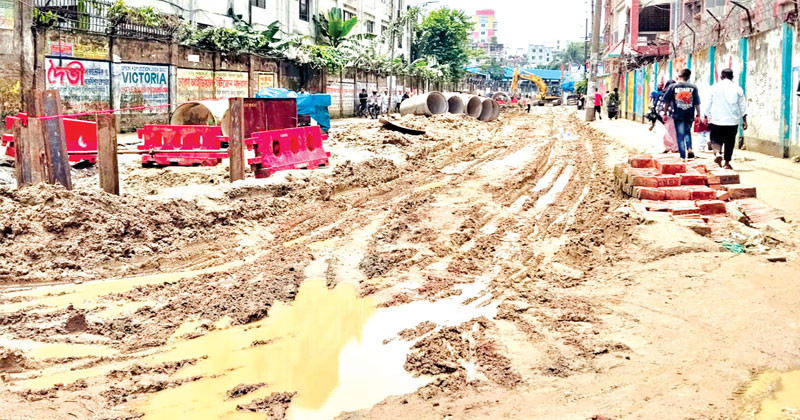
In several areas, roads have been excavated for underground pipelines or cables only a short time after repairs were completed. Elsewhere, drainage infrastructure has been cut again because of construction work by another agency. A lack of coordination between the projects of different agencies is forcing authorities to repeatedly excavate the same roads. Abul Hashem, a resident of Malibagh, said all necessary agencies should coordinate before undertaking any development work in Dhaka. He said roads repaired by city corporations are often excavated again by another service agency soon afterwards. This not only damages newly repaired roads but also causes suffering to local residents.
Institute for Planning and Development (IPD) Executive Director Prof Dr Adil Muhammad Khan told Inqilab that authorities must ensure proper planning, alternative routes and the capacity to complete work quickly when carrying out development projects during the monsoon. He said coordination must be ensured among agencies working on electricity, gas, water and telecommunications so that the same road does not have to be excavated repeatedly. Effective coordination among service agencies can reduce the need for repeated road excavation. Quality control in construction work must also be ensured. He said Dhaka’s waterlogging can be reduced through a combination of planning, regular maintenance and civic responsibility. Although the population and infrastructure have multiplied, drainage systems have not developed at the same pace. City corporations, water development authorities, local government agencies, the Department of Environment, urban planners and citizens must work together.
Water, sewerage, electricity, gas and telecommunications lines lie beneath the roads, while roads, footpaths, drainage systems and public transport infrastructure occupy the surface. If a single agency cannot permanently solve a problem on its own, citizens are likely to continue suffering.