
Monsoon watermelon brings new hope to Barisal
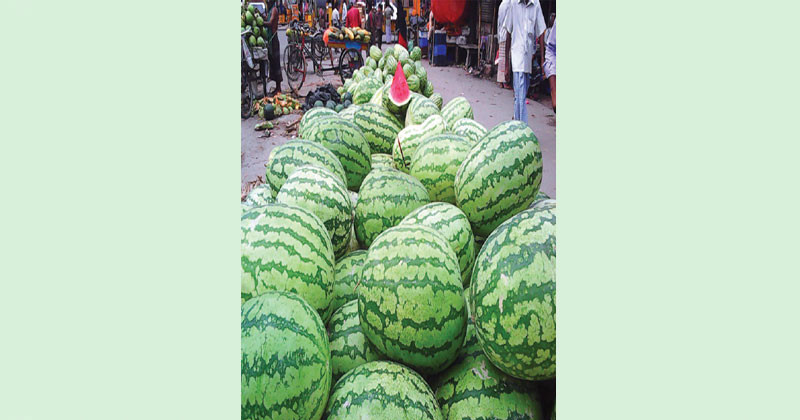
Monsoon watermelon farming is growing more popular in the Barisal farming region, bringing new hope to the local farm economy. As the monsoon season nears its end, farmers have grown watermelon on more than 100 acres across parts of Barisal. They used the monsoon method along with varieties like BARI Watermelon 1 and BARI Watermelon 2, developed by the Bangladesh Agricultural Research Institute, or BARI. Farmers also grew the Jasmine 1, Jasmine 2, and Jasmine 3 varieties.
About two months after farmers harvest winter watermelon in the Rabi season, they plant monsoon watermelon on higher land using a trellis method. Officials from the Department of Agricultural Extension, known as DAE, say demand for watermelon stays high in this hot period while supply remains low. This has pushed more farmers to expand monsoon and summer watermelon farming in hopes of better prices.
About 70 percent of the country’s watermelon comes from the Barisal farming region during the Rabi season. Last Rabi season, Bangladesh produced about 5 million tonnes of watermelon, and 3.5 million tonnes of that came from Barisal. Agricultural experts believe this new push into monsoon watermelon farming will open a new chapter for Barisal’s farmers and its farm economy.
Still, many farmers in the field do not yet have good knowledge of summer or monsoon watermelon farming methods. Most farmers do not know how to protect the plants from heavy rain or manage fertilizer and pest control during this season. Because of this gap in technical knowledge, many farmers feel unsure about taking the risk.
DAE officials say they plan to work more closely with farmers going forward to help expand monsoon and summer watermelon farming.
In Barisal markets this year, monsoon watermelon sells for 70 to 100 taka per kilogram. Even so, farmers say they cannot sell each watermelon for more than 100 taka at the field level. Farmers explain that transporting the harvest during the rainy season is hard and costly. Getting the watermelons to market traders adds extra expense, which makes monsoon watermelon farming a bigger risk. Even so, market prices during this season run one and a half to two times higher than in winter.
Watermelon, a sweet and juicy fruit from the gourd family, first came from Africa. It now grows across Bangladesh, Southeast Asia, and most parts of the world, and it has quickly become popular in this country. Bees mainly pollinate the plant to help it bear fruit. The watermelon plant is an annual, does not depend on day length, and grows as a vine. Farmers grow it in many kinds of soil, from sandy loam to clay loam.
It even grows well in the silty soil of low salinity river islands in the south, where many rivers meet. Soil with a pH between 5.5 and 7.0 suits this sweet and juicy crop best. However, the plant cannot handle high salinity under any condition. Watermelon resists drought and grows well in fairly dry conditions.
Because Barisal’s soil has lower salinity during the monsoon season, this helps watermelon farming. Even so, farmers must take extra care never to let water collect at the base of the plants.
Agriculture and nutrition experts say watermelon contains good amounts of vitamin A, riboflavin, thiamine, and pectin. Chinese herbal experts say watermelon juice helps keep blood pressure normal. The juicy flesh of a ripe watermelon has an unmatched taste and smell, and it satisfies hunger and thirst well.
In developed countries, people use watermelon to make various drinks, jams, syrups, and molasses, and even alcohol. Some places even make jelly from watermelon, which belongs to the citrus like gourd family. However, Bangladesh has no real effort yet to process watermelon into food products for sale.
Even though Barisal alone produces about 3.5 million tonnes of watermelon in the Rabi season, the country has yet to take any steps to process even 100,000 tonnes of that for export.