Nationwide Drives Continue to Protect Mother Hilsa During 22-Day Ban
The government is continuing regular nationwide operations to protect mother hilsa during their breeding season and increase hilsa production. The 22-day ban on hilsa fishing began on October 8 and will remain in force until October 28. During this period, catching, selling, storing, transporting, marketing and exchanging hilsa are strictly prohibited across the country.
To support fishermen who have lost their income during the ban, the government is providing rice and other food assistance. However, some fishermen continue to catch mother hilsa in violation of the restrictions. District and upazila administrations, fisheries departments, the Coast Guard and river police are conducting hundreds of joint operations and mobile court drives to enforce the ban. Authorities are maintaining regular surveillance to ensure compliance throughout the restricted period.
In a major joint operation in the Meghna River sanctuary in Chandpur, 32 fishermen were detained, of whom 30 were sentenced to 18 days in prison. In another operation, eight more fishermen received jail terms of varying lengths. In the Raipur section of the Meghna River in Lakshmipur, 15 people were detained, including 14 fishermen who were sentenced to 16 days in prison each. In Barishal, mobile courts sentenced eight fishermen to different jail terms during 23 separate operations in a single day. In Jhalakathi, more than 100 operations have been conducted, resulting in several cases and prison sentences.
Authorities are also imposing fines. During a late-night operation in Chattogram, fines totalling around Tk 150,000 were imposed and a large quantity of fish was seized. In the Majuchowdhuryhat area of Lakshmipur, three fishermen were fined a total of Tk 21,000 for violating fisheries conservation laws. Wholesalers and sellers at several fish landing centres in Barishal and Chandpur have also been fined thousands of taka.
Many boats and several hundred thousand metres of fishing nets have been seized for violating the ban. Despite these enforcement efforts, illegal fishing and the sale of hilsa continue in some areas, often beyond the reach of law enforcement agencies. Fisheries officials say staff shortages make it difficult to monitor every location. However, they are continuing operations with support from police, other law enforcement agencies and local administrations. The following reports from correspondents across the country describe the situation during the hilsa conservation campaign.
Barishal: Hundreds of operations conducted, fishermen still at risk
Nasim Ul Alam, from Barishal, reports:
Fishermen in Barishal and other coastal areas are showing a strong tendency to continue fishing despite the 22-day ban intended to protect mother hilsa during breeding. To support fishermen’s families during the period of lost income, the government has distributed 25 kilograms of rice each to 646,290 fishing families across 168 upazilas in the southern coastal region, totalling 16,157.25 tonnes. In the Barishal region alone, 8,962.9 tonnes of rice have been distributed among 358,516 fishing families.
The fishing ban covers 7,134 square kilometres of coastal waters from midnight on October 8 until midnight on October 28. Fishing is also prohibited nationwide, along with the transportation and marketing of hilsa. District police, river police, the Coast Guard and the Navy are working with fisheries officials to enforce the restrictions. During the first week of the ban, nearly 400 mobile courts were conducted. Around 300 fishermen and fish workers were sentenced to different jail terms for violating the law.
Authorities also collected around Tk 500,000 in fines, seized illegal fishing nets worth approximately Tk 200 million and filed nearly 450 cases. Fisheries teams seized around 50 tonnes of hilsa from rivers, wholesale markets and other locations and distributed the fish to orphanages and lillah boarding institutions, according to the Department of Fisheries.
Despite these efforts, illegal fishing and marketing continue in some areas. Fisheries officials say surveillance and operations will continue with support from law enforcement agencies and local administrations. After the current ban ends at midnight on October 28, a separate nationwide ban on catching jatka, or juvenile hilsa, will remain in effect from November 1 to June 30.
Chattogram: Fishing boats remain idle as families struggle
Rafiqul Islam Selim, from Chattogram, reports:
Fishing at sea has been suspended for 22 days during the breeding season of the country’s national fish, hilsa. Hundreds of fishing trawlers are anchored at landing centres across Chattogram city and district, bringing fishing activities to a standstill and affecting the fisheries-dependent economy.
Trawlers are lined up at Katttali Fishermen’s Village, Fisheries Ghat, Rani Rashmoni Ghat, Akmal Ali Ghat, Patenga, Firingi Bazar Dhumpara, Anandabazar, Baroghona and Bolirhat, as well as coastal areas in Anwara, Banshkhali, Sandwip, Mirsharai, Sitakunda and Karnaphuli. Some fishermen are repairing their nets, while others are spending time together or preparing their boats for the resumption of fishing.
The government is providing food assistance to fishing families under the Vulnerable Group Feeding (VGF) programme. However, some families say they have not received the support. They allege that only registered fishermen are eligible and that some registered families have also been left out. There are also allegations of favouritism involving local leaders of the ruling party.
District Fisheries Officer Salma Begum said 25 kilograms of rice had been allocated to each registered fishing family as humanitarian assistance and that there had been no irregularities. She added that fishermen’s registration records are updated throughout the year and that those who are not registered can apply at the fisheries office.
Khulna: Concerns over access to government assistance
Abu Hena Mukti, from Khulna, reports:
The administration and fisheries department are continuing operations in coastal rivers and surrounding areas to protect mother hilsa and increase production. However, concerns remain over whether fishermen who have lost their livelihoods during the ban are receiving government assistance on time. Residents of fishing communities are questioning whether eligible families have been included on beneficiary lists and whether allocated support is reaching everyone fairly.
Many coastal families depend directly on rivers and aquatic resources for their livelihoods. The suspension of fishing has sharply affected their income, particularly for households that rely on daily fish sales to meet their basic needs.
Munshiganj: Illegal fishing continues in the Padma and Meghna
Md Manzur Morshed, from Munshiganj, reports:
The Padma and Meghna rivers in Munshiganj are important breeding grounds for hilsa and habitats for juvenile fish. Although the government has taken several measures to protect mother hilsa, enforcement on the ground appears inadequate, according to local reports.
Fishermen are allegedly catching mother hilsa by evading authorities, while regular operations have led to the seizure of nets and the detention and punishment of 24 fishermen. However, illegal fishing continues in both rivers.
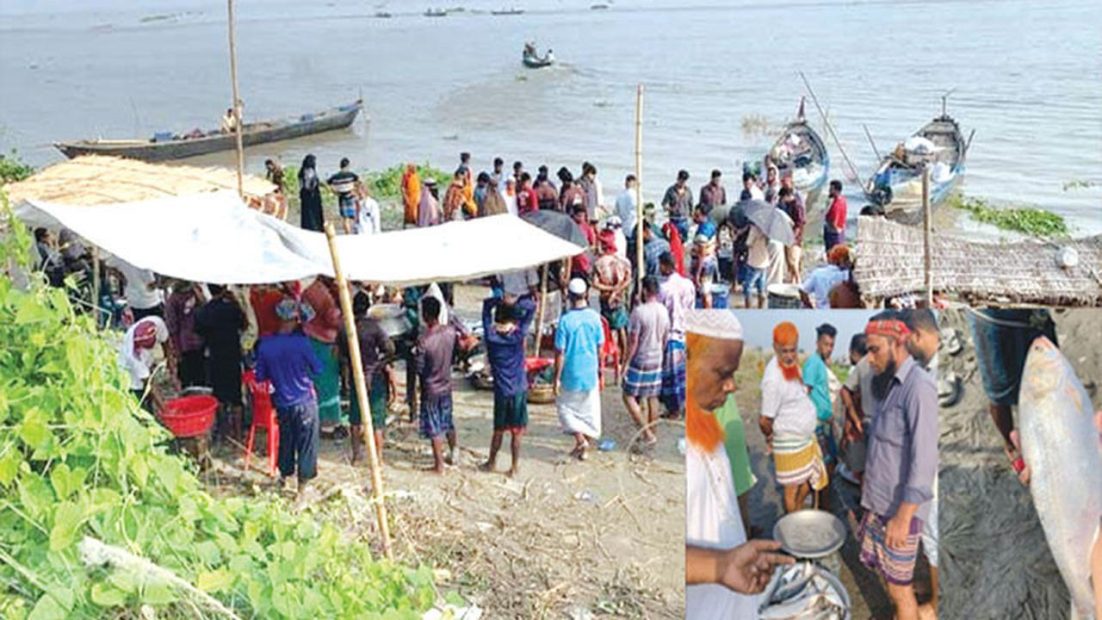
A syndicate reportedly charges Tk 3,000 per boat to allow fishermen to fish in the Padma. Fishermen from Gaudia, Singherhati, Dohori and Marai in Louhajang, as well as nearby Jazira in Shariatpur, wait for opportunities to enter the river near Sidarchar, Babuchar and Kalikarchar. High fish prices have encouraged more people to fish despite the ban. Hilsa is also being sold at temporary village markets and by vendors moving from door to door.
Sirajganj: Illegal nets worth Tk 10 million seized
Syed Shamim Shirazi, from Sirajganj, reports:
The fisheries department seized 105,000 metres of illegal current nets and 19 Chinese duari nets during an operation in the Jamuna River in Belkuchi, Sirajganj, to protect mother hilsa during the breeding season. The seized nets have an estimated market value of around Tk 10 million. The operation was conducted from the afternoon until night on October 16 in different areas along the Jamuna River in the upazila.
Lakshmipur: Fishermen continue catching hilsa in the Meghna
SM Babul (Babar), from Lakshmipur, reports:
Fishing is prohibited along a 100-kilometre stretch of the Meghna River, from Alexander in Ramgati, Lakshmipur, to Shatnol in Chandpur. The stretch has been declared a hilsa sanctuary, where catching, transporting, storing and marketing hilsa are prohibited during the ban.
The district administration and fisheries department are conducting awareness campaigns through public announcements, posters and other activities in riverside and coastal areas. Despite these efforts, fishermen continue to catch hilsa in the Meghna in violation of the restrictions. There are also allegations that local political leaders are providing protection to some of those involved in illegal fishing, making enforcement difficult.
Faridpur: Fishermen complain of missing government assistance
Anwar Zahid, from Faridpur, reports:
Fishermen in Faridpur, Sadarpur, Charbhadrasan, Bhanga and Madhukhali have raised concerns over government assistance and allowances during the mother hilsa conservation period. Several fishermen in Sadarpur have reportedly submitted written complaints to the upazila executive officer after failing to receive the government benefits they were entitled to.
Bhola: 35 fishermen sentenced, 170,000 metres of nets seized
Md Zahirul Haque, from Bhola, reports:
Authorities have imposed strict restrictions on fishing, transporting, storing and selling fish in designated river and sea areas in Bhola. However, illegal fishing of mother hilsa continues, leaving many fishermen worried about their livelihoods during the ban.
The enforcement of the restrictions has also raised questions about the effectiveness of the administration’s efforts. By October 16, mobile courts had detained more than 50 fishermen for catching hilsa illegally in the Meghna-Tetulia river sanctuary. Authorities filed 51 cases, imposed fines totalling Tk 45,000 and sentenced 35 people to prison. Some underage detainees were released after providing written undertakings.
Seized hilsa was distributed to orphanages. Authorities also confiscated 170,000 metres of fishing nets and detained several boats. The boats were later sold at auction, with the proceeds deposited in the government treasury. Bhola District Fisheries Officer Muhammad Delwar Hossain provided these details. He said the detainees had been arrested during separate operations in different upazilas.
Barguna: 128 operations conducted in nine days
Jahangir Kabir Mridha, from Barguna, reports:
Authorities have intensified enforcement drives, mobile courts and market inspections in Barguna to prevent violations of the fishing ban. Between October 8 and 16, officials conducted 128 operations and 31 mobile court drives. They seized 1.135 tonnes of hilsa and 2.15 kilometres of illegal fishing nets. Seven fishermen were detained, and one case was filed.
Alongside enforcement, concerns are growing over assistance for fishermen who have lost their income during the ban. Around 12,500 registered fishermen have been left off the list for government food assistance, while many unregistered fishermen also face uncertainty over their livelihoods.
Pirojpur: Joint patrols continue across rivers
Tanzid Hasan, from Pirojpur, reports:
The district administration and the Department of Fisheries are conducting operations and mobile court drives across local rivers to enforce the fishing ban. Patrols and surveillance have also been strengthened with support from law enforcement agencies.
The 2026 mother hilsa conservation campaign was formally launched from Hularhat Launch Terminal on the afternoon of October 8. Officials and law enforcement personnel later conducted joint patrols on the Kaliganga and Kocha rivers, with members of the Navy and police taking part. The district fisheries department is overseeing the campaign.
District Fisheries Officer Sanjib Sannamat said regular operations and mobile courts would continue across the district’s rivers throughout the 22-day ban. He said the main objectives were to ensure safe breeding for mother hilsa and increase overall production.