New Monitoring Policy, Revised Curriculum Planned for Primary Education
The government is taking steps to introduce a new monitoring policy and revise the primary education curriculum to improve the quality of education. Under the new monitoring system, authorities will closely monitor students’ attendance, actual learning outcomes, teaching quality and overall school activities.
State Minister for Primary and Mass Education Bobby Hajjaj said this on Wednesday (November 4) while visiting several government primary schools in Madhabpur upazila of Habiganj.
He said the curriculum was being revised to ensure scientific and enjoyable learning suited to students’ ages and abilities.
Praising the roles of school founders, local representatives, School Management Committee (SMC) members, headteachers and teachers, Mr. Hajjaj said teachers’ care for children, active participation by management committees and collective efforts at the local level could improve the learning environment in schools.
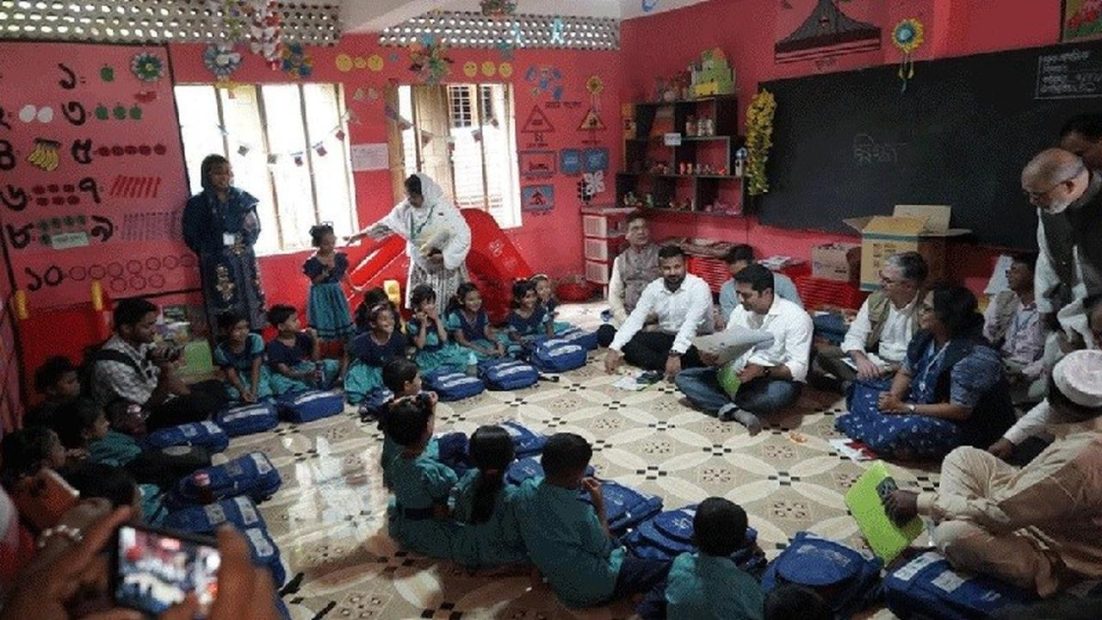
During the visit, he distributed midday meals among Class Two students and observed food storage and distribution. He also exchanged views with members of mothers’ associations and visited classroom libraries, where he spoke with book captains. He also visited school gardens and met members of the Little Agriculturist Club.
He highlighted the importance of these activities in developing children’s reading habits, nutrition, environmental awareness and practical learning.
Regarding the school feeding programme, Mr. Hajjaj said the government had already launched it in 100 upazilas. The programme is planned to be gradually expanded to all government primary schools across the country by next year.
He said the World Food Programme (WFP) was running its own school feeding programme in more than 100 schools in Madhabpur. One of the main purposes of his visit was to assess the programme and compare its activities with the government’s initiative.
The minister said the visit had provided an opportunity to identify effective initiatives, assess how they benefit students and find areas for improvement. The government would consider incorporating suitable practices from the WFP’s experience into its own programme in the context of Bangladesh.
Later, Mr. Hajjaj visited Jagadishpur Tea Garden Government Primary School. He observed students’ health check-ups and enquired about activities to ensure their healthcare, nutrition and overall well-being.
The WFP is implementing the school feeding programme in Madhabpur’s schools under the McGovern-Dole Food for Education Programme, funded by the United States Department of Agriculture (USDA). The Food and Agriculture Organization of the United Nations (FAO), Room to Read and CNRS are working as partners in the programme.
On curriculum development, Mr. Hajjaj said work was underway to prepare a revised curriculum in line with students’ ages, abilities and learning needs. The National Curriculum and Textbook Board (NCTB) had been assigned the task.
He said the revised curriculum would focus on reducing differences in learning hours among schools and making lessons and learning materials more scientific, easy to understand and age-appropriate. It would also place greater emphasis on students’ understanding and skills. Moral education, sports and cultural activities would receive greater importance as well.
The state minister said improving primary education was not just about building schools or ensuring students’ attendance. The most important issue was whether children were actually learning. Achieving this required coordinated efforts in school management, teaching quality, nutrition, healthcare, extracurricular activities and accountability.
WFP Bangladesh Head of Programme Jesse Wood and School Feeding Programme Policy Officer Emma Lefu were present during the visit. The local MP, officials from the Directorate of Primary Education, district and upazila administrations, local education officials, teachers, parents and other concerned people were also present.