Over Tk 18.21 Crore, Gold Spoons and Bowls Found in Pagla Mosque Donation Boxes
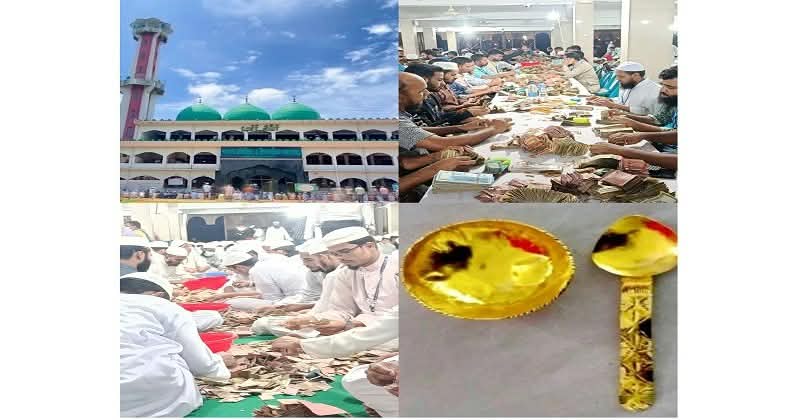
After four months and 24 days, opening the 13 donation boxes of Kishoreganj’s historic Pagla Mosque on the banks of the Narsunda River yielded Tk 18,21,69,517, along with cash filling 51 sacks, gold spoons and bowls, gold, silver, and diamond jewelry, and a substantial amount of foreign currency. Devotees from across the country contribute out of heartfelt pleas for a loved one’s recovery, prayers for deliverance from life’s crises, or gratitude to Almighty Allah, turning the mosque into a convergence of deep human faith, spiritual peace, and humanitarian generosity. Thousands of letters expressing wishes for fulfillment were also recovered, along with larger quantities of jewelry and a wider variety of foreign currencies, including dinars, euros, and dollars, than on previous occasions.
On Saturday, November 21, at 7:00 am, the donation boxes were opened in the presence of Kishoreganj-1 (Sadar-Hosenpur) Member of Parliament Mohammad Mazharul Islam and Deputy Commissioner and President of the Pagla Mosque Management Committee Sohana Nasrin. A total of 13 donation boxes, 10 permanent and three temporary, were opened one by one as a large operation began on the mosque premises from Saturday morning. The collected funds were packed into white sacks and carried to the second floor of the mosque complex, where the 51 sacks of cash were poured onto the floor one after another before counting began, each mound carrying stories of prayers, expectations, and devotion offered to the Creator.
A total team of 680 people took part in the massive counting operation, including 594 people, 390 students from Pagla Mosque Madrasa and Al-Jamiatul Imdadia, 35 staff members of Pagla Mosque, 19 staff members from the Deputy Commissioner’s office, and 150 officers and employees of Rupali Bank, working on folding and counting notes with assistance from RAB, police, and Ansar. Strict security was maintained at every stage, from opening the boxes to counting and safeguarding funds, under the overall supervision of 13 executive magistrates from the district administration, alongside 40 police personnel, eight RAB personnel, and 20 Ansar members, completing the exercise with religious faith, administrative transparency, discipline, and security.
Although Pagla Mosque’s donation boxes are usually opened every three months, they were opened this time after four months and 24 days, following an earlier opening on June 27 this year after 182 days that yielded Tk 15,90,80,146 plus significant foreign currency and jewelry. After counting, cash is deposited into Pagla Mosque’s account at Rupali Bank, while gold, silver, and foreign currency are sealed and stored in the district treasury. Built on religious sentiment and genuine love, these donated funds now play an important role in education, healthcare, support for orphans and disadvantaged people, and the mosque’s development.
Deputy Commissioner and Pagla Mosque Management Committee President Sohana Nasrin said all the cash found in the donation boxes would be deposited in the bank after counting. Weighing the jewelry kept in the treasury for nearly six years on October 12 yielded 1,044 bhori, 14 ana, and 4 ratti of gold and 1,088 bhori of silver, while currencies from 17 countries were also found and exchanged for Tk 65,62,724. Valuation and auction processes for the jewelry are underway, with serious consideration given to preserving devout people’s donated funds and using them for public welfare.
Sohana Nasrin also said a website has been launched for Pagla Mosque, allowing people at home and abroad to donate online and via mobile banking, with a Bangla version already active and Tk 44,09,936 received in online donations so far. Following the reconciliation of funds received on November 21, 2026, the bank account holds a total of Tk 1,33,21,80,564. Beyond donations and religious activities, initiatives are underway to develop Pagla Mosque into a modern, aesthetically pleasing, and public-friendly religious complex, including purchasing 53.77 decimals of vacant land between the current mosque complex and the graveyard in the mosque’s name, preparing an aesthetic design, and building public toilets outside.
Funds from Pagla Mosque also support education and humanitarian assistance, with Deputy Commissioner Sohana Nasrin stating that this fund covers all expenses for 130 orphaned and underprivileged students at the madrasa attached to the mosque complex. The fund also covers salaries for the mosque’s 35 employees and 10 Ansar members, electricity bills, and various development expenses. In contrast, grants from interest or returns on deposited funds support medical treatment for poor patients in Kishoreganj district. The Additional District Magistrate and Convener, Md. Ershadul Ahmed, Additional Deputy Commissioners Md. Istiaque Imon, Wadia Shabab, and Md. Zubayer Hossain, Sadar UNO Md. Kamrul Hasan Maruf, Rupali Bank AGM Mohammad Ali Haresi, assigned executive magistrates, and mosque committee members.
Standing on the banks of the Narsunda River, Pagla Mosque is today a familiar address of faith and affection for people from different parts of the country who visit daily to pray, make supplications, and donate according to their means. Alongside box donations, devotees also donate livestock, ducks and chickens, pigeons, milk, and seasonal vegetables, which are sold every afternoon through open auction with proceeds deposited into the mosque’s bank account. Meanwhile, three prayer sheds, an ablution area, and separate washrooms for women are being built at a cost of Tk 1,10,88,464 to address growing worshipper turnout and prayer space shortages.
Historic Pagla Mosque in Kishoreganj stands as a unique expression of deep trust, genuine love, religious emotion, and unwavering faith in Almighty Allah as donations, development work, and humanitarian activities continue to expand. When donated funds light the lamp of education for an orphan child, open a path to treatment for a helpless patient, or stand beside poor people, religious charity becomes a powerful vehicle for human welfare. Beyond financial accounting, the mosque’s greatest achievement remains the faith and love nurtured deep within people’s hearts and their hope for acceptance before Allah, making it a bright beacon of religious heritage, communal harmony, humanity, and public welfare.